Birth lore · Your birthday
Amber
Amber is fossilised tree resin, traded from the Baltic since the Bronze Age, named elektron by the Greeks and treasured from Rome to China as a stone of sunlight and memory.
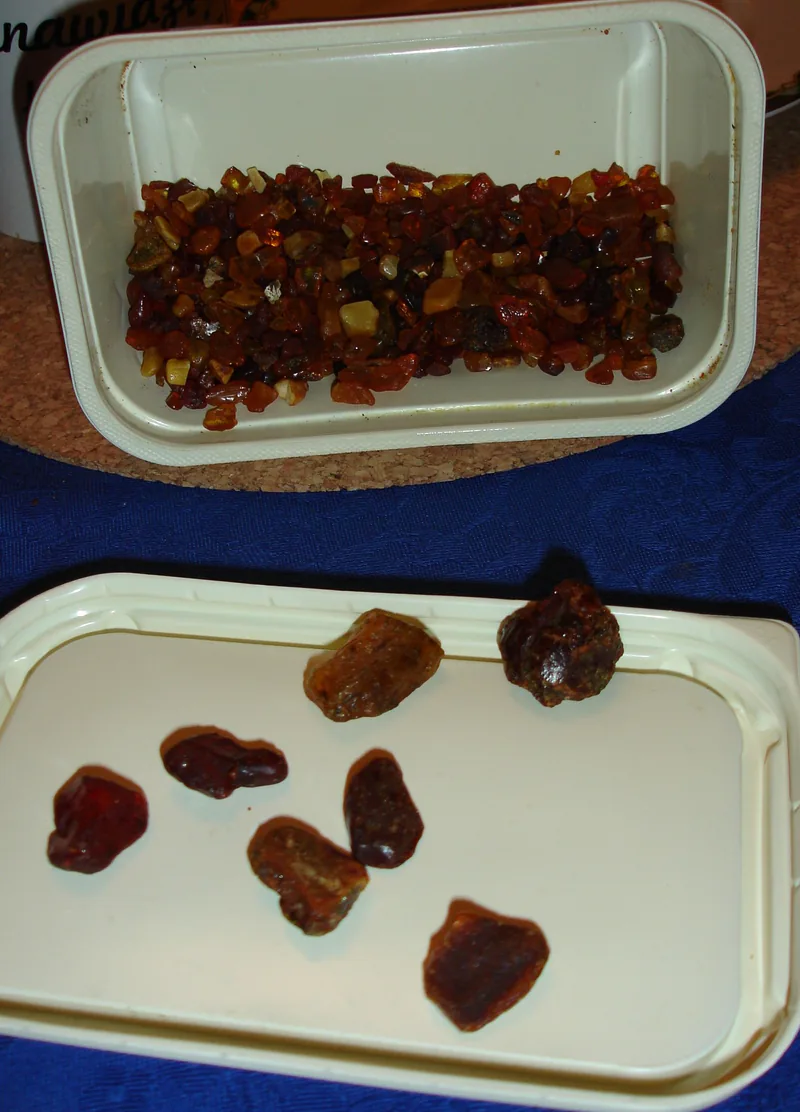
History and lore
Amber is the hardened resin of ancient trees, preserved for millions of years in sediments. Most of the amber in European history came from the shores of the Baltic, where it washes up after storms and is dug from deposits some forty million years old, especially on the Sambia peninsula near Kaliningrad. Baltic amber travelled south along trade routes already in the Bronze Age; amber beads appear in Mycenaean graves, and the overland routes to the Adriatic are now often called the Amber Road.
The Greeks called amber elektron, and its power to attract light objects when rubbed, a property later Greek writers traced back to Thales, eventually supplied modern science with a word: in 1600 William Gilbert coined the Latin electricus, "amber-like", for substances that attract in this way, and "electricity" followed. Ovid's Metamorphoses tells how the sisters of Phaethon, mourning their brother, became poplars whose tears hardened into amber. Pliny the Elder, who rightly judged amber to be pine resin, devoted a long passage to it, mocking the Greek fables and complaining that a small amber figurine cost more than a healthy slave. He also records that under Nero a Roman knight travelled to the Baltic coast and brought back amber in such quantity that it decorated the nets of the amphitheatre.
In the traditions
Amber appears in nearly every culture that could obtain it. In China it is hupo, a name popularly read as "tiger's soul", from the belief that the spirit of a dead tiger passed into the earth and became amber; it was carved into snuff bottles, court necklaces and Buddhist figures. In Turkey and the Arab world amber prayer beads (tesbih, misbaha) are prized for their warmth and soft click. Lithuanian tradition tells of the sea goddess Jūratė, whose amber palace was shattered by the thunder god, a legend known chiefly from nineteenth-century literary retellings. Medieval Europe ground amber into medicines and burned it as incense, and amber rosaries were so popular that the Teutonic Order, which controlled the Baltic coast, guarded the amber trade jealously. The most famous amber object of modern times, the Amber Room given by Prussia to Peter the Great in 1716, vanished after German troops removed it in the Second World War; a reconstruction was completed in 2003.
Modern correspondence tables assign amber to the Sun for its golden glow and warmth, and modern crystal books pair it with Leo.
Meaning and symbolism
Amber gathers ideas of sunlight, warmth, memory and time held still, especially when it encloses an insect or a leaf. In folk belief it protects children and travellers and draws away illness, and amber beads have long served as amulets. One modern custom deserves a clear caution: amber teething necklaces for babies. Health authorities, including the US Food and Drug Administration in 2018, have warned that they carry risks of choking and strangulation and have no proven benefit. More broadly, scientific studies have not found that amber or other stones heal.
The mineral
Amber is soft (2 to 2.5 on the Mohs scale), light and warm to the touch. Baltic amber contains succinic acid; other important deposits include the Dominican Republic, Mexico and Myanmar. Colours run from pale lemon through honey and cognac to cherry red, and rare pieces show a blue or green glow.
Imitations include copal (younger, less hardened resin), plastics, glass and "pressed amber" made from fused fragments. Amber floats in a strong salt solution while glass and many plastics sink; copal turns tacky under a drop of acetone; and a hot needle on amber gives a resinous, pine-like smell rather than a chemical one. Insects in cheap "amber" are often set in modern resin. Keep amber away from heat, perfume, alcohol and solvents, and clean it with a soft damp cloth.
Sources and further reading
- Natural History, Book 37 — Pliny the Elder, c. 77 CE
- Metamorphoses — Ovid, c. 8 CE
- De Magnete — William Gilbert, 1600
- Amber: The Golden Gem of the Ages — Patty C. Rice, 1980
- Amber: Window to the Past — David A. Grimaldi, 1996