Birth lore · Your birthday
Gemstones · Birthstone of January
Garnet
The deep red birthstone of January, the 'carbuncle' of ancient and medieval writers and the glowing stone of Anglo-Saxon goldwork; garnet is in fact a whole family of minerals in almost every colour.
History and lore
The name garnet is usually traced to the medieval Latin granatum, the pomegranate, whose seeds the small red crystals resemble. For most of history, however, the stone travelled under another name. Greek writers spoke of anthrax and Roman ones of carbunculus, "little glowing coal", a label that Pliny the Elder applied to a whole range of fiery red stones held up to the light. Many of these were garnets; some were rubies or spinels. The carbuncle's reputation for shining in the dark, repeated by medieval writers, belongs to legend rather than to any real stone.
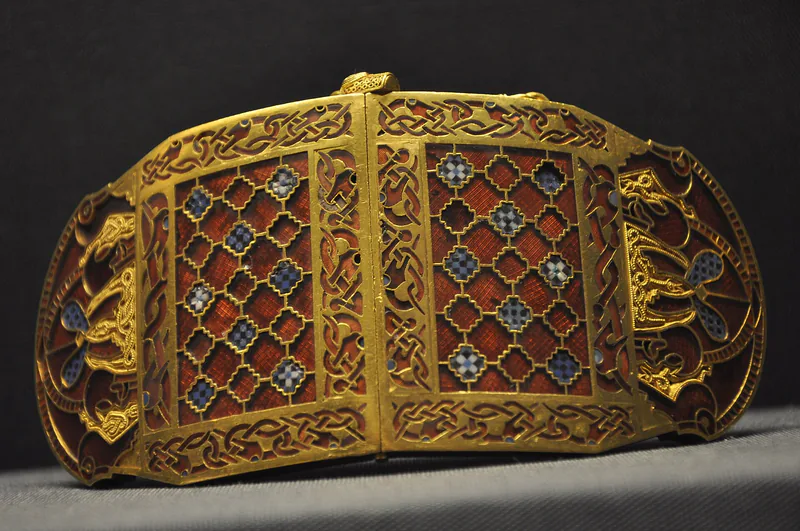
Garnet was the great jewel of early medieval Europe. Merovingian, Visigothic and Anglo-Saxon goldsmiths cut thin slabs of red garnet and set them in gold cells over patterned foil, the technique known as cloisonné. The shoulder clasps and purse lid from the Sutton Hoo ship burial (early seventh century) and the thousands of garnet fragments in the Staffordshire Hoard show the style at its height. Scientific analysis suggests that much of this garnet came from India and Sri Lanka, with European sources taking over later, though the details are still debated. In the nineteenth century the dark pyrope garnets of Bohemia supported a large jewellery industry, and close-set "Bohemian garnet" brooches became a fixture of Victorian dress.
In the traditions
In the King James Version, the third stone of the first row of the High Priest's breastplate (Exodus 28:17) is a "carbuncle", and the first stone of the second row is an "emerald". The Hebrew words, bareqet and nophek, cannot be identified with confidence, and the Greek Septuagint seems to reverse them, so whether any breastplate stone was a garnet is unknown. A later Jewish tradition that Noah lit the ark with a shining stone is sometimes connected with the carbuncle, though the Hebrew word in Genesis (tsohar) more probably means a window or opening.
Medieval lapidaries treated the carbuncle as the prince of red stones, a guard against nightmares and poison and a light for travellers. In Indian gem lore the orange-brown grossular garnet called hessonite is gomed, the Navaratna stone of the shadow planet Rahu (see hessonite). Modern correspondence tables usually give garnet to Mars because of its colour.
Meaning and symbolism
Garnet became the first stone of the American birthstone list of 1912 and has kept January in every list since, the older traditional lists included (see January). Its modern symbolism of constancy, friendship and safe return on journeys draws on the medieval travellers' lore. Garnet is also the stone usually given for a second wedding anniversary in modern lists. As with other gem meanings, these are associations made by tradition and the jewellery trade; studies have not found that stones affect health or fortune.
The mineral
Garnets are silicates that share one crystal structure but vary in chemistry. Almandine and pyrope give the classic dark reds; rhodolite is a raspberry pyrope-almandine; spessartine is orange; grossular includes the green tsavorite of Kenya and Tanzania and the cinnamon hessonite; andradite includes demantoid, the vivid green garnet of the Russian Urals prized by Fabergé. Garnets form mainly in metamorphic rocks such as mica schist and gneiss, and so many are mined that crushed garnet is used as an industrial abrasive.
Garnet is singly refractive, which helps separate it from ruby and red spinel under the polariscope. Older imitations include red glass and "garnet-topped doublets", in which a thin garnet slice is fused to coloured glass. At 6.5 to 7.5 on the Mohs scale, garnet is durable enough for rings; clean it with warm soapy water and keep demantoid away from heat.
Sources and further reading
- Natural History, Book 37 — Pliny the Elder, c. 77 CE
- The Curious Lore of Precious Stones — George Frederick Kunz, 1913
- Magical Jewels of the Middle Ages and the Renaissance — Joan Evans, 1922
- Gems: Their Sources, Descriptions and Identification — Robert Webster, 1962 (6th ed., ed. Michael O'Donoghue, 2006)
- The Staffordshire Hoard: An Anglo-Saxon Treasure — Chris Fern, Tania Dickinson and Leslie Webster (eds.), 2019