Birth lore · Your birthday
Gemstones · Birthstone of June
Moonstone
The feldspar with a floating blue-white sheen, linked with the moon in Indian and European lore, beloved of Art Nouveau jewellers and added to the June birthstones in 1912.
History and lore
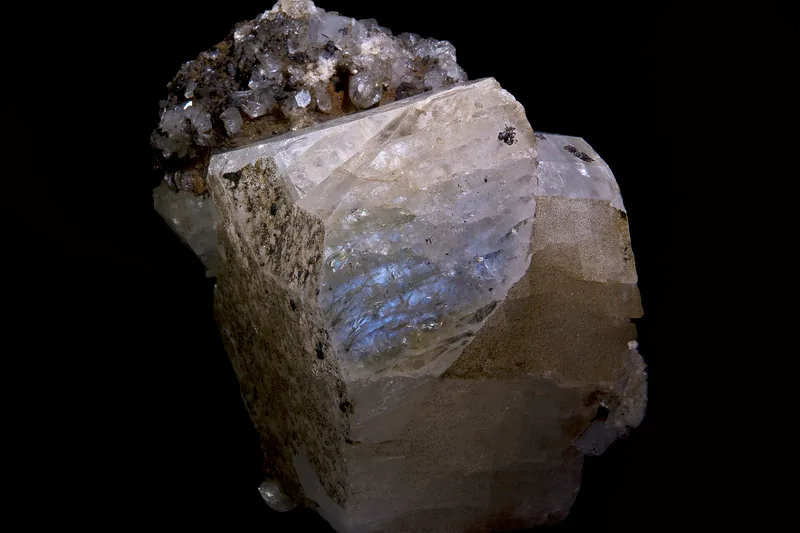
Moonstone is named for its light: a soft, bluish-white glow that seems to float beneath the surface and glides across the stone as it moves, an effect gemmologists call adularescence. Roman jewellers used moonstone, and Pliny the Elder describes a stone he calls selenitis that holds the image of the moon and waxes and wanes with it; whether he meant moonstone, a variety of gypsum or something else is uncertain, and the modern mineral called selenite is gypsum.
The best moonstones have long come from Sri Lanka, and Indian and Sri Lankan jewellers set them for centuries. Moonstone became fashionable in Europe at the end of the nineteenth century, when Art Nouveau jewellers such as René Lalique and the Tiffany studios valued its quiet glow over the brilliance of diamond. Wilkie Collins's novel The Moonstone (1868), often called the first full-length English detective novel, is built around a sacred stone stolen from an Indian temple, but his fictional gem is a large yellow diamond, not a feldspar. In 1970 Florida adopted moonstone as its state gem in honour of the Moon landings, even though the stone is not found there.
In the traditions
Sanskrit poetry speaks of the chandrakanta, the "moon-beloved" stone, which was said to sweat cool drops when touched by moonlight; later writers often identify it with moonstone, though the poetic stone is half legendary. Moonstone is not one of the nine Navaratna gems, but some present-day Vedic astrologers recommend it as a substitute for pearl, the stone of the Moon.
Moonstone has no place among the breastplate or Revelation stones, and it does not appear by this name in the classic medieval lapidaries. Its modern esoteric meanings, gathered from Indian lore, Victorian sentiment and the stone's appearance, link it with the Moon, intuition, dreams and the cycles of women's lives; in Western correspondence tables it belongs to the Moon and to Cancer, the sign the Moon rules.
Meaning and symbolism
The American jewellers' list of 1912 placed moonstone beside pearl as a June birthstone, and it has remained an alternative June stone since (see June). It has no traditional month in the older lists. Its common meanings today are calm, intuition, new beginnings and love, and in parts of India it has been considered a lucky gift between lovers. These are symbolic associations; studies have not found that gemstones influence emotions, fertility or health.
The mineral
Moonstone is feldspar in which two kinds, potassium-rich orthoclase and sodium-rich albite, separate into extremely thin alternating layers as the rock cools. Light scattering between these layers produces the sheen; the thinner the layers, the bluer the glow. The name adularia comes from the Adula massif in the Swiss Alps. Sri Lanka, India, Myanmar, Madagascar and Tanzania are the main sources. "Rainbow moonstone" from India and Madagascar is usually a white labradorite, a related feldspar.
Moonstones are cut as smooth cabochons to show the effect, and some show a cat's-eye or a star. Imitations include milky glass, sometimes sold as "opalite", and synthetic spinel; neither shows true adularescence. Moonstone is fairly soft (6 to 6.5) and has easy cleavage, so it can crack if knocked. Clean it with mild soap and water and avoid ultrasonic cleaners and heat.
Sources and further reading
- Natural History, Book 37 — Pliny the Elder, c. 77 CE
- The Curious Lore of Precious Stones — George Frederick Kunz, 1913
- The Moonstone — Wilkie Collins, 1868
- Gems: Their Sources, Descriptions and Identification — Robert Webster, 1962 (6th ed., ed. Michael O'Donoghue, 2006)
- Gemstones of the World — Walter Schumann, 1977 (later editions)