Birth lore · Your birthday
Fluorite
Fluorite is the many-coloured mineral that gave its name to fluorescence, possibly the murrhine of imperial Rome and the Blue John of Derbyshire; its esoteric meanings are modern.
History and lore
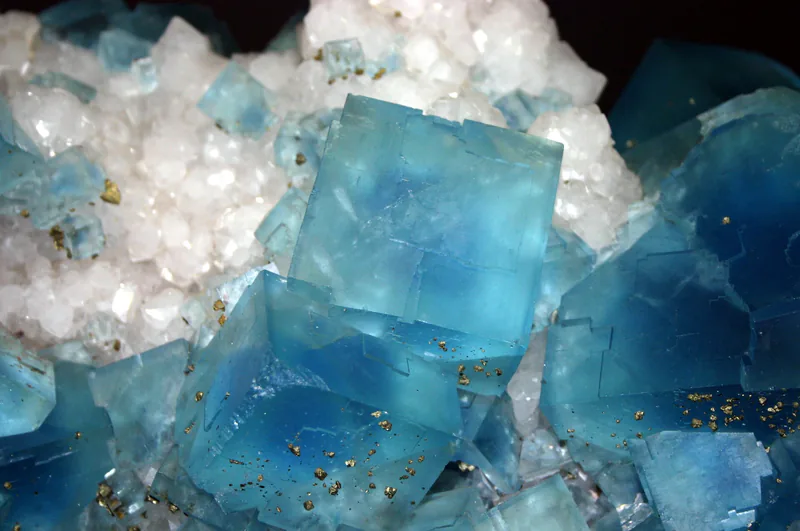
Fluorite is one of the most colourful minerals on earth, found in purple, green, blue, yellow, pink and colourless crystals, often with several colours banded in one stone. It grows as handsome cubes and octahedra and has been prized by collectors for centuries, but because it is soft and splits easily it has been used more for carving and decoration than for jewellery.
Its name records an industrial use. Miners and smelters added it as a flux to help ores melt, and the sixteenth-century German mineralogist Georgius Agricola wrote of these fluores, from the Latin fluere, "to flow". In 1852 the physicist George Gabriel Stokes coined the word "fluorescence" from fluorspar, some specimens of which glow blue under ultraviolet light, and the element fluorine was later named from the same root.
Many scholars believe that the costly murrhine vessels of imperial Rome were made of fluorite, though agate has also been proposed. Pliny the Elder writes that such vessels were first brought to Rome after Pompey's eastern victories, and he tells of fabulous prices: Nero is said to have paid a million sesterces for a single bowl, and the former consul Titus Petronius, facing death, broke a murrhine dipper so that Nero could not have it.
In England, the banded purple and yellow fluorite called Blue John, found only near Castleton in Derbyshire, was turned into vases, urns and candelabra in the eighteenth and nineteenth centuries, some mounted in gilt bronze by the workshop of Matthew Boulton.
In the traditions
Fluorite has no secure identification among the twelve breastplate stones of Exodus 28 or the foundations of Revelation 21, and it is absent from the Navaratna and from Agrippa's planetary tables. Chinese craftsmen have carved it for centuries, sometimes as a less costly stand-in for jade (see jade). Its esoteric reputation is almost entirely modern: it entered the literature of crystal healing in the late twentieth century (see crystals, auras and energy).
Meaning and symbolism
Modern crystal writers call fluorite a stone of mental order and clarity, sometimes "the genius stone", and recommend it for study, concentration and decision-making, meanings plainly suggested by its orderly crystals and clean geometric cleavage. Purple fluorite is linked with intuition and the third-eye chakra, green with the heart. These meanings are symbolic and recent; scientific studies have not found that fluorite improves concentration or health. Because it is a fluoride, fluorite should not be steeped in drinking water.
The mineral
Fluorite forms mainly in hydrothermal veins, often with lead and zinc ores, and in some sedimentary rocks. Celebrated localities include Weardale and Cornwall in England, Illinois, Mexico, Spain, Morocco and China, the leading producer today. It defines 4 on the Mohs scale and has perfect cleavage in four directions, so a sharp knock can split a cube into an octahedron; faceted fluorite is a collector's stone rather than an everyday gem.
Its colours come from trace elements and from defects created by natural radiation, and some specimens fade in strong sunlight or lose colour when heated. Imitations include glass and dyed quartz, but fluorite's softness, cleavage and frequent colour zoning help identify it. Clean it gently with lukewarm water, and avoid ultrasonic cleaners and sudden changes of temperature.
Sources and further reading
- Natural History, Book 37 — Pliny the Elder, c. 77 CE
- De natura fossilium — Georgius Agricola, 1546
- Gemstones of the World — Walter Schumann, 1977
- Gems: Their Sources, Descriptions and Identification — Robert Webster, 1962