Birth lore · Your birthday
Jade
Jade, the name shared by nephrite and jadeite, has been the supreme sacred stone of China for five thousand years and was prized above gold in ancient Mesoamerica.
History and lore
"Jade" is a trade name for two different minerals that look and behave alike: nephrite, a tough mat of interlocking amphibole fibres, and jadeite, a pyroxene. The French mineralogist Alexis Damour showed in 1863 that they were distinct. The word comes from the Spanish piedra de la ijada, "stone of the flank", because Spaniards in the Americas believed green stones eased pains in the side and kidneys; its Latin form, lapis nephriticus, gave us "nephrite". Early modern Europe knew jade mainly as a medicine-stone of this kind.
Two great civilisations made jade central to their sacred art, independently of each other. In China worked jade appears in the Neolithic: the Liangzhu culture of the lower Yangzi (roughly 3300–2300 BCE) buried its elite with bi discs and squared cong tubes in quantities that imply organised workshops and ritual purpose, though what the shapes signified is still debated. In Mesoamerica, the Olmec and later the Maya prized jadeite from the Motagua valley of Guatemala above gold; the funerary mask of the Maya king Pakal of Palenque (died 683) is a mosaic of jade. The Aztecs called precious greenstone chalchihuitl and used it as an image of everything precious, including water, maize and the breath of life (see Mesoamerican religion).
In the traditions
Chinese thought gives jade an ethical as well as a sacred meaning. The dictionary Shuowen Jiezi of Xu Shen (about 100 CE) defines jade (yu) as the beautiful among stones and credits it with five virtues, matching its warm lustre, translucency, clear ringing tone, toughness and clean edges to the qualities of a good person. The Book of Rites (Liji) puts into Confucius's mouth a longer comparison between jade and the virtue of the gentleman, and jade pendants that chimed as the wearer walked were meant to keep his bearing measured (see Confucianism).
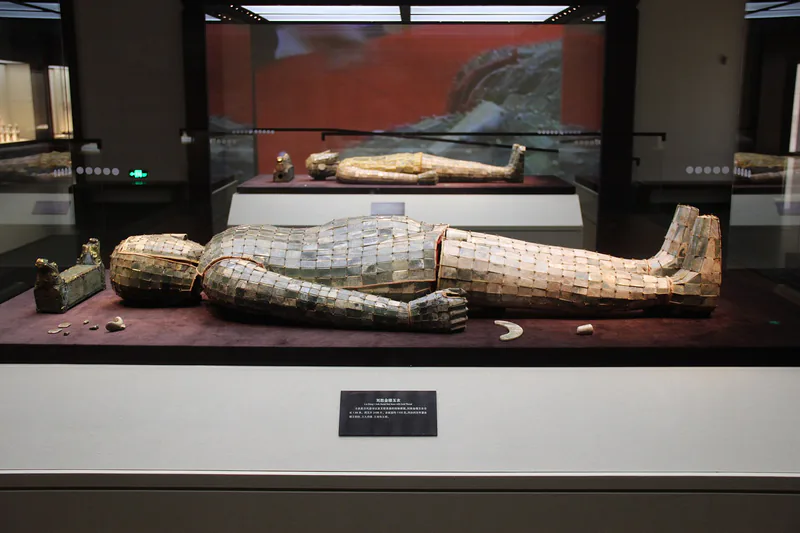
Jade was also bound up with death and immortality. Jade cicadas and plugs were placed on the dead, and Han princes were buried in suits of jade plaques sewn with gold wire, as in the tombs of Liu Sheng and his wife Dou Wan, excavated at Mancheng in 1968; the hope that jade would preserve the body connects it with ideas of the immortals (see what is Taoism). The Jade Emperor, ruler of heaven in popular religion, carries the same sense of jade as the highest purity.
In Aotearoa New Zealand, nephrite is pounamu, a taonga (treasure) of the Māori, worked into adzes, weapons and hei-tiki pendants that pass down through families and carry ancestral presence.
Meaning and symbolism
Across these cultures jade stands for virtue, permanence, life and rank. Modern Western crystal books add harmony, good luck and prosperity, often borrowing loosely from Chinese custom. Scientific research has not shown that jade or any other stone heals or brings fortune; its power lies in what generations have read into it.
The mineral
Nephrite (6 to 6.5 on the Mohs scale) is famously tough because its fibres interlock; classic sources include Hetian (Khotan) in Xinjiang, Siberia, British Columbia and New Zealand. Jadeite (6.5 to 7) is rarer, with the finest translucent "imperial" green coming from northern Myanmar, which supplied China in quantity from the eighteenth century. Both occur in white, green, lavender, yellow and black.
Imitations are many: serpentine, aventurine quartz, dyed quartzite, glass and plastics. Real jadeite may also be bleached and filled with polymer ("B jade") or dyed ("C jade"); for anything valuable, a laboratory report is the only safe guide. Clean jade with mild soapy water and avoid ultrasonic cleaners for treated stones.
Sources and further reading
- Jade: A Study in Chinese Archaeology and Religion — Berthold Laufer, 1912
- Chinese Jade from the Neolithic to the Qing — Jessica Rawson, 1995
- The Curious Lore of Precious Stones — George Frederick Kunz, 1913
- Gems: Their Sources, Descriptions and Identification — Robert Webster, 1962