Liber XXXI · Taoism & Chinese Religion · Chapter III: Confucianism
Confucianism: Confucius, the Analects and the Confucian Way
Confucianism explained: the life of Confucius, the Analects, ren and li, Mencius and Xunzi, the Five Classics, Neo-Confucianism, and whether it is a religion.

Confucianism is the tradition of thought, ethics and ritual that traces itself to Confucius (Kongzi, traditionally 551–479 BCE), who taught that a good society rests on cultivated persons practising humaneness (ren), ritual propriety (li), righteousness and filial piety. Developed by Mencius and Xunzi, made the official learning of the Han state, and renewed as Neo-Confucianism by Zhu Xi and Wang Yangming, it shaped the government, family life and religion of China, Korea, Japan and Vietnam for two thousand years.
Confucius: The Life of Kong Qiu§
"Confucius" is a Latinised form, coined by Jesuit missionaries, of Kong Fuzi, "Master Kong". His name was Kong Qiu, and he came from the small state of Lu in present-day Shandong, where he was born, by traditional reckoning, in 551 BCE. Sima Qian's biography, written some four centuries later, describes a youth of modest means who rose to minor office, left Lu after disagreements with its rulers, and spent years travelling among the courts of neighbouring states seeking a ruler who would put his teaching into practice. None did. He returned to Lu, taught a circle of disciples, and died in 479 BCE.
Confucius did not regard himself as an innovator. He presented himself as a transmitter of the ways of the early Zhou dynasty, especially the Duke of Zhou, whose rites and music he believed had created a harmonious order. His school was known as the ru, "classicists" or "scholars", and in Chinese Confucianism is usually called rujia or rujiao, the school or teaching of the scholars, rather than being named after Confucius himself.
The Analects and the Core Confucian Virtues§
The Analects is a collection of short sayings and conversations of Confucius and his disciples, compiled over several generations after his death; scholars think different books of it date from different periods. It presents the ideal of the junzi, originally "son of a lord" but redefined by Confucius as a person noble in character rather than birth.
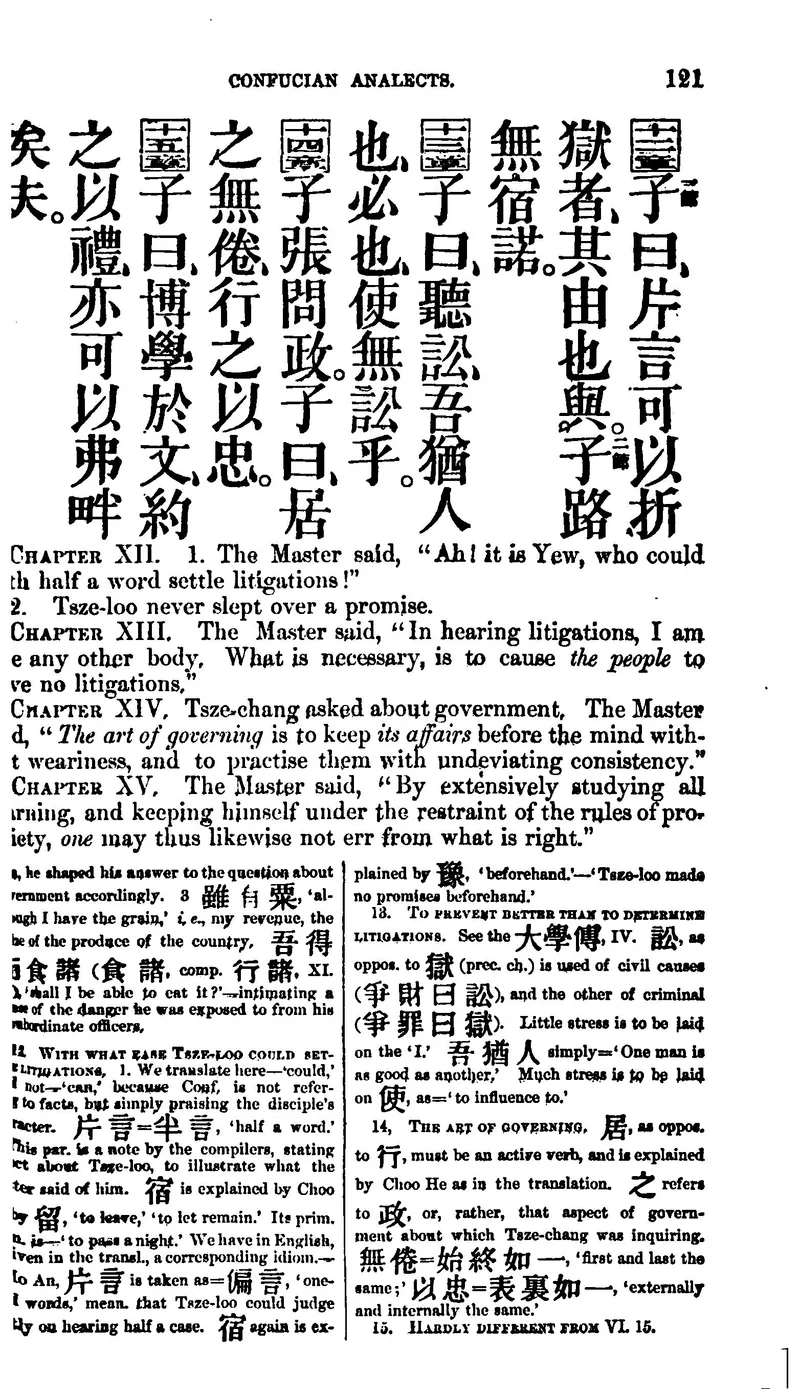
The central virtues are closely linked:
- Ren (仁), humaneness or benevolence, the fully realised quality of a good person, grounded in care for others. In James Legge's translation of Analects 15.23, Confucius sums up a lifelong rule: "What you do not want done to yourself, do not do to others."
- Li (禮), ritual propriety, the whole range of ceremonial, social and courteous forms through which respect is expressed, from sacrifices to the ancestors to the proper way of greeting. The philosopher Herbert Fingarette famously argued that Confucius saw the "secular as sacred" in these shared human forms.
- Yi (義), righteousness, doing what is right rather than what is profitable.
- Xiao (孝), filial piety, reverence and care for parents in life and correct rites after their death, the root of all other virtues.
- Zhengming, the "rectification of names", the idea that social order requires that rulers, ministers, fathers and sons act in accordance with their roles.
Confucius believed that rulers should govern by virtue and example rather than by punishments, so that the people would be transformed "like grass bending before the wind".
Mencius, Xunzi and the Debate on Human Nature§
Two later thinkers developed Confucius' teaching in opposite directions. Mencius (Mengzi, c. 372–289 BCE) argued that human nature is good: everyone has "four sprouts" of compassion, shame, deference and the sense of right and wrong, which can grow into the four virtues if nurtured. He also taught that Heaven's mandate (tianming) to rule could be lost by a tyrant, an idea that justified resistance to unjust rulers.
Xunzi (c. 310–235 BCE) held the opposite view: human nature, left to itself, tends toward selfish desire, and goodness is the product of deliberate effort, education and ritual. He interpreted Heaven as the regular order of nature rather than a conscious power, and explained ritual as a human creation that channels emotion. In the long run Mencius' view prevailed, becoming orthodox in Neo-Confucianism.
The Five Classics, the Four Books and the Examination System§
Confucian learning was organised around a canon. The Five Classics are the Book of Odes (Shijing), the Book of Documents (Shujing), the Book of Rites (Liji), the Book of Changes (the I Ching, whose "Ten Wings" commentaries were traditionally ascribed to Confucius), and the Spring and Autumn Annals (Chunqiu) of the state of Lu. A sixth, the Classic of Music, was lost. Michael Nylan has shown that these texts were not all Confucian in origin; they became "Confucian" through the Han dynasty's selection.
In 136 BCE Emperor Wu of Han established official posts for scholars of the Five Classics, and the scholar Dong Zhongshu (c. 179–104 BCE) merged Confucian ethics with the cosmology of yin, yang and the five phases, presenting the emperor as the link between Heaven, Earth and humanity. Later, Zhu Xi grouped the Analects, the Mencius, and two chapters of the Book of Rites, the Great Learning and the Doctrine of the Mean, as the Four Books. From 1313 his commentaries were the standard for the civil service examinations, which remained the main route into officialdom until they were abolished in 1905.
Neo-Confucianism: Zhu Xi, Wang Yangming and the Supreme Ultimate§
Between the Tang and Song dynasties, Confucian scholars responded to the intellectual prestige of Buddhism and Taoism by building a comprehensive metaphysics of their own. Zhou Dunyi (1017–1073) wrote a short Explanation of the Diagram of the Supreme Ultimate (Taijitu shuo), drawing on a diagram of Taoist origin, which described how the Supreme Ultimate generates yin and yang, the five phases and all things. The brothers Cheng Hao and Cheng Yi, and Zhang Zai, developed the theory of li (principle, a different word from ritual li) and qi (material force).
Zhu Xi (1130–1200) synthesised these ideas into the school of principle, teaching that every thing embodies principle and that the "investigation of things" and reverent attention lead to the recovery of one's originally good nature. Wang Yangming (1472–1529) challenged him, arguing that principle is found in the mind itself, that everyone possesses "innate knowing" (liangzhi), and that true knowledge and action are one. Neo-Confucianism included forms of meditation, "quiet sitting", that historians compare to Chan Buddhist practice.
Is Confucianism a Religion? Heaven, Ritual and the Cult of Confucius§
Scholars disagree about whether Confucianism should be called a religion. It has no church, priesthood or doctrine of salvation, and Confucius himself was reticent about spirits, advising people to respect them while keeping them at a distance. Yet Confucianism was embedded in religious practice. The emperor offered sacrifices to Heaven at the winter solstice, most famously at the Temple of Heaven in Beijing; officials performed sacrifices in Confucian temples across the empire, which still hold ceremonies, for example on Confucius' birthday in Taiwan; and family rites for the ancestors, codified in Zhu Xi's Family Rituals, were the centre of household religion (see ancestor veneration).
The question had practical consequences. In the "Chinese Rites Controversy" of the seventeenth and eighteenth centuries, Jesuit missionaries argued that rites for Confucius and the ancestors were civil customs that Chinese Christians could perform; papal decrees of 1704, 1715 and 1742 ruled against them, a position reversed in 1939. In the early twentieth century Kang Youwei campaigned to make Confucianism a national religion, while the May Fourth Movement of 1919 attacked it as the root of China's backwardness.
Confucianism in East Asia and the Modern World§
Confucian ideas shaped the Joseon dynasty of Korea (1392–1910), whose rulers adopted Neo-Confucianism as state orthodoxy, Tokugawa Japan, and imperial Vietnam. Under Mao, Confucius was denounced, notably in the campaign of 1973–1974 that linked him with the disgraced marshal Lin Biao. Since the 1980s Confucianism has enjoyed a revival in mainland China, both as a philosophy, represented by the "New Confucian" thinkers of Hong Kong, Taiwan and the diaspora, and as a symbol of national culture. In everyday life, its influence is felt in the value placed on education, family obligation and respect for elders, often alongside Taoist and Buddhist practice.
Frequently asked questions§
What are the main teachings of Confucianism?§
Confucianism teaches that people become good through learning and self-cultivation, practising humaneness (ren), ritual propriety (li), righteousness and filial piety. A harmonious society depends on rulers governing by virtue and on each person fulfilling their roles within family and state.
Is Confucianism a religion or a philosophy?§
It has features of both. It lacks a priesthood and has little to say about the afterlife, but it involves reverence for Heaven, sacrifices to Confucius and the ancestors, and temples. Many scholars describe it as a religious humanism or a tradition that does not fit Western categories neatly.
How is Confucianism different from Taoism?§
Confucianism stresses social roles, ritual, education and government by moral example, while Taoism emphasises spontaneity, simplicity and harmony with the Tao, often withdrawing from public life. In practice most Chinese drew on both, together with Buddhism, as the "three teachings".
What are the Four Books?§
They are the Analects, the Mencius, the Great Learning and the Doctrine of the Mean, grouped by Zhu Xi in the twelfth century. With his commentaries, they formed the core of the Chinese civil service examinations from 1313 to 1905.
Sources and further reading§
- The Analects of Confucius — Arthur Waley, 1938
- Mencius — D. C. Lau, 1970
- Confucius: The Secular as Sacred — Herbert Fingarette, 1972
- An Introduction to Confucianism — Xinzhong Yao, 2000
- The Five "Confucian" Classics — Michael Nylan, 2001
- Neo-Confucianism in History — Peter K. Bol, 2008
- Confucianism: A Very Short Introduction — Daniel K. Gardner, 2014
- A Source Book in Chinese Philosophy — Wing-tsit Chan, 1963