Liber XXXI · Taoism & Chinese Religion
What Is Taoism? The Way, Its Texts, Schools and Practice
What is Taoism? An overview of the Tao, Laozi and Zhuangzi, the Celestial Masters, the Taoist canon, Quanzhen and Zhengyi, ritual and self-cultivation.

Taoism (or Daoism) is a Chinese religious and philosophical tradition centred on the Tao, "the Way": the nameless source and pattern of all things, which the sage follows by simplicity, non-striving and harmony with nature. It includes both the ancient classics attributed to Laozi and Zhuangzi and an organised religion, founded in the second century CE, with its own priests, scriptures, gods, temples and methods of self-cultivation aimed at long life and union with the Tao.
Taoism or Daoism? The Name and the Idea of the Tao§
"Taoism" and "Daoism" are two spellings of the same word. The older Wade–Giles system of romanising Chinese wrote tao; the pinyin system, official in the People's Republic since 1958 and now standard in scholarship, writes dao. Both are pronounced roughly "dow". This library uses "Taoism" in titles, as it remains the more familiar English form, and the two words interchangeably in the text.
The Chinese character 道 means a road or path, and by extension a method, a teaching, or the way something is done. Confucians spoke of the Way of the former kings, meaning a moral and ritual order. What is distinctive about the Taoist classics is that they push the word further, to mean the source from which heaven and earth arise and to which all things return. The opening of the Tao Te Ching famously warns that the Tao that can be spoken of is not the constant Tao. It is described as empty yet inexhaustible, soft yet overcoming the hard, "doing nothing" (wuwei) and yet leaving nothing undone.
Several related ideas recur across Taoist history: ziran, "being so of itself" or spontaneity; wuwei, effortless or non-coercive action; the return to simplicity, likened to an uncarved block (pu); and the complementary forces of yin and yang. Taoism shares this cosmology with Chinese medicine, divination and astronomy rather than owning it exclusively.
Philosophical and Religious Taoism: A Contested Distinction§
Western writers long divided the tradition into two: a pure "philosophical Taoism" (daojia, "Taoist school") of Laozi and Zhuangzi, and a later "religious Taoism" (daojiao, "Taoist teaching") of priests, talismans and immortality techniques, often presented as a superstitious decline. The label daojia itself goes back to the Han historian Sima Tan (d. 110 BCE), who grouped thinkers into six schools.
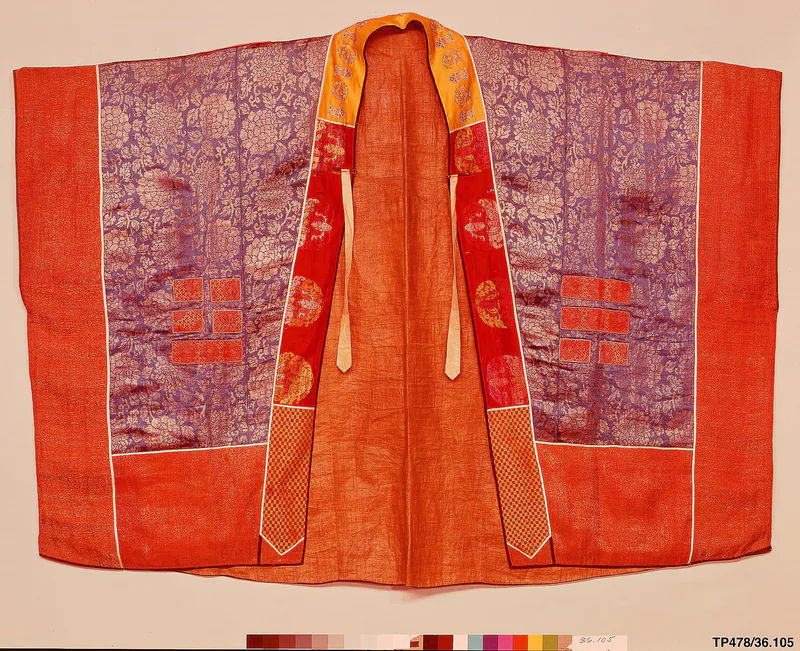
Most scholars now regard the sharp division as misleading. Kristofer Schipper, Isabelle Robinet and Livia Kohn, among others, have shown that the classics were read, recited and commented on within the religion; that Laozi was worshipped as a deity from at least the second century CE; and that the "philosophical" texts themselves speak of breath, longevity and spirit. The distinction is still useful for describing different emphases, but historians treat Taoism as one complex tradition with many strands, rather than a philosophy that was corrupted into a religion.
Origins: Laozi, Zhuangzi and the Han Dynasty§
According to the traditional account recorded by Sima Qian around 100 BCE, Laozi was an archivist at the Zhou court and an older contemporary of Confucius, who wrote the Tao Te Ching at a frontier pass before departing westward. Sima Qian himself was uncertain about Laozi's identity, and modern scholarship treats the book as a compilation that reached something like its present form by the third century BCE; bamboo slips excavated at Guodian contain material from it dating to around 300 BCE. See Laozi and the Tao Te Ching for the details.
The Zhuangzi, named after Zhuang Zhou (traditionally fourth century BCE), adds parables, humour and a radical questioning of fixed viewpoints; its "Inner Chapters" are generally considered the oldest layer (see the Zhuangzi). During the Han dynasty (206 BCE–220 CE), "Huang–Lao" thought, which paired the legendary Yellow Emperor with Laozi, influenced statecraft, while fangshi ("masters of methods") offered emperors techniques of divination, medicine and the search for immortals. Emperor Huan ordered sacrifices to Laozi in 165–166 CE, a sign that he was by then a divine figure.
The Celestial Masters and the Taoist Church§
Organised Taoism traces itself to Zhang Daoling, who in 142 CE is said to have received a revelation in Sichuan from Laozi in deified form, the Most High Lord Lao (Taishang Laojun). The movement he founded, called the Way of the Celestial Masters (Tianshi dao) or, by outsiders, the Way of the Five Pecks of Rice after its membership levy, organised communities into parishes led by libationers, healed illness through confession of sins and written petitions to heavenly officials, and rejected blood sacrifice to popular gods. Under Zhang Lu it governed a semi-independent state in the Hanzhong region until submitting to the warlord Cao Cao in 215. Its later history and ritual are described in Religious Taoism.
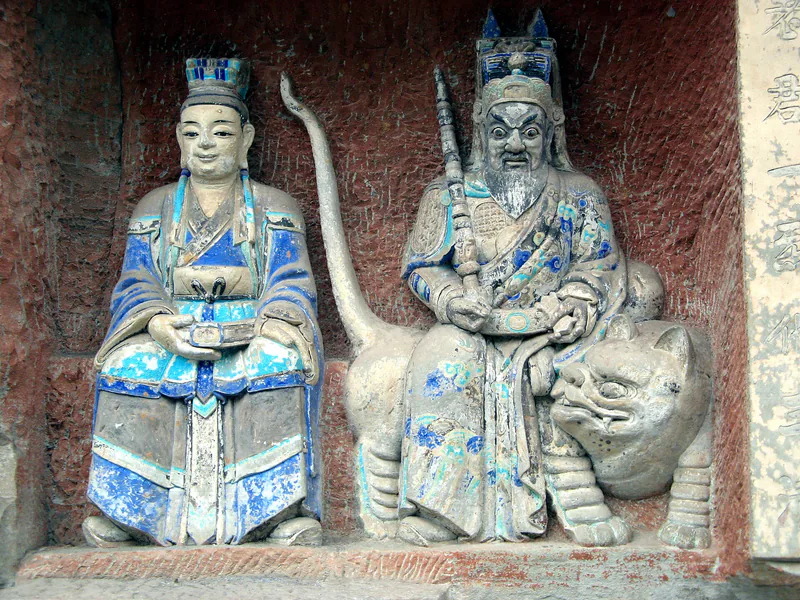
Over the following centuries new revelations produced new scriptural traditions. The Shangqing ("Highest Clarity") texts, revealed to Yang Xi between about 364 and 370 at Maoshan near modern Nanjing, emphasised visualisation and ascent to the heavens. The Lingbao ("Numinous Treasure") scriptures, circulated from the 390s, developed a grand liturgy of universal salvation influenced by Buddhism. The scholar-priest Lu Xiujing (406–477) organised the growing body of texts into the "Three Caverns", the framework of all later Taoist canons.
Scriptures, Schools and the Taoist Canon§
The great collection of Taoist scripture is the Daozang, or Taoist Canon. Imperially sponsored canons were compiled several times; the edition that survives was printed in 1445 under the Ming emperor Zhengtong, with a supplement in 1607, and contains some 1,400–1,500 works on philosophy, ritual, alchemy, medicine, hagiography and divination.
Two main living branches emerged in the medieval period:
- Zhengyi ("Orthodox Unity"), heir to the Celestial Masters, whose priests usually marry, live at home and serve local communities through rituals of offering, exorcism and funerals. The hereditary Celestial Masters were based for centuries at Longhushan (Dragon and Tiger Mountain) in Jiangxi.
- Quanzhen ("Complete Perfection"), founded by Wang Chongyang (1113–1170), a monastic order of celibate monks and nuns whose practice combines meditation, inner alchemy and ethical precepts drawn from all "three teachings" of Taoism, Buddhism and Confucianism.
Alongside these, countless local lineages, ritual masters and spirit-medium cults draw on Taoist ritual without belonging formally to either order, and Taoist gods are worshipped throughout Chinese popular religion.
Taoist Practice: Ritual, Self-Cultivation and Ethics§
Taoist practice has three broad dimensions.
Ritual and liturgy§
The central communal rite is the jiao, a "rite of cosmic renewal" that may last from one to several days, in which priests purify a sacred area, present written memorials to the highest deities, and make offerings on behalf of a whole community. Funerals and rites for the dead (zhai) are another major part of priestly work. Taoist priests also write talismans (fu) and perform exorcisms.
Self-cultivation§
The pursuit of long life and transcendence takes in diet, breathing and gymnastic exercises (daoyin), meditation and visualisation, and above all the inner alchemy that developed from the earlier external alchemy of elixirs. Modern qigong draws much from this heritage. The ideal of the xian, the transcendent or "immortal", is discussed in Taoist immortality.
Ethics§
Taoist precepts forbid killing, theft, lying, sexual misconduct and intoxication, much as Buddhist precepts do. Popular morality books such as the Treatise of the Most High on Action and Response (Taishang ganying pian, c. twelfth century) taught that good and bad deeds are recorded by spirits and rewarded or punished with longer or shorter life.
Taoism in Modern China and the World§
Taoism suffered heavily in the twentieth century. Reformers attacked temple religion as superstition, and during the Cultural Revolution (1966–1976) temples were closed, scriptures burned and clergy laicised. The Chinese Taoist Association, founded in 1957 and based at the White Cloud Monastery in Beijing, revived after 1979, and thousands of temples have since reopened. In Taiwan and Hong Kong, and among Chinese communities in Southeast Asia, Zhengyi ritual traditions continued without interruption, and the line of hereditary Celestial Masters moved to Taiwan in 1949.
In the West, Taoism has been known mainly through the Tao Te Ching, which is among the most frequently translated books in the world, and through popular adaptations ranging from Jungian psychology to self-help. Scholars and practitioners have increasingly drawn attention to the living religion behind the classic, with its priests, rituals and temples, as well as to its links with the I Ching and Chinese astrology.
Frequently asked questions§
What do Taoists believe?§
Taoists understand the Tao as the source and pattern of all things, and seek to live in harmony with it through simplicity, spontaneity and non-coercive action. Religious Taoists also worship a hierarchy of deities, honour Laozi as a manifestation of the Tao, and practise ritual and self-cultivation aimed at health, long life and spiritual transcendence.
Is Taoism a religion or a philosophy?§
It is both. The classics of Laozi and Zhuangzi can be read as philosophy, but since at least the second century CE Taoism has also been an organised religion with clergy, scriptures, temples and liturgy. Most scholars now treat the two as aspects of one tradition.
Who founded Taoism?§
Laozi is traditionally regarded as its founder, though his historical existence is uncertain and the Tao Te Ching is probably a compilation. Organised religious Taoism dates from Zhang Daoling, who founded the Celestial Masters movement around 142 CE.
Do Taoists believe in God?§
Taoism has no single creator God in the Abrahamic sense. The Tao is impersonal, but it is personified in high deities such as the Three Pure Ones, and Taoists also venerate many gods, immortals and local spirits.
Sources and further reading§
- Tao Te Ching — Laozi, trans. D. C. Lau, 1963
- The Taoist Body — Kristofer Schipper, 1993
- Taoism: Growth of a Religion — Isabelle Robinet, 1997
- Daoism and Chinese Culture — Livia Kohn, 2001
- Taoism: The Enduring Tradition — Russell Kirkland, 2004
- Daoism Handbook — Livia Kohn (ed.), 2000
- The Encyclopedia of Taoism — Fabrizio Pregadio (ed.), 2008
- The Taoist Canon: A Historical Companion to the Daozang — Kristofer Schipper and Franciscus Verellen (eds.), 2004