Liber VIII · Eastern Mysticism · Chapter VI: Qigong & Internal Arts
Qigong and the Internal Arts: Daoyin, Tai Chi, Xingyi and Bagua
Qigong and the Chinese internal arts explained: ancient daoyin, the modern qigong movement, neigong, taijiquan, xingyiquan, baguazhang and the theory of qi.

Qigong ("work with qi") is a modern umbrella term for Chinese practices that coordinate posture, movement, breath and attention to cultivate qi, the vital breath that animates body and cosmos. The "internal arts" (neijia) are martial traditions, chiefly taijiquan, xingyiquan and baguazhang, that apply the same principles of relaxation, rootedness and inner energy to self-defence and self-cultivation.
Daoyin and the Ancient Arts of Nourishing Life§
Long before the word qigong existed, Chinese physicians and adepts practised yangsheng, "nourishing life": dietetics, sexual hygiene, breathing and gymnastics intended to preserve health and extend life. The Zhuangzi, a Daoist classic of the fourth to third centuries BCE, mentions, rather disapprovingly, those who "huff and puff" and stretch like bears and birds in pursuit of longevity. The most striking evidence comes from tomb 3 at Mawangdui in Hunan, sealed in 168 BCE, which contained a painted silk chart of forty-four figures performing daoyin exercises, many named after animals.
Tradition credits the physician Hua Tuo (died c. 208 CE) with the "Five Animal Frolics," imitating the tiger, deer, bear, monkey and bird. Daoist texts of later centuries preserved breathing methods, the swallowing of saliva and the circulation of breath, and from around the Song dynasty these merged with internal alchemy (neidan), which uses the body's essence, breath and spirit as the ingredients of an inner elixir. Popular sets such as the "Eight Pieces of Brocade" (baduanjin) are documented from roughly the twelfth century onward. The religious background of these practices is introduced in what is Taoism?.
The Making of Modern Qigong§
The modern history of qigong is well documented by David Palmer and others. In the early 1950s Liu Guizhen, a cadre who had recovered from illness through breathing exercises learned from a rural master, was encouraged by the new Communist government to teach a simplified method in clinics. The term qigong, used occasionally before, was adopted to present these techniques as a scientific, secular part of Chinese medicine, stripped of their religious context. Sanatoriums such as the one at Beidaihe treated patients with qigong in the late 1950s.
Suppressed during the Cultural Revolution, qigong re-emerged after 1978 and became a mass movement, the "qigong fever" of the 1980s and 1990s. Millions practised in parks; charismatic masters claimed extraordinary powers and gathered huge followings; scientists debated whether "external qi" could be measured. The movement ended abruptly after 1999, when the government banned Falun Gong, a qigong-based spiritual movement founded in 1992, and restricted other groups. Since then the state-sponsored Chinese Health Qigong Association has promoted standardised sets such as baduanjin and the Five Animal Frolics.
Neigong and the Internal Martial Arts§
The distinction between "internal" (neijia) and "external" (waijia) boxing first appears in an epitaph written in 1669 by the scholar Huang Zongxi for the boxer Wang Zhengnan. It contrasted the famous Shaolin monastery style, which relied on strength and attack, with an "internal school" that used stillness to overcome movement, and attributed the latter to a Daoist immortal, Zhang Sanfeng. Historians regard the attribution as legendary and the text as partly a statement of Ming loyalist and anti-Manchu sentiment.
Around the turn of the twentieth century, teachers in Beijing, notably Sun Lutang (1860–1933), grouped three arts as the internal family: taijiquan, xingyiquan and baguazhang. What they share is an emphasis on neigong, "internal work": relaxation, alignment, rooting the body through the legs, coordinating breath and intention, and generating power from the whole body rather than local muscular force. Many internal stylists also practise standing meditation (zhan zhuang), in which a posture is held for long periods.
Taijiquan: Legend, Lineage and Philosophy§
Taijiquan, "supreme ultimate boxing," takes its name from the taiji, the cosmological principle from which yin and yang emerge, represented by the familiar black-and-white diagram. Its legend credits Zhang Sanfeng with inventing the art after watching a crane fight a snake. The documented history begins in Chenjiagou, the Chen family village in Henan, where Chen Wangting (seventeenth century) is credited by family tradition with creating the forms. In the nineteenth century Yang Luchan (1799–1872) learned the Chen art and taught in Beijing, founding the Yang style; the Wu, Wu/Hao and Sun styles followed.
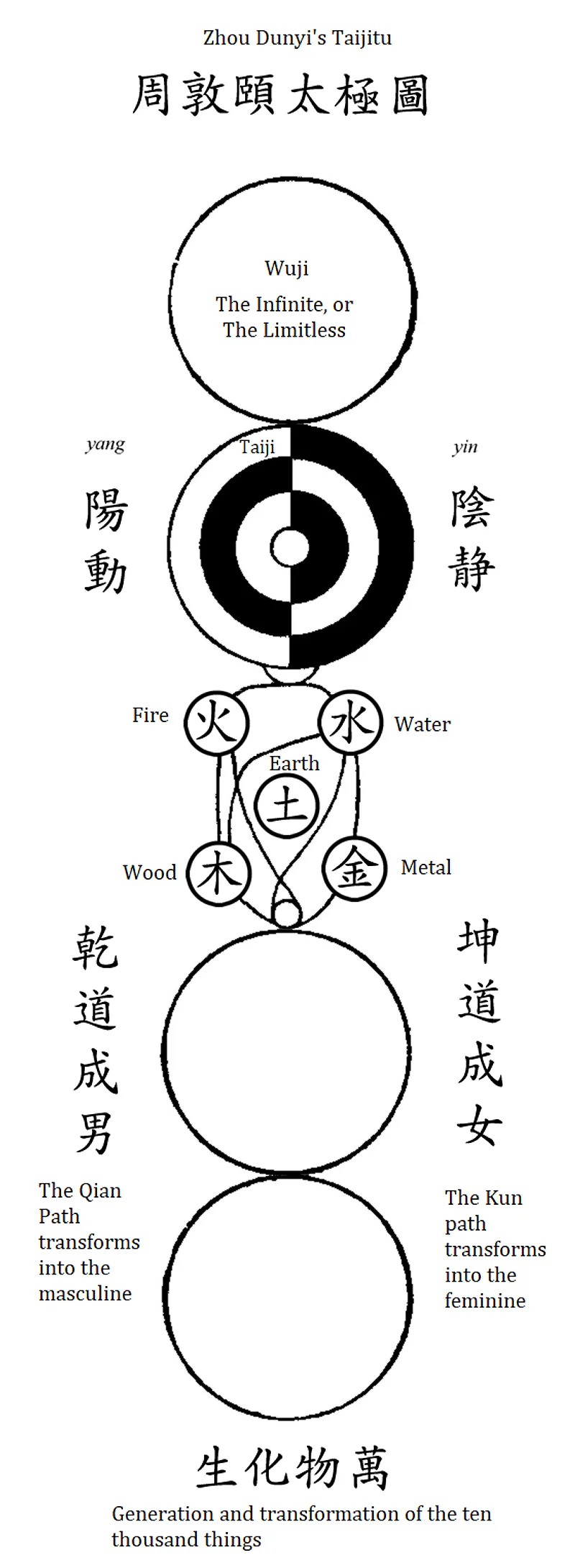
The texts known as the "Taiji Classics," attributed to Zhang Sanfeng, Wang Zongyue and others but surfacing in the nineteenth century, describe softness overcoming hardness, sinking the qi to the dantian and responding to an opponent's force rather than meeting it head on. In 1956 China's sports authorities published a simplified twenty-four-movement Yang-style form, which became the most widely practised version in the world. Today taijiquan is practised both as a martial art and, far more commonly, as gentle exercise.
Xingyiquan and Baguazhang§
Xingyiquan, "form and intention boxing," traces its origins to Ji Jike (also called Ji Longfeng) in the seventeenth century, who is said to have adapted spear techniques to empty-hand fighting. Its five fundamental fists are correlated with the five phases (wood, fire, earth, metal and water) of Chinese cosmology, and its twelve animal forms recall the ancient daoyin tradition. Its movements are linear, direct and explosive.
Baguazhang, "eight trigram palm," is associated with Dong Haichuan (d. 1882), who taught in Beijing in the mid-nineteenth century and is said to have learned from Daoist recluses. Its distinctive practice is circle walking, with constant turning and changes of direction, and its name links it to the eight trigrams of the Yijing. Some scholars have connected circle walking with Daoist ritual circumambulation, though the evidence is limited.
Qi, Meridians and the Dantian: Theory and Evidence§
Behind all these arts lies the theory of qi shared with Chinese medicine: a vital breath that flows through channels (jingluo), is stored in organs and gathers in the dantian, the "elixir field" below the navel. Practitioners describe sensations of warmth, tingling and fullness as signs of qi circulation. The theory also links these arts to the meditative traditions surveyed in meditation in Eastern traditions, and comparisons are often drawn with the Indian ideas of prana and kundalini.
Modern research has found reasonable evidence that tai chi improves balance and reduces falls in older adults, and suggestive evidence for benefits in some chronic conditions, while there is no accepted scientific evidence that qi exists as a measurable physical energy. Chinese sources themselves warn of "qigong deviations" (zouhuo rumo), disturbances that can follow intense or poorly guided practice; anyone experiencing persistent distress should stop and seek qualified advice.
Frequently asked questions§
What is the difference between qigong and tai chi?§
Qigong is a broad family of breathing, movement and meditation exercises aimed mainly at health and self-cultivation. Tai chi (taijiquan) is a specific martial art with its own lineages and long forms; it shares qigong's principles and is often practised as qigong, but its movements are also self-defence techniques.
How old is qigong?§
The practices behind it are ancient: daoyin exercises are illustrated on a silk chart from 168 BCE. The word "qigong" as the standard name for these practices, however, dates from the 1950s.
Is qigong a religious practice?§
It can be either. Modern state-sponsored qigong is presented as secular health exercise, but many methods derive from Daoist and Buddhist cultivation, and some qigong groups have developed into religious movements.
What are the three internal martial arts?§
Taijiquan, xingyiquan and baguazhang, grouped together as the "internal family" around 1900. Some teachers add others, such as liuhebafa or yiquan, a twentieth-century style derived from xingyi.
Sources and further reading§
- Qigong Fever: Body, Science and Utopia in China — David A. Palmer, 2007
- Chinese Healing Exercises: The Tradition of Daoyin — Livia Kohn, 2008
- Taoist Meditation and Longevity Techniques — Livia Kohn (ed.), 1989
- Lost T'ai-chi Classics from the Late Ch'ing Dynasty — Douglas Wile, 1996
- Chinese Martial Arts: From Antiquity to the Twenty-First Century — Peter A. Lorge, 2012
- The Encyclopedia of Taoism — Fabrizio Pregadio (ed.), 2008
- Chinese Boxing: Masters and Methods — Robert W. Smith, 1974