Liber XXXI · Taoism & Chinese Religion · Chapter X: Zhuangzi
The Zhuangzi: Butterfly Dream, Cook Ding and the Free Mind
The Zhuangzi explained: Zhuang Zhou, the Inner Chapters, the butterfly dream, Cook Ding, fasting of the mind, death and transformation, and its Taoist legacy.

The Zhuangzi (Chuang Tzu) is the second great classic of Taoism, a collection of stories, dialogues and arguments named after the thinker Zhuang Zhou (traditionally fourth century BCE). Through parables such as the butterfly dream and the cook who carves an ox without effort, it questions fixed viewpoints, celebrates spontaneous skill, and treats life and death as transformations of the Tao, in a voice more playful and personal than that of the Tao Te Ching.
Zhuang Zhou: The Man Behind the Book§
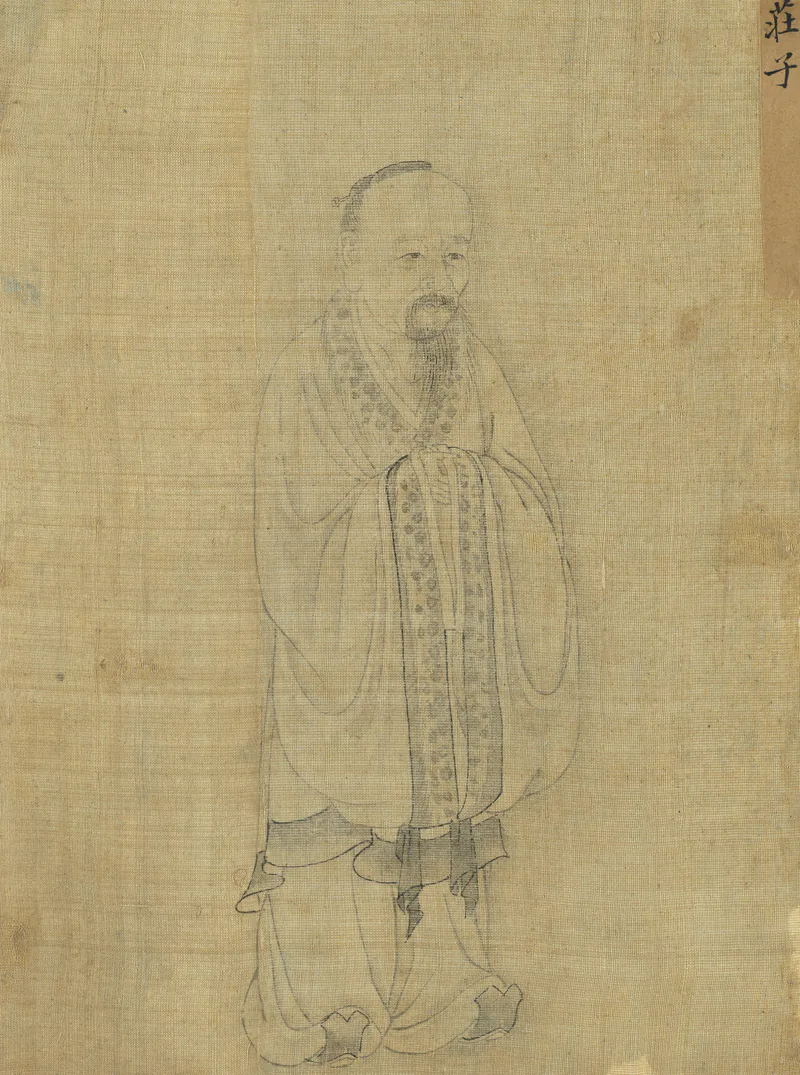
Almost everything known about Zhuang Zhou comes from the book itself and from a brief notice by the historian Sima Qian (c. 100 BCE). He is said to have come from Meng in the state of Song, in what is now Henan or Anhui, to have served as a minor official in charge of a lacquer garden, and to have been a contemporary of King Hui of Liang and King Xuan of Qi, which places him in the second half of the fourth century BCE. Dates of roughly 369 to 286 BCE are often given but are approximate.
The book presents him as poor, witty and indifferent to office. In one well-known episode, envoys from the king of Chu offer him a ministry; he asks whether a sacred tortoise, its shell kept in a box in the ancestral temple, would rather be dead and honoured or alive and dragging its tail in the mud, and sends them away. His friend and sparring partner is the logician Hui Shi (Huizi), whose debates with Zhuangzi supply some of the book's sharpest exchanges.
How the Zhuangzi Was Compiled: Inner, Outer and Miscellaneous Chapters§
The Han imperial bibliography lists a Zhuangzi in 52 chapters. The version that survives was edited, abridged and annotated by Guo Xiang around 300 CE, who reduced it to 33 chapters and cut material he judged spurious. His arrangement has three parts:
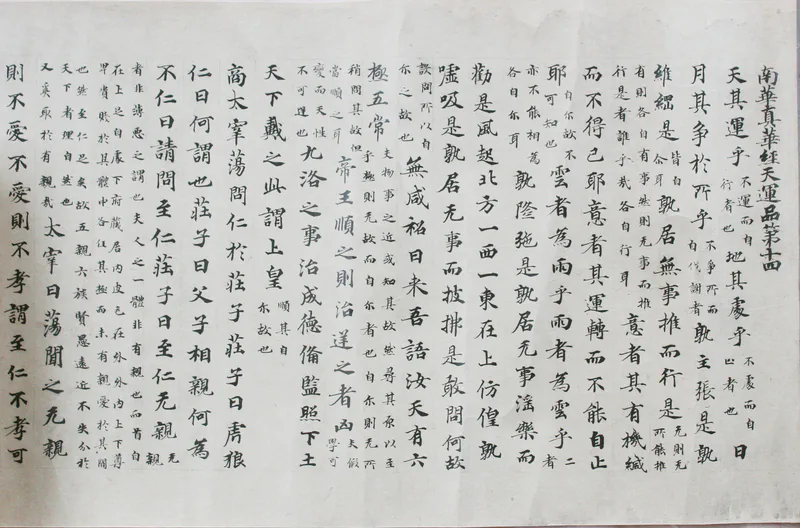
- Inner Chapters (1–7), including "Free and Easy Wandering" (Xiaoyao you), "On Making All Things Equal" (Qiwu lun) and "The Primacy of Nourishing Life" (Yangsheng zhu).
- Outer Chapters (8–22), among them "Autumn Floods" (Qiushui) and "Perfect Happiness" (Zhile).
- Miscellaneous Chapters (23–33), ending with a survey of the thinkers of the age.
The British sinologist A. C. Graham proposed that the book contains several distinct groups of writers: Zhuang Zhou himself in the Inner Chapters; his later followers; a "Primitivist" author who idealised a simple society (chapters 8–11 in part); "Yangists" concerned with preserving life; and "Syncretists" who combined Taoist and other ideas. Not every detail of his scheme is accepted, but the view that the Zhuangzi is a layered anthology, completed perhaps by the second century BCE, is widely shared.
Perspective and Relativism: "On Making All Things Equal"§
The second chapter is the philosophical core of the book. Zhuangzi observes that every judgement of "this" and "that", right and wrong, is made from a standpoint. The Confucians and Mohists each affirm what the other denies, and no neutral judge can settle between them. Rather than adding another position, the sage "illuminates" both, standing at the "pivot of the Way" from which each perspective appears in its place, like a hinge set in the centre of a ring.
The chapter ends with the most famous passage in Chinese philosophy. In Herbert Giles' 1889 translation: "Once upon a time, I, Chuang Tzŭ, dreamt I was a butterfly, fluttering hither and thither, to all intents and purposes a butterfly." On waking he cannot tell whether he is Zhuang Zhou who dreamed of being a butterfly, or a butterfly dreaming of being Zhuang Zhou. The text calls this "the transformation of things". Whether this is scepticism, mysticism or a therapy for the anxious mind has been debated ever since.
The first chapter makes a related point with the giant Peng bird, which rises ninety thousand li on the wind, and the small birds who laugh at it. Great and small have their own scales; the free person "wanders" without depending on anything.
Skill, Spontaneity and Nourishing Life§
The third chapter tells of Cook Ding, who carves an ox for Lord Wenhui with movements like a dance. Asked about his skill, he explains that he no longer sees the ox with his eyes but meets it with spirit, following its natural structure and slipping his blade through the spaces between the joints, so that after nineteen years his knife is as sharp as new. The lord exclaims that he has learned how to nourish life.
Similar figures recur: the wheelwright who cannot put his knack into words, the swimmer who goes with the current of a waterfall, the cicada catcher, the bell-stand carver who fasts until he forgets reward and even his own body. Together they present an ideal of action that is spontaneous yet perfected, close to the wuwei of the Tao Te Ching but rooted in craft rather than government. The useless tree, which survives because no carpenter wants it, illustrates the paradoxical value of being of no use to the world.
Death, Transformation and the Fasting of the Mind§
Fasting of the heart-mind and sitting in forgetfulness§
In the fourth chapter Confucius, used as a mouthpiece, teaches his disciple Yan Hui the "fasting of the heart-mind" (xinzhai): to stop listening with the ears and the mind and to listen with qi, which is empty and waits on things. In the sixth chapter Yan Hui reports that he has "sat and forgotten" (zuowang), letting go of body and intellect to merge with the "great thoroughfare". Later Taoist meditation took both terms as names for contemplative practice, and they are often compared with Buddhist and other forms of meditation.
Death as transformation§
The Zhuangzi treats death with striking equanimity. When Zhuangzi's wife dies, his friend Huizi finds him drumming on a basin and singing. Zhuangzi explains that he grieved at first, but then reflected that she had come from formlessness and returned to it like the turning of the seasons. On his own deathbed, he refuses an elaborate burial: heaven and earth will be his coffin, the sun and moon his jade ornaments. The book's "perfected persons" (zhenren), who cannot be burned by fire or drowned by water, later became models for the Taoist immortals.
The seventh chapter closes with the parable of Hundun, "Chaos", the faceless emperor of the centre. His friends, wishing to repay his kindness, bore seven openings in him so that he can see, hear, eat and breathe like them; on the seventh day Hundun dies. It is often read as a warning against imposing distinctions on the undivided.
Zhuangzi in Religious Taoism and Chinese Culture§
From the third century the Zhuangzi was central to "Mysterious Learning" (xuanxue), the philosophical movement of Wang Bi and Guo Xiang. Buddhist translators borrowed its vocabulary, and Chan (Zen) Buddhism absorbed much of its humour, its distrust of words and its praise of spontaneous action; see Zen and Chan. In 742 Emperor Xuanzong of the Tang granted Zhuangzi the title "True Man of Southern Florescence" and his book the name Nanhua zhenjing, making it a scripture of the Taoist canon alongside the Tao Te Ching.
Its images of the Peng bird, the butterfly and the happy fish of the River Hao became stock themes of Chinese poetry and painting, and its spirit of "free and easy wandering" shaped the ideal of the recluse scholar. In the West, translations by Giles, James Legge, Burton Watson, A. C. Graham, Victor Mair and Brook Ziporyn have made it one of the most admired works of world philosophy. For the wider tradition, see What Is Taoism?.
Frequently asked questions§
What is the butterfly dream in the Zhuangzi?§
At the end of chapter two, Zhuang Zhou dreams he is a butterfly and, on waking, cannot tell whether he is a man who dreamed of being a butterfly or a butterfly dreaming of being a man. The story illustrates "the transformation of things" and the limits of any single perspective.
Did Zhuangzi write the whole book?§
Probably not. Most scholars attribute the Inner Chapters, or much of them, to Zhuang Zhou or his close circle, and regard the Outer and Miscellaneous Chapters as the work of later followers and other schools, compiled over the following one or two centuries.
How is the Zhuangzi different from the Tao Te Ching?§
The Tao Te Ching is terse, poetic and often addressed to rulers. The Zhuangzi is longer and full of stories, humour and argument, shows little interest in government, and focuses on personal freedom, the relativity of viewpoints and acceptance of change and death.
Sources and further reading§
- Chuang Tzŭ: Mystic, Moralist, and Social Reformer — Herbert A. Giles, 1889
- The Complete Works of Chuang Tzu — Burton Watson, 1968
- Chuang-tzŭ: The Seven Inner Chapters and Other Writings from the Book Chuang-tzŭ — A. C. Graham, 1981
- Wandering on the Way: Early Taoist Tales and Parables of Chuang Tzu — Victor H. Mair, 1994
- Zhuangzi: The Essential Writings — Brook Ziporyn, 2009
- Essays on Skepticism, Relativism, and Ethics in the Zhuangzi — Paul Kjellberg and Philip J. Ivanhoe (eds.), 1996
- Disputers of the Tao — A. C. Graham, 1989