Liber XXXI · Taoism & Chinese Religion · Chapter VI: Laozi & the Tao Te Ching
Laozi and the Tao Te Ching: Origins, Teachings and Texts
Laozi and the Tao Te Ching explained: the legend of Laozi, the Guodian and Mawangdui manuscripts, wuwei and the Tao, commentaries, and famous translations.

The Tao Te Ching (Daodejing, "Classic of the Way and Its Power") is a short Chinese book of about 5,000 characters in 81 chapters, traditionally attributed to the sage Laozi (Lao Tzu), which teaches that the sage follows the nameless Tao through simplicity, humility and wuwei, non-coercive action. Modern scholars regard it as a compilation of sayings that took shape between roughly the fourth and third centuries BCE, and it is the founding classic of both philosophical and religious Taoism.
Who Was Laozi? Legend and History§
The name Laozi means simply "Old Master". The earliest biography, in Sima Qian's Records of the Grand Historian (Shiji), says that his personal name was Li Er, that he came from the state of Chu and served as a keeper of archives at the Zhou royal court, and that Confucius once visited him for instruction on ritual and came away comparing him to a dragon. Seeing the decline of Zhou, Laozi rode west; at the frontier pass the gatekeeper Yin Xi asked him to set down his teaching, and he wrote a book in two parts on the Way and its power before vanishing.
Sima Qian immediately adds that some identified Laozi with other figures, a certain Lao Laizi or a court astrologer named Dan, and that he was said to have lived for more than a hundred and sixty years. In other words, the historian himself was assembling traditions he could not verify. Most modern scholars doubt that a single author called Laozi wrote the book. Some think a real teacher stands behind part of it; others see "Laozi" as a name gathered around an anonymous body of wisdom sayings. The famous meeting with Confucius was probably told to give Laozi's teaching precedence over the Confucian school.
Dating the Tao Te Ching: Guodian and Mawangdui§
For centuries the text was known only through later editions, chiefly the one transmitted with the commentary of Wang Bi (226–249 CE). Two archaeological discoveries changed the picture.
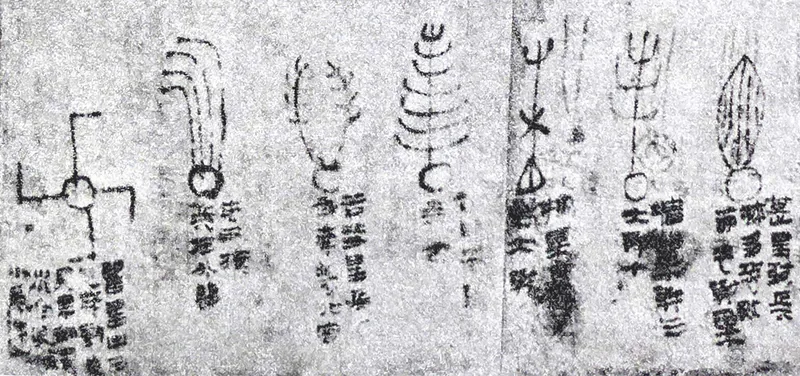
In 1973 two silk manuscripts of the book were found in a tomb at Mawangdui in Hunan, sealed in 168 BCE. They are close to the received text, but the section on de (chapters 38–81) comes before the section on dao (chapters 1–37), which is why some translators call this version the Te-Tao Ching.
In 1993 a tomb at Guodian, also in the old territory of Chu and usually dated to around 300 BCE, yielded bamboo slips with material corresponding to roughly two-fifths of the received text, arranged in three bundles in a different order and mixed with other writings. Scholars disagree about whether these slips are excerpts from an already complete book or witnesses to an earlier stage when the collection was still forming. Either way, they show that much of the Tao Te Ching existed by about 300 BCE. Notably, the Guodian version of the passage that became chapter 19 lacks the received text's explicit rejection of the Confucian virtues of humaneness and righteousness, which suggests that the work's anti-Confucian edge may have sharpened over time.
The Structure of the Book: Dao and De§
The received text has 81 short chapters, many of them rhymed, written in a terse style that allows multiple readings. The first 37 form the Dao jing ("classic of the Way"), the rest the De jing ("classic of virtue"). De is often translated "virtue", but in early Chinese it means something closer to potency, charisma or the efficacy that comes from embodying the Way, the quality by which a ruler draws people without force.
The book contains no narrative, no named persons and no historical references, which makes it unusually adaptable. Readers have found in it a mystical metaphysics, a manual of government, a strategy of survival, a guide to bodily cultivation and a poem of nature.
Core Teachings: The Tao, Wuwei and the Power of Softness§
The nameless Tao§
The opening lines set the tone. In James Legge's 1891 translation: "The Tao that can be trodden is not the enduring and unchanging Tao. The name that can be named is not the enduring and unchanging name." The Tao precedes heaven and earth; it is called "the mother of all things", empty like a vessel that is never filled, and dark or mysterious (xuan). Chapter 42 describes the emergence of the world in a sequence: the Tao produces the One, the One the Two, the Two the Three, and the Three the myriad things, which carry yin and embrace yang.
Wuwei and ziran§
Wuwei, literally "not doing", does not mean idleness but action without forcing, contrivance or self-assertion, the way water finds its course. Ziran, "so of itself", names the spontaneous self-ordering of things when they are not interfered with. The sage "does nothing, yet nothing is left undone".
Water, the valley and the feminine§
The book repeatedly praises what is low, soft and receptive. Water benefits all things without contending and yet wears away the hardest stone; the valley and the empty hub of a wheel are useful because of their emptiness; the "mysterious female" and the "valley spirit" that never dies are images of the generative Tao. The ideal person returns to the simplicity of the infant and the "uncarved block" (pu), sees through desire and ambition, and knows when enough is enough.
The Sage-Ruler and the Politics of the Tao Te Ching§
Much of the book addresses a ruler. The best government is barely noticed; the more laws and prohibitions there are, the more thieves and poverty appear; the sage keeps the people's bellies full and their ambitions weak. Chapter 80 imagines a small state with few people, where boats and weapons go unused and neighbours hear each other's dogs and cocks but never visit. Warfare is called inauspicious, to be undertaken only when unavoidable and mourned even in victory.
In the Han dynasty this political reading flourished in "Huang–Lao" thought, which paired Laozi with the Yellow Emperor and advised rulers to govern with a light hand. The Legalist philosopher Han Feizi had already written commentary on parts of the Laozi in the third century BCE, showing how its ideas could serve very different political ends.
Laozi as a God: Commentaries and Worship§
By the late Han, Laozi had become a deity. A stele inscription of 165 CE, the Laozi ming, presents him as a cosmic being who has transformed himself through the ages, and Emperor Huan ordered sacrifices to him. For the Celestial Masters he was the Most High Lord Lao (Taishang Laojun), who revealed the covenant to Zhang Daoling in 142 CE. Their early commentary, the Xiang'er, partly preserved in a Dunhuang manuscript, reads the book as a guide to moral precepts and to preserving the body's vital essence.
Other commentaries shaped how the book was read for centuries: Wang Bi's philosophical interpretation, centred on non-being (wu) as the root of being; and the commentary attributed to the legendary Heshang Gong ("the Old Man by the River"), which reads it in terms of nourishing life and governing the body. The Tang emperors, who shared Laozi's surname Li, claimed him as their ancestor and made the book a subject of the civil service examinations. A controversial text, the Classic of the Conversion of the Barbarians, claimed that Laozi had gone west to become the Buddha; it fuelled centuries of Taoist–Buddhist polemic and was ordered destroyed under the Yuan dynasty in 1281.
The Tao Te Ching in Translation§
European knowledge of the book began with Jesuit missionaries, who made Latin versions in the eighteenth century. Stanislas Julien published a French translation in 1842 and James Legge an English one in 1891, in the Sacred Books of the East. Arthur Waley's The Way and Its Power (1934) and D. C. Lau's Penguin translation (1963) became classics of twentieth-century scholarship. Since then hundreds of English versions have appeared, from careful philological translations based on the excavated manuscripts, such as those of Robert Henricks, to free poetic adaptations by writers who do not read Chinese.
The variety is partly a result of the text itself: its grammar is compact, its key terms are polysemous, and the excavated versions differ in wording and order. Readers interested in its later spiritual use can compare the Zhuangzi, the practices of inner alchemy, and the meditative traditions surveyed in meditation.
Frequently asked questions§
What does Tao Te Ching mean?§
Tao (dao) means "way", te (de) means virtue, power or potency, and ching (jing) means "classic" or canonical text. The title is usually rendered "The Classic of the Way and Its Power" or "Book of the Way and Virtue". Early sources often simply call it the Laozi.
Did Laozi really exist?§
It is uncertain. The only early biography, by Sima Qian, already mixes several traditions, and most scholars think the Tao Te Ching is a compilation rather than the work of one author. Some accept a historical teacher behind part of it; others regard Laozi as a legendary figure.
How old is the Tao Te Ching?§
The Guodian bamboo slips show that much of the text existed by about 300 BCE, and the Mawangdui silk manuscripts show a nearly complete version before 168 BCE. The traditional date in the sixth century BCE, based on Laozi being an older contemporary of Confucius, is not accepted by most historians.
What is wuwei?§
Wuwei means "non-action" or "effortless action": acting in harmony with the natural course of things rather than forcing them. In the Tao Te Ching it describes both the sage's inner disposition and an ideal of light, non-coercive government.
Sources and further reading§
- Tao Te Ching — Laozi, trans. D. C. Lau, 1963
- The Way and Its Power — Arthur Waley, 1934
- Lao-Tzu: Te-Tao Ching — Robert G. Henricks, 1989
- Lao Tzu's Tao Te Ching: A Translation of the Startling New Documents Found at Guodian — Robert G. Henricks, 2000
- Lao-tzu and the Tao-te-ching — Livia Kohn and Michael LaFargue (eds.), 1998
- The Tao of the Tao Te Ching — Michael LaFargue, 1992
- Dao De Jing: Making This Life Significant — Roger T. Ames and David L. Hall, 2003
- Disputers of the Tao — A. C. Graham, 1989