Liber XXXI · Taoism & Chinese Religion · Chapter VI: Laozi & the Tao Te Ching
Wu Wei: Effortless Action and Naturalness in Taoism
Wu wei explained: effortless action in the Tao Te Ching, ziran or naturalness, the Zhuangzi's craftsmen, Confucian and Legalist uses and the paradox.

Wu wei (wuwei, literally "no doing" or "non-action") is the Taoist ideal of acting without forcing, striving or calculating, so that action flows spontaneously and in harmony with the Tao. It does not mean idleness: in the Tao Te Ching and the Zhuangzi it describes the effortless ease of the sage, the skilled craftsman and the good ruler, and it is closely linked with ziran, the "naturalness" of things that are "so of themselves".
What Does Wu Wei Mean?§
The Chinese wu means "without" or "not having", and wei means "to do", "to act" or "to make", often with the sense of deliberate, purposeful action. Wu wei is therefore "not doing" or "doing nothing", but early Chinese writers did not use it to praise inactivity. Its meaning is closer to "non-coercive action", "action without contrivance" or "effortless action", the phrase chosen by Edward Slingerland for his study of the concept.
Three related ideas help to explain it. First, wu wei is the opposite of forcing: imposing one's will on people or things against their nature. Second, it is free of self-conscious calculation, the anxious weighing of gain and loss. Third, it is efficacious: the person who acts in this way accomplishes more, not less, because his or her action flows with the grain of things. Water, which yields to everything yet wears away stone, is the classic image.
Wu Wei in the Tao Te Ching§
The Tao Te Ching presents wu wei as the way of the Tao itself and of the sage who models himself on it. Its best-known formulation, in chapter 37 of the received text, says that the Way constantly does nothing, yet there is nothing it does not do. Excavated manuscripts read this chapter differently: the Guodian bamboo slips of around 300 BCE say that the Way is constantly without action, and the Mawangdui silk texts of the second century BCE speak of the Way as nameless. The famous paradox may therefore have been sharpened in later editions.

Other chapters develop the idea. The sage "manages affairs without action and spreads teaching without words" (chapter 2). The pursuit of learning adds something every day, while the pursuit of the Way takes something away every day, until one arrives at non-action (chapter 48). A good ruler says, in effect, that he does nothing and the people transform themselves (chapter 57). Those who act on things spoil them, and those who grasp things lose them (chapter 64). The text often addresses rulers, and its wu wei is in large part a political ideal: government by minimal interference, without heavy taxes, wars or proliferating laws.
Wu wei belongs to a cluster of images in the book: the uncarved block (pu), the infant, the valley, the feminine and, above all, water, which benefits all things without contending.
Ziran: The Way That Is So of Itself§
Wu wei is inseparable from ziran, literally "self-so" or "so of itself", often translated "naturalness" or "spontaneity". Chapter 25 sets out a chain of models: humans follow Earth, Earth follows Heaven, Heaven follows the Way, and the Way follows ziran, which is to say that the Way has nothing outside itself to follow and is simply what it is. In chapter 17 the best rulers are those whose subjects barely know they exist; when the work is done, the people say that it happened of itself.
If ziran describes how things are when left to their own natures, wu wei describes the conduct that allows them to be so. The sage does not impose a plan but responds to situations as they arise, like a mirror or like water taking the shape of its container. In modern Chinese ziran has become the ordinary word for "nature" in the scientific sense, a later development that can mislead readers of the ancient texts.
Skill and Spontaneity in the Zhuangzi§
The Zhuangzi rarely theorises about wu wei but brings it to life in stories of skill. Cook Ding carves an ox for Lord Wenhui so smoothly that his knife moves like a dance; he explains that after years of practice he no longer sees the whole ox but follows its natural joints, and his blade has stayed sharp for nineteen years. Wheelwright Bian tells a duke that the knack of shaping a wheel lies in his hands and cannot be put into words, so the books of the ancient sages are only their leftovers. An old man swims unharmed through a torrent that no fish could survive, because he goes in with the whirlpools and comes out with the eddies and does not impose himself on the water.
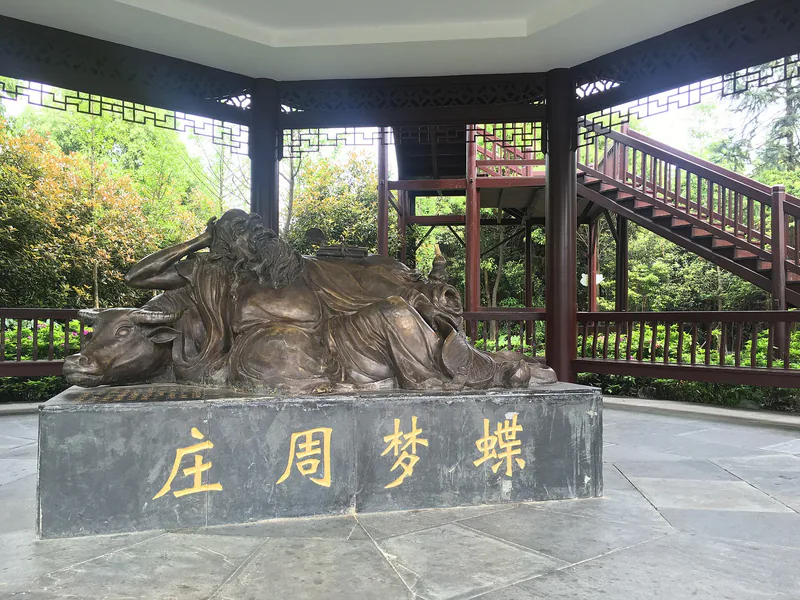
These stories suggest that wu wei is not the absence of discipline but its fulfilment. Long training lets deliberate effort fall away, until the craftsman responds to his material without self-consciousness. The Zhuangzi links this to a mind emptied of fixed opinions and free from concern with reputation and profit, the condition it calls "free and easy wandering".
Wu Wei Beyond Taoism: Confucians, Legalists and Huang-Lao§
Wu wei was not a Taoist monopoly. The Confucian Analects (15.5) praises the ancient sage-king Shun for governing by wu wei: he made himself reverent, took his place facing south, and nothing more was needed, because his virtue ordered the realm. Mencius warned against forcing moral growth with the parable of a farmer from Song who pulled at his sprouts to help them grow and found them withered. For Confucians, as Slingerland argues, wu wei is the state of a person whose cultivated virtue has become second nature; see Confucianism.
The Legalist thinker Han Fei (d. 233 BCE) turned wu wei into a technique of power: the ruler should remain still and inscrutable, let ministers reveal their abilities, and govern through impersonal laws and the matching of words to results. In the early Han dynasty a school known as Huang-Lao, after the Yellow Emperor and Laozi, advocated light government in this spirit and enjoyed court favour under Emperor Wen and the Empress Dowager Dou. Silk manuscripts found at Mawangdui in 1973 have been linked to this movement.
The Huainanzi, presented to the Han court in 139 BCE, explicitly rejects the idea that wu wei means doing nothing. It explains that wu wei means not allowing private desire to distort public affairs and working with the natural tendencies of things, as one uses boats on water and carts on land.
The Paradox of Wu Wei§
If wu wei is spontaneous, how can anyone set out to achieve it? Slingerland calls this the "paradox of wu wei": the effort to become effortless seems self-defeating. Chinese thinkers answered it in different ways. Some, in the line of Mencius and the inner chapters of the Zhuangzi, held that spontaneity is already within us and only needs to be uncovered or allowed to grow. Others, following Xunzi, stressed long training in ritual and learning, through which a new nature is acquired.
Later commentators reshaped the concept again. Wang Bi (226–249) read the Tao Te Ching in terms of non-being as the root of all things. Guo Xiang (d. 312), the editor of the Zhuangzi, argued that every thing is "self-so" and transforms by itself, so that even a busy ruler acts without acting when he accords with his own nature and circumstances. This interpretation made wu wei compatible with social and political life.
Wu Wei in Religious Taoism and the Modern World§
In the Taoist religion wu wei became an ethical and contemplative ideal. Early commentaries such as the Xiang'er read the Tao Te Ching as a book of precepts, including warnings against striving for fame and wealth, and the monastic Quanzhen order made "clarity and stillness" the goal of its meditation. The internal martial arts, discussed in the guide to qigong and the internal arts, drew on the language of softness and yielding.
In the West wu wei has been read in many ways: as a philosophy of "going with the flow" in Benjamin Hoff's The Tao of Pooh (1982), as a precursor of psychological "flow", and as a case for minimal government, as when President Reagan quoted the Tao Te Ching's advice to govern a large state as one cooks a small fish. Scholars caution that such readings often detach the idea from its ancient setting, in which wu wei was tied to cosmology, kingship and self-cultivation.
Frequently asked questions§
Does wu wei mean doing nothing?§
No. Literally "no doing", wu wei refers to action that is effortless, unforced and free from selfish calculation. The Tao Te Ching says that through it "nothing is left undone", and the Huainanzi explicitly rejects reading it as idleness.
What is the difference between wu wei and ziran?§
Ziran ("self-so") describes the natural, spontaneous way things are when left to themselves, while wu wei describes the conduct that respects and follows that naturalness. The sage practises wu wei so that people and things can be ziran.
Is wu wei only a Taoist idea?§
No. The Analects praises the sage-king Shun for ruling through wu wei, Legalists used it for a technique of rulership, and Han-dynasty Huang-Lao thinkers built a political philosophy around it. Taoism gave it its most famous and radical expression.
Sources and further reading§
- Effortless Action: Wu-wei as Conceptual Metaphor and Spiritual Ideal in Early China — Edward Slingerland, 2003
- Trying Not to Try: The Art and Science of Spontaneity — Edward Slingerland, 2014
- Tao Te Ching — Laozi (D. C. Lau, trans.), 1963
- Dao De Jing: Making This Life Significant — Roger T. Ames and David L. Hall, 2003
- The Complete Works of Chuang Tzu — Burton Watson, 1968
- Disputers of the Tao — A. C. Graham, 1989
- The World of Thought in Ancient China — Benjamin I. Schwartz, 1985
- The Huainanzi — John S. Major, Sarah A. Queen, Andrew Seth Meyer and Harold D. Roth, 2010