Liber XXXI · Taoism & Chinese Religion · Chapter VIII: Religious Taoism
Quanzhen Taoism: Wang Chongyang and Complete Perfection
Quanzhen Taoism explained: Wang Chongyang, the Seven Perfected, Qiu Chuji and Chinggis Khan, monastic life, the Longmen lineage and White Cloud Temple.

Quanzhen ("Complete Perfection") Taoism is the monastic branch of the Taoist religion, founded in northern China in the twelfth century by Wang Zhe, better known as Wang Chongyang (1113–1170). Its monks and nuns are celibate, live in monasteries, and pursue self-cultivation through meditation, moral discipline and inner alchemy; today it is, with the Zhengyi priesthood, one of the two great orders of Taoism, centred on the White Cloud Temple in Beijing.
Wang Chongyang: From Official to Hermit§
Wang Zhe was born in 1113 near Xianyang in Shaanxi, into a prosperous family, at a time when north China was passing from the Song to the Jurchen Jin dynasty. According to his biographies he studied for the civil examinations, then turned to the military examinations and held a minor post, but found no satisfaction in official life and took to drink. He later took the religious name Chongyang, "Double Yang".
The turning point, as Quanzhen hagiography tells it, came in 1159 at the town of Ganhe, where Wang met a mysterious stranger, or in some versions two, who transmitted secret instructions to him. Later tradition identified his teachers as the immortals Lü Dongbin and Zhongli Quan, two of the Eight Immortals, and Quanzhen counts them among its Five Northern Patriarchs, with Wang Chongyang as the fifth. Historians read the encounter as a conversion story told in the language of revelation.
Wang then dug a pit at the village of Nanshi and lived in it for around three years, calling it the "Tomb of the Living Dead". The image was deliberate: the old self was to die so that a perfected self could be born. In 1167 he burned down his hut and set off east, alone, for the Shandong peninsula.
Founding Complete Perfection in Shandong§
In Ninghai, Shandong, Wang won over a wealthy couple, Ma Yu and his wife Sun Bu'er, who gave him a hermitage in their garden. He called it the Hermitage of Complete Perfection (Quanzhen an), and the name passed to the movement. Hagiographies tell how he shut himself in for a hundred days of winter retreat and sent the couple pears cut into pieces, a pun on fenli, "dividing pears" and "separation", urging them to give up married life. Both eventually became his disciples and lived apart as renunciants.
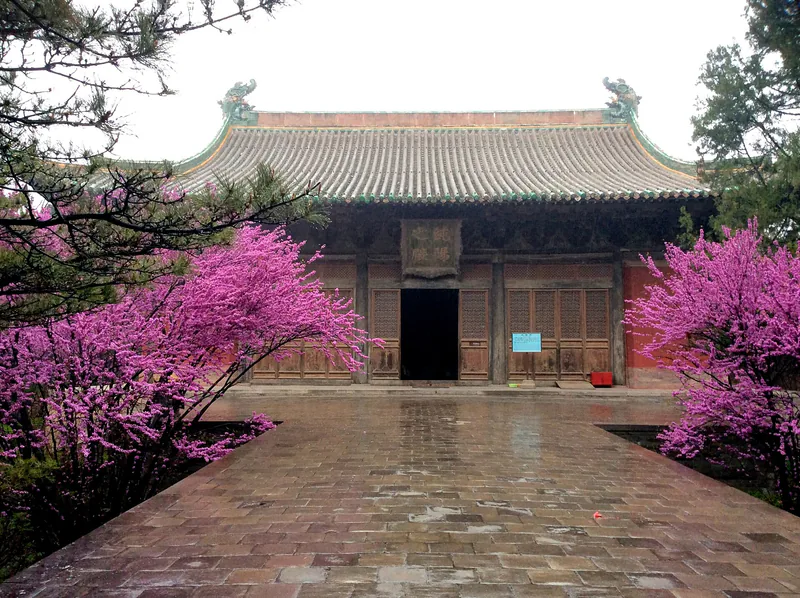
Wang preached in poetry and song, preserved in the Taoist Canon. He organised lay followers into five religious associations whose names all began with Sanjiao, "Three Teachings", signalling that Confucianism, Buddhism and Taoism were one at root. He recommended to his followers the Tao Te Ching, the Buddhist Heart Sutra and the Confucian Classic of Filial Piety alike. In 1169 he set out westward with four disciples and died early in 1170 at Kaifeng. His followers later buried him at Liujiang in Shaanxi, where the Chongyang Palace became the order's ancestral temple.
The Seven Perfected and the Spread of Quanzhen§
Quanzhen tradition honours seven disciples as the Seven Perfected (qizhen): Ma Yu (1123–1184), Sun Bu'er (1119–1182), Tan Chuduan, Liu Chuxuan, Qiu Chuji, Wang Chuyi and Hao Datong. Each was later regarded as the founder of a sub-lineage, among them Ma Yu's Yuxian branch, Sun Bu'er's Qingjing ("Clarity and Stillness") branch and Qiu Chuji's Longmen ("Dragon Gate") branch.
The Seven Perfected practised severe austerities in the early years: begging for food, enduring cold and exposure, long periods of solitary meditation and efforts to overcome sleep and desire. Stephen Eskildsen and Louis Komjathy have studied these accounts in detail and stress that, for the early masters, ascetic hardship was a way of testing and purifying the mind rather than an end in itself. Such austerities belong to the order's history and are not presented here as practices to imitate.
Sun Bu'er became the model of the female Taoist adept, and later texts on women's inner alchemy (nüdan) were attributed to her; Quanzhen has always admitted nuns (kundao) alongside monks. By 1200 the Jin court alternately invited and restricted the movement's leaders.
Qiu Chuji, Chinggis Khan and the Mongol Era§
The most famous of the seven, Qiu Chuji (1148–1227), known by his religious name Changchun ("Eternal Spring"), turned Quanzhen into a mass movement. In 1219 Chinggis Khan, then campaigning in Central Asia, summoned him, reportedly hoping to learn the secret of long life. Qiu set out in 1220 with a party of disciples, crossed Mongolia and the Altai, and met the Khan in 1222 in the region of the Hindu Kush. His disciple Li Zhichang wrote an account of the journey, the Record of the Journey to the West of the Perfected Changchun, which Arthur Waley translated in 1931 as The Travels of an Alchemist.
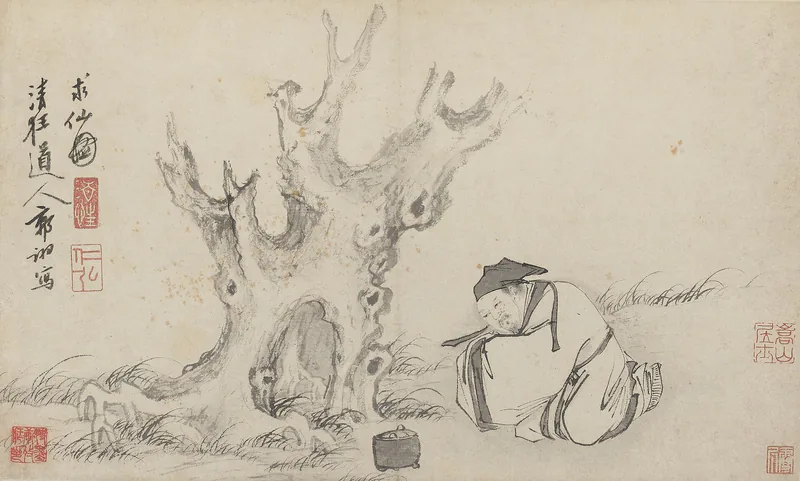
According to the record, Qiu told the Khan that there were means of preserving life but no medicine of immortality, and advised him to reduce killing and moderate his desires. The Khan granted Quanzhen clerics exemption from taxes and labour service. Qiu returned to Beijing in 1224 and was installed in a great temple there; after his death in 1227 he was buried in the adjoining complex that became the White Cloud Temple (Baiyun guan).
Under Mongol patronage Quanzhen grew rapidly, acquiring hundreds of temples and absorbing refugees from the wars. Its success provoked Buddhist opposition. In court debates in 1255 and 1258 Buddhist monks defeated Taoist representatives, chiefly over the Scripture of Laozi Converting the Barbarians, which claimed that the Buddha was a disciple of Laozi. Quanzhen had to return temples to Buddhist control, and in 1281 Khubilai Khan ordered the burning of Taoist scriptures other than the Tao Te Ching.
Teachings: Inner Nature, Vital Life and the Three Teachings§
Quanzhen teaching centres on the dual cultivation of inner nature (xing) and vital life (ming). Inner nature is the original, luminous mind; vital life is the body's energies, described in the language of internal alchemy as essence, breath and spirit. Early Quanzhen writings generally give priority to the mind: the adept seeks "clarity and stillness" (qingjing), freedom from desire and attachment, and a mind as unmoved as dead ashes. The short Scripture of Clarity and Stillness became one of the order's daily recitations.
The Fifteen Discourses to Establish the Teaching, attributed to Wang Chongyang, outline the life of a renunciant: dwelling in a hermitage, wandering as a "cloud", reading scriptures, sitting in meditation, taming the mind, refining the inner nature, and finally "leaving the family" in the full sense, transcending the three realms of desire, form and formlessness. Scholars have noted how much this resembles Chan Buddhism in tone and vocabulary, and Quanzhen masters freely used Buddhist terms. Its ethic of loyalty and filial piety also drew on Confucianism, in keeping with the slogan that the Three Teachings form a single household.
Quanzhen rejected the external alchemy of mineral elixirs, which had a long and often fatal history in China, and generally disparaged reliance on talismans and miracles. Immortality was redefined as the realisation of an inner "yang spirit" that survives the death of the body.
Monastic Life, Precepts and the Longmen Lineage§
Quanzhen is a monastic order. Its clergy leave their families, remain celibate, abstain from meat, alcohol and the pungent vegetables, wear their hair in a topknot under a cap, and live in public monasteries (shifang conglin, "forests of the ten directions") or smaller hereditary temples. A characteristic early practice was enclosed meditation in a small hermitage or "circular retreat" (huandu) for a fixed period.
In the Ming dynasty the court favoured the Zhengyi Celestial Masters, and Quanzhen survived with less prominence. Its revival in the early Qing is credited to Wang Changyue (d. 1680), abbot of the White Cloud Temple, who from 1656 held large public ordinations and codified a three-stage system of precepts: the Initial Precepts of Perfection, the Intermediate Precepts and the Great Precepts of the Celestial Immortals. His Longmen lineage became the dominant form of Quanzhen, and most Quanzhen clergy today trace their ordination through it. Monica Esposito and others have shown that the standard history of an unbroken Longmen line from Qiu Chuji was partly constructed by later lineage writers, especially Min Yide (1748–1836).
The Palace of Eternal Joy (Yongle gong) in Shanxi, a great Quanzhen temple, preserves fourteenth-century murals of the lives of Lü Dongbin and Wang Chongyang.
Quanzhen Taoism Today§
Vincent Goossaert's history of the Taoists of Beijing shows that, around 1900, Quanzhen clerics there were a respected urban clergy who also performed rituals for lay patrons. The twentieth century brought anti-religious campaigns, temple confiscations and, during the Cultural Revolution, the near-total suppression of monastic life. When religious activity resumed, the Chinese Taoist Association, founded in 1957 and headquartered at the White Cloud Temple, resumed Quanzhen ordinations there in 1989.
Today Quanzhen monasteries flourish on the sacred mountains of Huashan, Wudang, Qingcheng and Zhongnan, among others, and the order is the main channel for monastic training in China (see what is Taoism). Popular culture knows Quanzhen best through Jin Yong's martial-arts novels, in which Wang Chongyang and the Seven Perfected lead a sword-fighting sect, a literary invention.
Frequently asked questions§
What does Quanzhen mean?§
Quanzhen means "Complete Perfection" or "Complete Reality". The name comes from the Hermitage of Complete Perfection that Ma Yu built for Wang Chongyang in Ninghai, Shandong, around 1168, and refers to the full realisation of one's true nature.
Who founded Quanzhen Taoism?§
It was founded by Wang Zhe (1113–1170), called Wang Chongyang, a former minor official from Shaanxi. Quanzhen tradition credits his teaching to an encounter with immortals in 1159, and his seven disciples, the Seven Perfected, spread it after his death.
How is Quanzhen different from Zhengyi Taoism?§
Quanzhen clergy are celibate monks and nuns who live in monasteries and emphasise meditation and inner cultivation. Zhengyi priests continue the older Celestial Master tradition, usually marry, live at home and specialise in community rituals, talismans and exorcisms.
Is Wang Chongyang a real person?§
Yes. Wang Chongyang is a well-documented historical figure whose poetry and teachings survive in the Taoist Canon. The miraculous elements of his life story, such as his meeting with immortals, belong to hagiography, while the martial-arts master of modern fiction is a literary creation.
Sources and further reading§
- The Teachings and Practices of the Early Quanzhen Taoist Masters — Stephen Eskildsen, 2004
- Cultivating Perfection: Mysticism and Self-Transformation in Early Quanzhen Daoism — Louis Komjathy, 2007
- The Travels of an Alchemist — Arthur Waley, 1931
- The Taoists of Peking, 1800–1949: A Social History of Urban Clerics — Vincent Goossaert, 2007
- Images of the Immortal: The Cult of Lü Dongbin at the Palace of Eternal Joy — Paul R. Katz, 1999
- Daoism Handbook — Livia Kohn (ed.), 2000
- Taoism: Growth of a Religion — Isabelle Robinet, 1997