Liber VIII · Eastern Mysticism · Chapter IX: Taoist Mysticism
Taoist Internal Alchemy (Neidan): Jing, Qi, Shen and the Elixir
Taoist internal alchemy (neidan) explained: waidan vs neidan, jing, qi and shen, the dantian, the Wuzhen pian, Quanzhen, the Golden Flower and qigong.

Taoist internal alchemy, or neidan (內丹, "inner elixir"), is a Chinese tradition of meditation and self-cultivation that uses the vocabulary of laboratory alchemy to describe a process carried out within the body and mind. Its practitioners seek to refine the three treasures of essence (jing), vital breath (qi) and spirit (shen) into an inner elixir, returning to the Dao and, in the tradition's own terms, attaining immortality.
From external to internal alchemy: waidan and neidan§
Chinese alchemy began as waidan, "external elixir," the attempt to produce an elixir of immortality from minerals and metals. Practitioners heated cinnabar (mercury sulphide), lead, mercury, gold and other substances in sealed vessels within a ritual setting, aiming to reproduce in compressed time the cosmic processes that were thought to mature minerals over millennia. Ge Hong's Baopuzi (early fourth century CE) is a major source for this tradition and for the wider pursuit of transcendence. Several Tang dynasty emperors are believed to have died from elixir poisoning, a fact often cited in accounts of external alchemy's decline.
A pivotal text for both forms is the Zhouyi cantong qi ("Token for the Agreement of the Three According to the Book of Changes"), traditionally attributed to Wei Boyang of the Han dynasty, though its present form is likely later. It describes the alchemical work through the trigrams and hexagrams of the Yijing and the cycles of yin and yang, in language that can be read both as laboratory instruction and as a description of inner cultivation. Fabrizio Pregadio, whose translations and studies are standard references, has shown how this ambiguity allowed the text to become foundational for neidan.
From around the eighth century, and decisively in the Song (960–1279), neidan became the dominant form. The terms were kept: the furnace, the cauldron, lead and mercury, fire phases, the elixir. But they were now understood as features of the body and mind. "Lead" and "mercury" became the true yang hidden in yin and the true yin hidden in yang; the "fire" became intention and breath; the "cauldron" became a region of the body. Interested readers may compare the parallel turn toward spiritual readings in Western alchemy.
The three treasures: jing, qi and shen§
Neidan rests on a cosmology shared with Chinese medicine. The Dao gives rise to the One, the One to yin and yang, and their interplay to the myriad things. A human being is formed by a similar sequence and gradually depletes the original endowment through living, desire and ageing. The three treasures are the key categories:
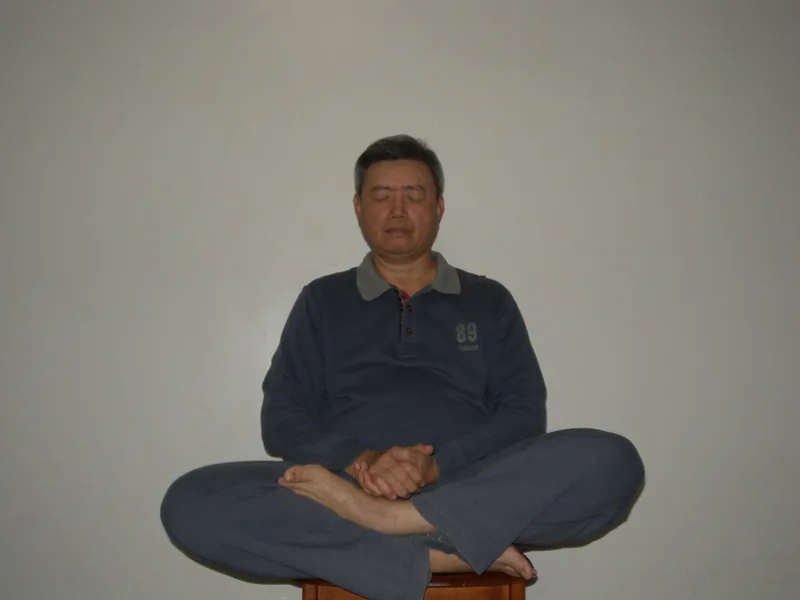
- Jing (精), essence, is the densest, associated with reproductive and constitutional vitality. Texts distinguish a prenatal essence received at conception from a postnatal essence replenished by food and breath.
- Qi (氣), breath or vital energy, animates the body and circulates through channels.
- Shen (神), spirit, is the subtlest, linked with consciousness, clarity and the heart-mind.
The classic formula of the work runs in three stages: refining essence into qi, refining qi into spirit, and refining spirit to return to emptiness. A final stage is sometimes described as "breaking through emptiness to merge with the Dao." Ordinary life moves in the direction of manifestation and loss, from spirit to qi to essence to depletion; alchemy reverses the current, "going against the flow" (ni) to return to the source.
The dantian and the inner landscape§
The dantian (丹田, "elixir field") is the place in which the elixir is cultivated. Most texts describe three. The lower dantian, a few finger-widths below the navel and inside the body, is the principal site for gathering and refining essence and qi. The middle dantian, in the region of the heart or solar plexus, is associated with qi and emotion, and the upper dantian, between and behind the eyebrows, with spirit. These are not identical with the Indian chakras, though comparisons are often drawn.
Neidan texts also map the circulation of qi along two principal vessels: the dumai ("governing vessel") up the spine and the renmai ("conception vessel") down the front of the body. Circulating qi through this loop is called the "microcosmic orbit" (xiao zhoutian), a term that became widely known through twentieth-century teachers. Some neidan diagrams, such as the famous Neijing tu ("Chart of the Inner Warp") carved on stone at the White Cloud Monastery in Beijing in the nineteenth century, picture the body as a landscape of mountains, rivers, waterwheels and farmers ploughing, an image of internal processes as natural ones. The parallel with the Indian imagery of a channel through which kundalini rises is often remarked upon, but the two systems arose in different cosmologies.
The Wuzhen pian and the Southern lineage§
Among the most celebrated neidan classics is the Wuzhen pian ("Awakening to Reality"), a collection of poems by Zhang Boduan (d. 1082), traditionally dated to 1075. In verse rich with the imagery of lead and mercury, tiger and dragon, and the trigrams kan and li, it presents inner alchemy as the true meaning of the elixir and integrates Daoist cultivation with Chan Buddhist insight into the nature of mind. Zhang Boduan was later honoured as the first patriarch of the "Southern Lineage" (Nanzong) of neidan, a retrospective genealogy of masters who emphasised cultivating "life" (ming, the bodily vitality) before "nature" (xing, the original mind). Later commentators, including Liu Yiming (1734–1821), wrote influential commentaries on the Wuzhen pian.
Quanzhen Daoism and monastic internal alchemy§
The Quanzhen ("Complete Perfection") school was founded in northern China by Wang Zhe, also called Wang Chongyang (1113–1170). He and his seven famous disciples, among them the woman master Sun Bu'er and Qiu Chuji, who travelled to meet Chinggis Khan in 1222, established a monastic Daoism combining celibacy, asceticism, meditation and inner alchemy with ethical teachings drawn from Confucianism and Buddhism. Quanzhen generally gave priority to cultivating "nature," the mind's original clarity, while also working with "life."
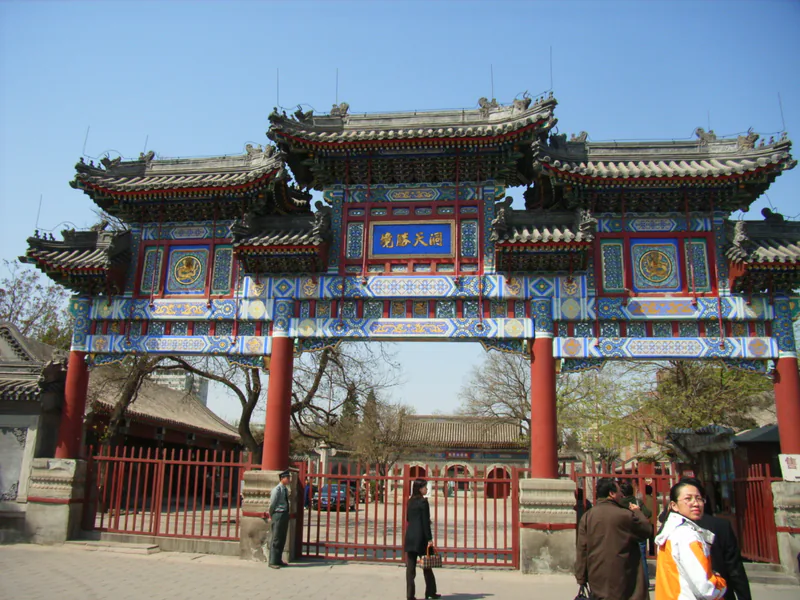
Quanzhen became one of the two main surviving branches of organised Daoism, alongside the Zhengyi (Celestial Masters) tradition. Its headquarters, the White Cloud Monastery (Baiyun guan) in Beijing, remains the seat of the Chinese Daoist Association. The Longmen ("Dragon Gate") sub-lineage, which traces itself to Qiu Chuji, became especially widespread from the seventeenth century.
The Secret of the Golden Flower§
The text that introduced neidan to the West is the Taiyi jinhua zongzhi, The Secret of the Golden Flower. It is attributed to the immortal Lü Dongbin and is thought to have been produced through spirit-writing in the late seventeenth century, though its textual history is complex and debated. It teaches the "turning around of the light": stilling thought and directing awareness back toward its source, so that a radiant "golden flower" of spirit blossoms.
In 1929 the sinologist Richard Wilhelm published a German translation with a psychological commentary by C. G. Jung, translated into English by Cary F. Baynes in 1931. Jung saw in it a parallel to the European alchemical texts he was beginning to study and to his own concept of individuation. Wilhelm's version was based on a later edition with Buddhist-leaning revisions, and it has been criticised for its interpretations. Thomas Cleary produced a fresh English translation in 1991 from a different edition, presenting the text as a manual of meditation rather than of Jungian psychology.
Neidan, qigong and modern practice§
In the twentieth century, breath and posture exercises from medical, martial and Daoist traditions were reorganised in the People's Republic of China under the name qigong ("work with qi"), initially as a secular health practice. David Palmer's Qigong Fever documents how qigong boomed in the 1980s and 1990s into a mass movement with millions of practitioners, before government suppression after 1999, particularly of Falun Gong. Many qigong methods simplify neidan techniques such as focusing on the lower dantian or circulating qi through the orbit, while dropping the cosmological and religious framework.
Neidan itself continues in Daoist monasteries in China and Taiwan and among lay practitioners worldwide. Traditional teachers stress that it should be learned from a qualified master, that virtue and a calm mind are prerequisites, and that forcing breath or concentration can cause physical and psychological disturbance, a caution Chinese sources discuss under the name "deviations" (pianchai). Anyone experiencing persistent distress during intensive practice should stop and seek qualified advice.
Frequently asked questions§
What is the difference between waidan and neidan?§
Waidan, "external elixir," tried to make an elixir of immortality from minerals such as cinnabar and lead in laboratory vessels. Neidan, "internal elixir," keeps the same vocabulary but applies it to meditation, breath and the refinement of the body's essence, qi and spirit.
What are jing, qi and shen?§
They are the three treasures of Chinese thought: essence, vital breath and spirit. Internal alchemy refines essence into qi, qi into spirit, and spirit back into emptiness, reversing the depletion that comes with ordinary life.
Where is the dantian?§
Most sources describe three dantian. The lower and most important lies a few finger-widths below the navel inside the body; the middle is near the heart; the upper is between and behind the eyebrows.
Is qigong the same as internal alchemy?§
Not quite. Qigong is a modern umbrella term, formalised in twentieth-century China, for health-oriented breath and movement practices. Many draw on neidan techniques, but neidan is a religious path aiming at union with the Dao within a Daoist cosmology.
Sources and further reading§
- The Secret of the Golden Flower — trans. Richard Wilhelm, with commentary by C. G. Jung, 1929 (English 1931)
- The Secret of the Golden Flower — trans. Thomas Cleary, 1991
- Understanding Reality (Wuzhen pian) — Zhang Boduan, trans. Thomas Cleary, 1987
- The Encyclopedia of Taoism — Fabrizio Pregadio (ed.), 2008
- Great Clarity: Daoism and Alchemy in Early Medieval China — Fabrizio Pregadio, 2006
- Taoism: Growth of a Religion — Isabelle Robinet, 1997 (English translation)
- Qigong Fever: Body, Science and Utopia in China — David A. Palmer, 2007
- Science and Civilisation in China, vol. 5, part 5 — Joseph Needham and Lu Gwei-Djen, 1983