Liber VIII · Eastern Mysticism · Chapter IX: Taoist Mysticism
The Microcosmic Orbit: Xiao Zhoutian in Daoist Internal Alchemy
The microcosmic orbit (xiao zhoutian) explained: the governing and conception vessels, the three passes, its place in Daoist neidan, and its modern history.

The microcosmic orbit, in Chinese xiao zhoutian ("lesser heavenly circuit"), is a Daoist internal-alchemy practice in which vital energy (qi) is guided by attention in a loop up the spine along the governing vessel and down the front of the body along the conception vessel. Modelled on the circuit of the heavens, it became in late imperial China the standard first stage of internal alchemy, refining essence into energy, and in the twentieth century one of the best-known qigong meditations in the West.
What the Microcosmic Orbit Is: The Lesser Heavenly Circuit§
Zhoutian means "a full circuit of the heavens", the path the sun appears to trace through the sky in a year, or the turning of the sky in a day. Chinese cosmology divided both into twelve parts: the twelve months and the twelve double-hours, each ruled by a balance of yin and yang that waxes and wanes in a regular cycle. Internal alchemists, who regarded the body as a small universe, applied the same model to the inner world. As the heavens turn and return, so the practitioner's refined energy is made to rise and descend in a closed circuit, completing a "lesser" heavenly revolution within the body.
The image belongs to a long Chinese tradition of correspondence between cosmos and person, expressed in the theory of yin, yang and the five phases. The English name "microcosmic orbit" is a modern translation that captures this idea of the body as a microcosm whose energy circulates like the planets.
The Governing and Conception Vessels in Chinese Medicine§
The route of the orbit is borrowed from Chinese medicine. Alongside the twelve regular channels (jingluo), classical medical theory describes eight "extraordinary vessels" (qijing bamai), which act as reservoirs that regulate the flow of the regular channels. The Nanjing ("Classic of Difficulties"), usually dated to around the first or second century CE, already describes these vessels, including two in terms close to later usage. The du mai, or governing vessel, rises from the perineum along the spine, over the crown of the head and down to the upper lip; it is said to govern the yang channels. The ren mai, or conception vessel, runs from the lower lip down the midline of the chest and abdomen to the perineum and governs the yin channels.
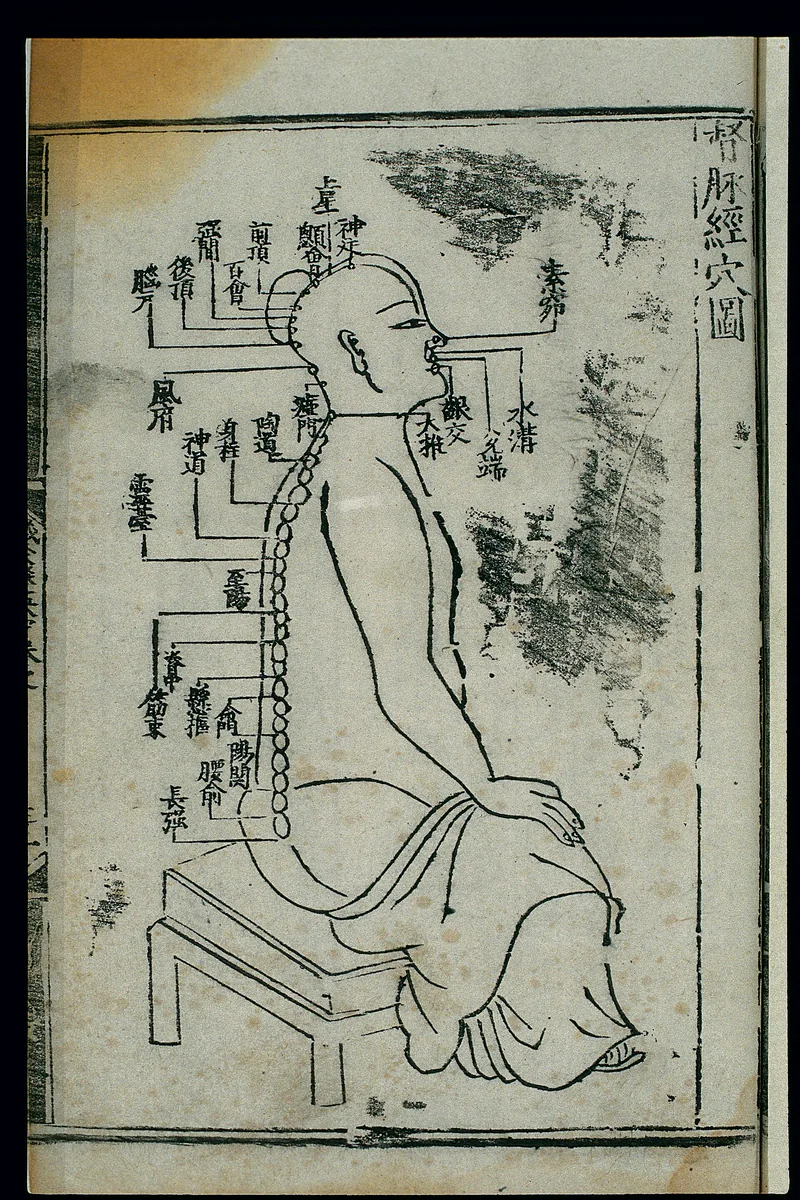
Linked together, these two vessels form a single loop around the trunk. The great physician Li Shizhen, in his sixteenth-century study of the extraordinary vessels, quoted alchemical writers on them and remarked that their paths are known to those who look inward, a sign of how closely medicine and inner alchemy were intertwined. Whether these vessels exist as anatomical structures is a different question: anatomy and physiology have found no physical counterparts, and the system is best understood as a traditional map of experience and function rather than of tissue.
The Orbit in Neidan: Passes, Fire Times and the Stages of the Work§
In the developed internal alchemy of the Ming and Qing dynasties, the work was commonly divided into stages: laying the foundation; refining essence into energy (lian jing hua qi); refining energy into spirit (lian qi hua shen); and refining spirit to return to emptiness. The microcosmic orbit belongs to the first of the main stages. Essence (jing), the generative energy of the body, is gathered in the lower dantian below the navel, transformed by the "fire" of focused attention and breath, and circulated through the orbit until it becomes refined energy. The three treasures of essence, energy and spirit are the raw materials of the whole process.
Texts describe three "passes" (sanguan) where the ascent up the spine is said to meet resistance: the "tailbone gate" (weilü) at the base of the spine, the "spine-straddling pass" (jiaji) between the shoulder blades, and the "jade pillow" (yuzhen) at the back of the skull. Above them lies the niwan, the upper field in the head, from which the energy descends through the face, the "magpie bridge" formed by the tongue touching the palate, the throat, the heart region and back to the lower field. The circuit is timed by "fire phases" (huohou), a language of advancing yang and withdrawing yin expressed through twelve hexagrams of the Book of Changes that goes back to the Cantong qi tradition. A "greater heavenly circuit" (da zhoutian), in which energy pervades the whole body and limbs, belongs to the later stage of refining energy into spirit.
The comparison with Indian yoga is obvious and often made. Both systems describe an ascent along the spine, but the Indian nadis and kundalini rise through a central channel to the crown, while the Chinese orbit is a circuit that returns down the front of the body. The two developed independently and use very different symbolism.
Charts of the Inner Landscape: The Neijing Tu and Xiuzhen Tu§
The orbit was also taught through pictures. The most famous is the Neijing tu ("Chart of the Inner Warp"), preserved on a stele dated 1886 at the White Cloud Temple (Baiyun guan) in Beijing, the headquarters of the Quanzhen order. It shows the human torso in profile as a mountain landscape. At its base a boy and a girl work a treadle water-wheel, the "river chariot" (heche), which lifts water up the spine; streams, fields, forests and figures of immortals mark the passes and fields along the way, and the brain appears as a range of peaks. The picture is a visual allegory of essence being drawn upward through the governing vessel.
A related chart, the Xiuzhen tu ("Chart for the Cultivation of Perfection"), survives in several versions and maps the body's palaces, deities and alchemical stages. Catherine Despeux has made a detailed study of it. Such diagrams were teaching aids within lineages, not self-explanatory manuals; their imagery assumed oral instruction.
From Wu–Liu Alchemy to Modern Qigong and the West§
The orbit's popular modern form owes much to the Wu–Liu school, named after Wu Shouyang (1574–1644) and Liu Huayang (1735–1799), which taught internal alchemy in comparatively plain language with strong Buddhist influences. Liu's Huiming jing ("Book of Wisdom and Life"), completed in 1794, includes diagrams of the circulation, and a translation of it was added to later editions of Richard Wilhelm's The Secret of the Golden Flower. In 1933 Zhao Bichen, a later heir of this line, published a detailed manual that Charles Luk translated as Taoist Yoga: Alchemy and Immortality (1970), and it gave many English readers their first systematic account of the orbit.
In the People's Republic, the qigong boom of the 1980s spread simplified circulation exercises to millions, a movement chronicled in David Palmer's Qigong Fever. In the West the term "microcosmic orbit" became widely known through the books of Mantak Chia, beginning with Awaken Healing Energy Through the Tao (1983), which presented the practice as the foundation of a "Healing Tao" system. These modern presentations often detach the orbit from the ritual, ethical and monastic frame it had in Daoism, as the guide to qigong and the internal arts notes for qigong more generally.
Cautions, Qigong Deviation and Gentle Practice§
Traditional teachers repeatedly warn against forcing the circulation. They advise that energy should follow attention naturally, without strain, and that pushing heat or pressure into the head is a classic error. Chinese practitioners call the resulting disturbances zouhuo rumo, "the fire going astray and entering the demonic", and during the qigong boom Chinese psychiatrists described "qigong-induced" mental disturbances; a "qi-gong psychotic reaction" appeared in the glossary of culture-related syndromes in the American DSM-IV (1994). Headaches, agitation, insomnia, or persistent strange sensations are signs to stop and seek qualified help.
For this reason most teachers begin not with the circuit itself but with quiet sitting and gentle attention to the lower abdomen. One sits upright and relaxed, lets the breath be natural and unforced, without holding it at any point, and rests attention lightly a little below the navel for a few minutes, returning to it whenever the mind wanders. Anyone wishing to go further is traditionally advised to do so under an experienced teacher, and people with a history of psychiatric illness should consult a professional first.
Frequently asked questions§
What is the microcosmic orbit in simple terms?§
It is a Daoist meditation in which attention, and with it qi, is circulated in a loop up the spine and down the front of the body. Internal alchemy treats it as the first stage of transforming the body's essence into refined energy.
What are the three passes of the microcosmic orbit?§
They are the tailbone gate (weilü) at the base of the spine, the spine-straddling pass (jiaji) between the shoulder blades, and the jade pillow (yuzhen) at the back of the head. Texts describe them as points where the rising energy meets resistance.
Is the microcosmic orbit the same as kundalini?§
No. Both involve an ascent along the spine, but kundalini rises through a central channel to the crown, while the orbit is a closed circuit that returns down the front of the body. They come from separate Indian and Chinese traditions.
Is the microcosmic orbit dangerous?§
Practised gently it is usually experienced as calming, but forcing the circulation can produce headaches, agitation or insomnia, known in Chinese as "qigong deviation". Traditional and modern teachers advise patience, natural breathing and guidance from an experienced teacher.
Sources and further reading§
- Taoist Yoga: Alchemy and Immortality — Lu K'uan Yü (Charles Luk), 1970
- The Secret of the Golden Flower: A Chinese Book of Life — Richard Wilhelm, 1931
- The Encyclopedia of Taoism — Fabrizio Pregadio (ed.), 2008
- Daoist Body Cultivation — Livia Kohn (ed.), 2006
- Taoism and Self Knowledge: The Chart for the Cultivation of Perfection (Xiuzhen tu) — Catherine Despeux, 2019
- Qigong Fever: Body, Science and Utopia in China — David A. Palmer, 2007
- Awaken Healing Energy Through the Tao — Mantak Chia, 1983