Liber VIII · Eastern Mysticism · Chapter I: Chakras & Subtle Body
Nadis, Prana and the Subtle Body in Yoga and Tantra
Nadis, prana and the subtle body explained: ida, pingala and sushumna, the 72,000 channels, the five vayus and the three granthis in yoga and tantra.

In Indian yoga and tantra, the subtle body is an inner anatomy of channels (nāḍī), vital winds (prāṇa or vāyu) and centres (cakra) through which breath, life and consciousness are believed to move. Its core is the central channel, suṣumnā, flanked by the left and right channels iḍā and piṅgalā, through which the winds and the coiled power of Kuṇḍalinī are guided upward; texts speak of 72,000 or even 350,000 channels in all, of five principal winds, and of three "knots" (granthi) that block the way.
The Subtle Body in Indian Thought§
"Subtle body" translates several distinct Sanskrit ideas. In the Sāṃkhya philosophy, the liṅga-śarīra or sūkṣma-śarīra is the vehicle of intellect, ego, mind and senses that passes from life to life while the gross body perishes. Vedānta speaks of three bodies (gross, subtle and causal) and, following the Taittirīya Upaniṣad, of five sheaths (kośa) of the self: the sheaths of food, breath, mind, understanding and bliss. The "breath sheath" (prāṇamaya-kośa) is the layer most closely linked with the channels and winds.
The tantric and hatha subtle body is something more concrete and more practical: a body of channels, winds, drops of vital essence and centres that a practitioner works on through breath, posture, mantra and visualisation. Scholars such as Geoffrey Samuel have pointed out that the English phrase "subtle body", popularised in part by Theosophical writers around 1900, groups these different conceptions under one label. Within the tradition they served as templates for meditation and ritual, as discussed in the history of the chakras, rather than as rival anatomies to be checked against a corpse.
Nadis in the Upanishads§
The word nāḍī means a tube, pipe or stalk, as of a reed. The early Upaniṣads already describe channels of the body. The Bṛhadāraṇyaka Upaniṣad speaks of 72,000 channels called hitā running out from the heart, fine as a hair split a thousand times and filled with fluids of different colours, through which the self moves in dreamless sleep. The Chāndogya Upaniṣad and the Kaṭha Upaniṣad both state that there are a hundred and one channels of the heart, and that one of them rises to the crown of the head: the person who departs by it at death reaches immortality, while those who leave by the others return to birth. The Praśna Upaniṣad multiplies the heart's hundred and one channels by branches and sub-branches into a vast number.
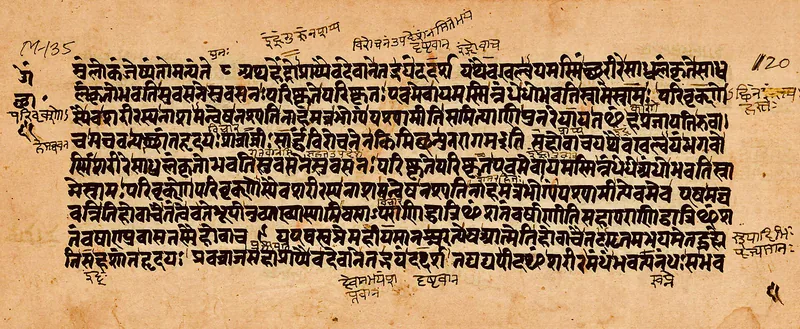
These passages contain the seed of later doctrine: a centre from which channels radiate, a single privileged channel leading upward to liberation, and a self that moves through the channels in different states of consciousness. What they lack is the spinal axis with its sequence of lotuses. The early texts are discussed in the Vedas and Upanishads.
Ida, Pingala and Sushumna§
In the tantric and hatha texts the centre of the system moves from the heart to an axis running from the base of the trunk to the crown. The Haṭhayogapradīpikā repeats the figure of 72,000 channels; the Śiva Saṃhitā gives 350,000, of which fourteen are principal and three supreme. A common list of ten main channels, found in Nāth sources, adds gāndhārī, hastijihvā, pūṣā, yaśasvinī, alambuṣā, kuhū and śaṅkhinī, which run to the eyes, ears, mouth and organs of excretion and generation.
The three supreme channels are iḍā on the left, piṅgalā on the right and suṣumnā in the centre. In the usual account iḍā and piṅgalā begin near the base of the spine and end at the left and right nostrils, which is why the alternation of breath between the nostrils was read as a sign of which channel was active. Modern diagrams often show the two side channels crossing at each chakra like the snakes of a caduceus; older texts more often describe them simply running to either side. Ordinary breathing is said to flow through the side channels; the aim of yoga is to make it enter suṣumnā, where, according to the Haṭhayogapradīpikā, the mind becomes still.
Sun, moon and the three rivers§
Iḍā is lunar, pale and cooling; piṅgalā is solar, red and heating. The Haṭhayogapradīpikā identifies them with the sacred rivers Gaṅgā and Yamunā, and later writers make suṣumnā the hidden Sarasvatī. The point where the three meet, often placed between the eyebrows at the centre Ajñā, is called triveṇī, "the triple braid", after the confluence of the three rivers at Prayāga (Allahabad), one of India's holiest pilgrimage sites.
The inner layers of sushumna§
The Ṣaṭ-cakra-nirūpaṇa (1577), translated by John Woodroffe in The Serpent Power, describes suṣumnā as a sheath containing finer channels: within it lies the vajrā, within that the citriṇī on which the lotuses are strung, and within that the brahma-nāḍī, the channel of Brahman itself, through which Kuṇḍalinī rises. At its lower end lies the coiled goddess in Muladhara, closing the entrance with her mouth.
Prana and the Five Vayus§
Prāṇa means breath and, by extension, life. A famous Upaniṣadic story tells how the bodily faculties of speech, sight, hearing and mind quarrelled over which was the greatest; each left the body in turn and the body lived on, but when breath began to leave, all the others were dragged with it and conceded its supremacy. Breath is the life-force on which the other functions depend.
Indian physiology divides this force into five winds (vāyu), each with a characteristic direction and seat, though the texts vary in the details:
- Prāṇa, the inward and upward-moving breath, seated in the chest and heart, governing respiration.
- Apāna, the downward-moving breath, seated in the pelvis, governing excretion and birth.
- Samāna, the "equalising" breath at the navel, governing digestion and assimilation; see Manipura.
- Udāna, the upward breath at the throat, governing speech and, according to the Praśna Upaniṣad, carrying the self out of the body at death.
- Vyāna, the diffused breath that pervades the whole body and governs circulation and movement.
Many hatha texts add five secondary winds (upa-vāyu), commonly named nāga, kūrma, kṛkara, devadatta and dhanañjaya, responsible for belching, blinking, hunger or sneezing, yawning, and a residual presence said to remain in the body after death.
The Three Granthis and the Bandhas§
The central channel is not open in ordinary people. Besides the sleeping Kuṇḍalinī who blocks its lower end, the texts describe three knots: the brahma-granthi, the viṣṇu-granthi and the rudra-granthi, named after the three gods of creation, preservation and dissolution. In the scheme followed by Woodroffe and by most modern teachers they lie at the root, the heart and the brow. The Haṭhayogapradīpikā, however, ties the piercing of the three knots to stages in hearing the inner sound, which it locates in the heart, the throat and the space between the brows, so even this basic map is not fixed.
Hatha yoga's techniques for opening the channel centre on three "locks" (bandha): the root lock (mūla-bandha) at the pelvic floor, the abdominal lift (uḍḍīyāna-bandha) and the chin lock (jālandhara-bandha). They were meant to unite prāṇa and apāna, to stop the loss of the nectar believed to drip from the head, and to drive the breath into suṣumnā. Breath control (prāṇāyāma), including channel-cleansing by alternate-nostril breathing (nāḍī-śodhana) and prolonged breath retention (kumbhaka), was the main method. The Haṭhayogapradīpikā itself urges caution, comparing the breath to a lion, elephant or tiger that must be tamed slowly and warning that forced practice causes illness. Intensive breath retention and kundalini-oriented practice can be destabilising, especially for people with heart, respiratory or mental-health conditions; see kundalini yoga and hatha yoga. A gentle modern practice in the tradition's manner is described under chakra meditation.
Subtle Bodies Beyond India and Modern Interpretations§
Comparable maps exist elsewhere. Tibetan Buddhism's teaching of channels, winds and drops (rtsa rlung thig le) uses a central channel with left and right channels and a set of five root winds, closely related to the Indian Buddhist tantras discussed in Vajrayana Buddhism. Chinese medicine's meridians and the circulation of qi in Taoist internal alchemy are often compared with the nadis, but they developed independently and are not the same system. In the West, Theosophists described etheric and astral bodies, and G. R. S. Mead's The Doctrine of the Subtle Body in Western Tradition (1919) traced Neoplatonic ideas of a subtle vehicle of the soul.
From the early twentieth century, writers such as Woodroffe and Vasant Rele tried to match the nadis with the spinal cord and the sympathetic nerve chains, and the chakras with nerve plexuses. Modern research has found measurable effects of slow breathing and meditation on heart rate, blood pressure and the autonomic nervous system, and the alternation of airflow between the nostrils, the "nasal cycle", is a real physiological rhythm. But there is no scientific evidence for nadis, vayus or chakras as physical structures; they are best understood as the concepts of a contemplative tradition, describing experience in its own terms.
Frequently asked questions§
What are ida, pingala and sushumna?§
They are the three principal channels of the yogic subtle body. Iḍā, on the left, is lunar and cooling; piṅgalā, on the right, is solar and heating; and suṣumnā runs through the centre of the spine, the path along which Kuṇḍalinī is said to rise.
How many nadis are there?§
The texts disagree. The Bṛhadāraṇyaka Upaniṣad and the Haṭhayogapradīpikā give 72,000, the Śiva Saṃhitā 350,000, and the Kaṭha and Chāndogya Upaniṣads speak of 101 channels of the heart.
What are the five vayus?§
They are the five divisions of the vital breath: prāṇa (in the chest), apāna (in the pelvis), samāna (at the navel), udāna (at the throat) and vyāna (throughout the body). Each is associated with a direction of movement and a bodily function.
Are nadis the same as nerves or meridians?§
No. Early twentieth-century writers compared the nadis with nerves, and they are often compared with Chinese meridians, but each belongs to its own system of thought. There is no anatomical evidence for nadis as physical structures.
Sources and further reading§
- Upaniṣads — Patrick Olivelle, 1996
- Hatha Yoga Pradipika — Svatmarama, 15th c.
- The Shiva Samhita — James Mallinson (trans.), 2007
- The Gheranda Samhita — James Mallinson (trans.), 2004
- The Serpent Power — Arthur Avalon (Sir John Woodroffe), 1919
- Roots of Yoga — James Mallinson and Mark Singleton, 2017
- Yoga: Immortality and Freedom — Mircea Eliade, 1958
- Religion and the Subtle Body in Asia and the West: Between Mind and Body — Geoffrey Samuel and Jay Johnston (eds.), 2013
- The Doctrine of the Subtle Body in Western Tradition — G. R. S. Mead, 1919
- Light on Pranayama — B. K. S. Iyengar, 1981