Liber VIII · Eastern Mysticism · Chapter II: Hatha Yoga
Hatha Yoga Pradipika: Svatmarama's Classic Text Explained
The Hatha Yoga Pradipika of Svatmarama explained: its date and sources, the four chapters on asana, pranayama, mudra and samadhi, and its modern translations.

The Hatha Yoga Pradipika ("Lamp on Hatha Yoga") is a Sanskrit manual compiled by the yogi Svatmarama, probably in the fifteenth century, that gathered the methods of the earlier hatha tradition into four chapters on posture, breath control, seals and meditative absorption. It is the best-known classical text of hatha yoga and the source most often cited for the original meaning of practices now taught in yoga studios worldwide.
Svatmarama, the Nath Lineage and the Date of the Text§
Svatmarama, whose name means "one who delights in his own self", tells us almost nothing about himself. He opens by saluting Adinatha, the "First Lord", a name of Shiva regarded as the original teacher of hatha yoga, and then lists some thirty great adepts (mahasiddhas) who, "having broken the rod of time", wander the universe. The list begins with Adinatha, Matsyendra and Goraksha, the founding figures of the Nath order of yogis, and places the author within that ascetic milieu. The broader story of the Naths and the emergence of the "yoga of force" is told in the hatha yoga guide.
The work is usually dated to around the middle of the fifteenth century. The reasoning is relative: it quotes or adapts texts known to be earlier, such as the Dattatreyayogashastra, the Amaraughaprabodha, the Vivekamartanda and the Khecarividya, and it is itself quoted by later works. Mallinson's research shows that Svatmarama drew together material from rival traditions, including methods for preserving the vital essence (bindu) and tantric techniques for raising kundalini, and organised them into one coherent system. The Pradipika's achievement was therefore less invention than synthesis: it fixed the name "hatha yoga" for a body of practice that had been described under several labels.
Most manuscripts give four chapters (upadesha) of roughly 390 verses in total. An expanded recension in ten chapters also survives, and verse numbering differs between editions. A widely used Sanskrit commentary, the Jyotsna ("Moonlight") of Brahmananda, dates from the nineteenth century.
Chapter One: Postures, Place and Diet§
The first chapter opens with a statement of purpose that frames everything after it: hatha yoga is taught solely for the sake of raja yoga. Physical technique is a means to stillness of mind, not an end. Svatmarama advises keeping the practice secret and describes the ideal setting: a small hut (matha) in a well-governed, peaceful country, with a small door, free of holes and crevices, kept clean, and far from rocks, fire and water.
He lists six things that ruin yoga, among them overeating, overexertion, idle talk, rigid adherence to rules, too much company and restlessness, and six that bring success, including enthusiasm, courage, patience, true knowledge and determination. A section on moderate eating (mitahara) recommends simple, nourishing food taken in moderation and lists foods to avoid; it is a guide to sobriety rather than to fasting, which the text discourages for the beginner.
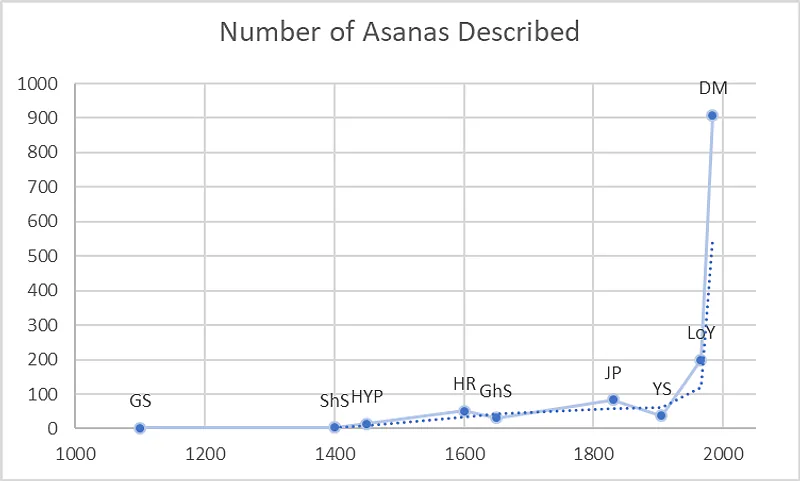
Fifteen postures (asana) are then described. Shiva is said to have taught eighty-four, but the text explains only a selection: the auspicious pose (svastikasana), the cow-face pose, the hero pose, the tortoise, the cockerel, the bow, the twist named after Matsyendra, the seated forward bend, the peacock, the corpse pose, and four seated postures, of which the accomplished pose (siddhasana) and the lotus (padmasana) are praised as the best. The seated forward bend is credited with making the breath flow in the central channel; the peacock is said to strengthen digestion. Several are what modern teachers would call meditation seats rather than exercises.
Chapter Two: Cleansing and Breath Retention§
The second chapter turns to breath, and its opening verses state the principle on which the whole system rests: when the breath moves, the mind moves; when the breath is still, the mind is still. Breath and mind are treated as two aspects of one restless force, so that mastering one steadies the other. The practice is said to purify the network of channels (nadi) described in the article on nadis, prana and the subtle body.
Svatmarama recommends six cleansing practices (shatkarma) for those with an excess of fat or phlegm: dhauti, basti, neti, trataka (steady gazing), nauli (abdominal churning) and kapalabhati. He reports that some teachers consider breath control sufficient on its own. The core of the chapter is kumbhaka, breath retention, of which eight varieties are named, including suryabhedana, ujjayi, shitali, bhastrika and bhramari, the last named after the humming of a bee. The final goal is kevala kumbhaka, a spontaneous suspension of breath said to arise without effort.
The text is notably frank about danger. It compares the breath to a lion, elephant or tiger that must be tamed slowly, warning that otherwise it injures the practitioner, and it lists hiccups, asthma, cough and pains in the head, ears and eyes among the results of improper practice. These descriptions are historical; the forceful retentions they describe were meant to be learned gradually under a teacher, and they are not suitable for self-instruction. Anyone curious about breathwork today should keep to gentle, natural breathing unless guided by a qualified teacher, and should consult a doctor if they have heart, lung or blood-pressure conditions, are pregnant, or have a history of mental illness.
Chapter Three: Mudras, Bandhas and the Awakening of Kundalini§
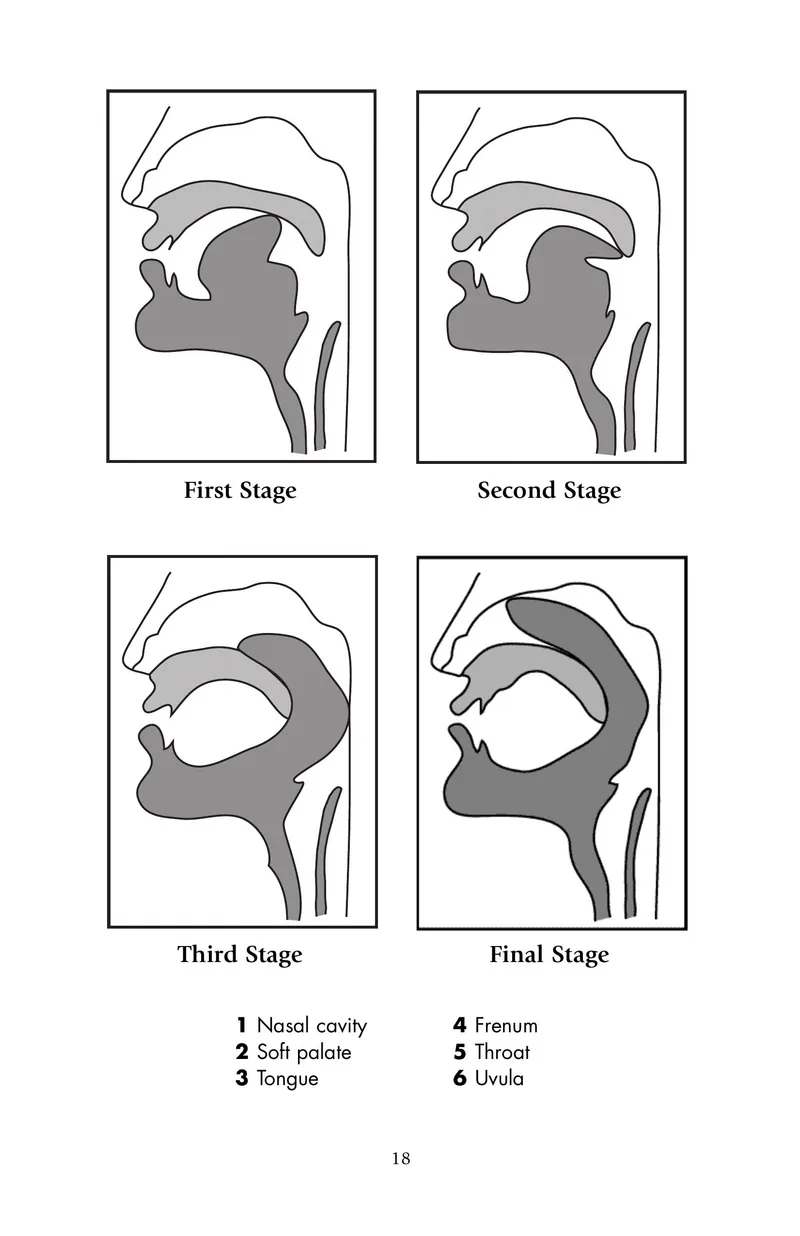
The third chapter, the longest, describes ten mudras, "seals" that combine posture, breath and muscular contraction to direct the vital force. They are mahamudra, mahabandha, mahavedha, khecari, uddiyana, mulabandha, jalandharabandha, viparitakarani, vajroli and shakticalana. The three locks (bandha) at the perineum, abdomen and throat appear here, and so does khecari mudra, in which the tongue is turned back into the cavity above the palate, a practice that traditionally involved a gradual lengthening of the tongue and that Mallinson studied in detail in his edition of the Khecarividya.
The chapter's aim is stated in tantric language: the goddess kundali sleeps coiled at the base of the central channel, blocking the way, and the mudras rouse her so that she enters the sushumna and rises. The practices called vajroli, sahajoli and amaroli concern the control and reabsorption of bodily fluids, reflecting the older hatha concern with preserving bindu. Some early English translators abridged or omitted these verses; modern scholars treat them as important evidence for the ascetic and alchemical background of the tradition, discussed in David Gordon White's The Alchemical Body.
Chapter Four: Nada, Laya and Samadhi§
The final chapter returns to the goal announced at the start. It gives a long list of names that the text treats as synonyms for the highest state, among them raja yoga, samadhi, unmani, laya ("dissolution"), shunya ("void"), amanaska ("no-mind"), jivanmukti (liberation while living) and turiya, the "fourth" state beyond waking, dream and deep sleep. When the vital breath flows through the central channel and the mind dissolves, the text says, the yogi reaches a condition beyond time and death.
A large part of the chapter is devoted to nadanusandhana, attending to the inner sound, which Svatmarama attributes to Goraksha as the best of all methods of absorption. The yogi, seated with the ears closed, listens inwardly and passes through four stages (arambha, ghata, paricaya, nishpatti) as three "knots" (granthi) associated with Brahma, Vishnu and Rudra are pierced. The sounds heard are compared to the ocean, thunder, drums, a conch, a bell, a flute and the hum of bees. The text also describes shambhavi mudra, an inward gaze with the eyes outwardly open, linking the chapter to the wider history of meditation in Eastern traditions.
Translations and the Modern Afterlife of the Pradipika§
The Pradipika entered English in the late nineteenth century, including a translation by Srinivasa Iyangar issued in Bombay in 1893 under Theosophical auspices, and the version by Pancham Sinh published in Allahabad in 1914. Hans-Ulrich Rieker's German rendering (1957) reached a wide public, and in India the Kaivalyadhama institute at Lonavla issued a critical edition in 1970. The Bihar School of Yoga's edition with commentary by Swami Muktibodhananda (1985) and Brian Dana Akers's plain translation (2002) are widely read by practitioners.
Modern postural yoga, as Mark Singleton has shown, owes far more to twentieth-century physical culture than to the fifteen asanas of this text. Yet the Pradipika lent the new movement a classical pedigree, and teachers such as those of the Bihar School and Kaivalyadhama read it alongside Patanjali, whose more philosophical Yoga Sutras say almost nothing about technique. Scholarship since 2000, especially the Hatha Yoga Project led by Mallinson, has returned the text to its historical setting among Nath ascetics, tantric ritualists and wandering yogis.
Frequently asked questions§
Who wrote the Hatha Yoga Pradipika?§
It was compiled by Svatmarama, a yogi who places himself in the lineage of Matsyendra and Goraksha of the Nath tradition. Nothing certain is known of his life, and the text is usually dated to around the fifteenth century.
How many asanas are in the Hatha Yoga Pradipika?§
It describes fifteen postures, while mentioning a tradition that Shiva taught eighty-four. Most are seated postures suited to breath control and meditation; siddhasana and padmasana are praised as the best.
What are the four chapters of the Hatha Yoga Pradipika?§
The first covers postures, diet and the setting for practice; the second, cleansing practices and breath retention; the third, the ten mudras and the awakening of kundalini; the fourth, inner sound and samadhi.
Is it safe to follow the Hatha Yoga Pradipika at home?§
The text was written for disciplined practitioners under a teacher and itself warns that wrong breath control causes illness. Forceful retentions and cleansing techniques should not be learned from a book; gentle posture and natural breathing are the sensible scope of unsupervised practice.
Sources and further reading§
- Hatha Yoga Pradipika — Svatmarama, 15th c.
- The Hatha Yoga Pradipika — Brian Dana Akers, 2002
- Roots of Yoga — James Mallinson & Mark Singleton, 2017
- The Khecarividya of Adinatha — James Mallinson, 2007
- Yoga Body: The Origins of Modern Posture Practice — Mark Singleton, 2010
- The Alchemical Body: Siddha Traditions in Medieval India — David Gordon White, 1996
- The Gheranda Samhita — James Mallinson (trans.), 2004