Liber VIII · Eastern Mysticism · Chapter IV: Kundalini
Kundalini Yoga: The Serpent Power from Tantra to the West
Kundalini yoga explained: the coiled serpent of Shaiva and Shakta tantra, hatha yoga's nadis, Woodroffe, Gopi Krishna, Jung, Yogi Bhajan and 3HO.
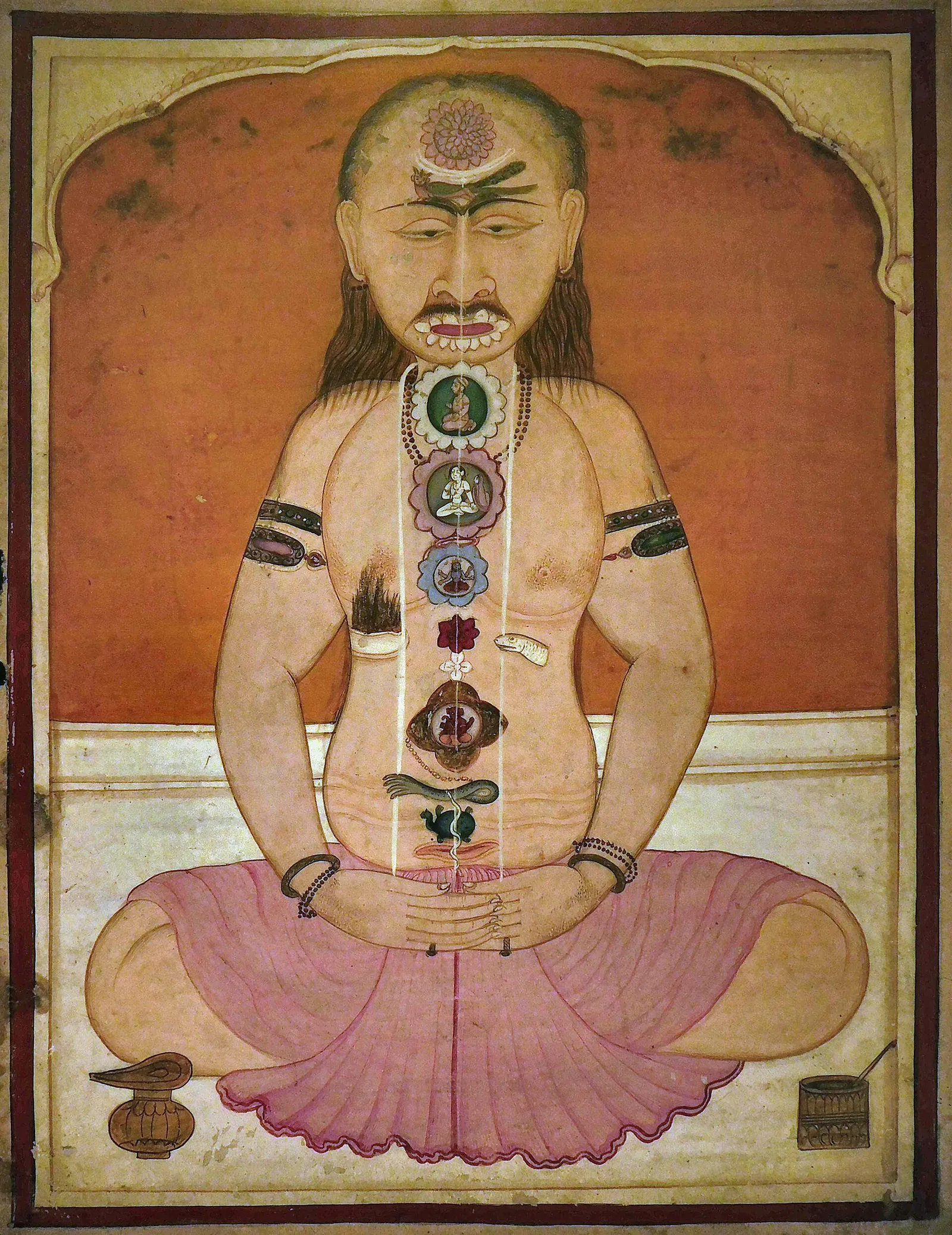
Kundalini yoga is the family of practices that aims to awaken kuṇḍalinī, a feminine power that Indian tantric texts picture as a serpent coiled at the base of the spine, and to draw it upward through a central channel until it unites with pure consciousness at the crown of the head. The idea took shape in medieval Shaiva and Shakta tantra, was absorbed into hatha yoga, and reached the West in the twentieth century through translators, psychologists and teachers whose versions differ considerably from one another.
The coiled goddess in Shaiva and Shakta tantra§
The Sanskrit word kuṇḍala means a ring, coil or earring, and kuṇḍalinī is "she who is coiled." In the tantric traditions devoted to Śiva and to the Goddess, the cosmos is understood as the self-expression of a single conscious reality, and Śakti is the dynamic power by which that reality manifests. The human body was treated as a small-scale replica of the cosmos, so the same power that unfolds the universe was located within the practitioner. In her latent state she sleeps, wrapped around a central point and blocking the entrance to the central channel; awakened, she rises, and her journey reverses the process of manifestation, dissolving the elements back into their source.
Scholars place the development of the concept in the Shaiva tantric literature of the later first millennium CE. Texts of the Kaula traditions and of the goddess Kubjikā, whose cult made the serpentine goddess especially prominent, gave it detailed treatment. The great Kashmiri exegete Abhinavagupta (c. 950–1016) discussed kuṇḍalinī in a subtle, largely contemplative register, describing her movements as phases of awareness rather than as a physical sensation climbing the spine. The French scholar Lilian Silburn's study of these Kashmiri sources remains one of the best introductions to this earlier, more philosophical understanding. For the wider setting of these schools, see our overview of tantra's history and practice.
Kundalini in the hatha yoga texts§
Hatha yoga, the "yoga of force," emerged as a recognisable system between roughly the eleventh and fifteenth centuries. According to James Mallinson and Mark Singleton, the earliest hatha methods were chiefly concerned with preserving bindu, the vital essence identified with semen, and the practice of raising kuṇḍalinī was integrated from Kaula tantra somewhat later. By the time of Svātmārāma's Haṭhayogapradīpikā (fifteenth century), the awakening of kuṇḍalinī had become one of hatha yoga's central goals, and later works such as the Śiva Saṃhitā and the Gheraṇḍa Saṃhitā continued the theme.
Suṣumnā, iḍā and piṅgalā§
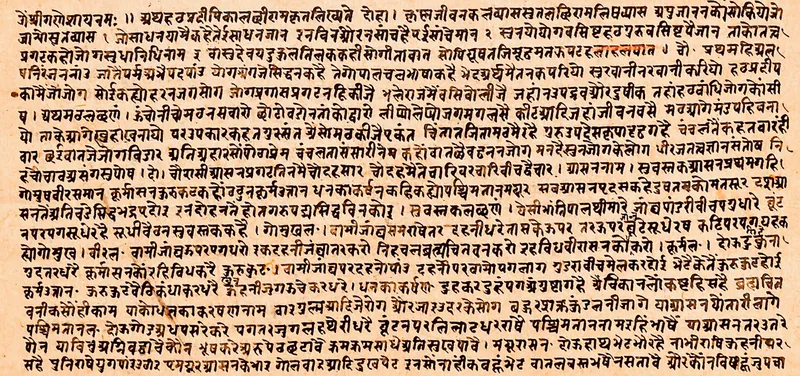
The hatha texts describe a network of channels (nāḍī), often numbered at 72,000, through which vital breath (prāṇa) circulates. Three are paramount. Iḍā, on the left, is associated with the moon and cooling; piṅgalā, on the right, with the sun and heat; and between them runs suṣumnā, the central channel, which in ordinary people is closed. The yogic project is to draw prāṇa out of the two side channels and force it into suṣumnā. When this succeeds, the texts say, kuṇḍalinī wakes and enters the central channel, piercing a series of centres or lotuses (cakra) and three "knots" (granthi) associated with Brahmā, Viṣṇu and Rudra, before reaching the thousand-petalled lotus at the crown. Our article on the history of the chakras traces how those centres were counted and coloured over time.
The techniques described§
The methods named in these texts include breath retention (kumbhaka), the three "locks" (bandha) at the perineum, abdomen and throat, the sealing gestures called mudrā, and a practice known as śakticālana, "stirring the power." These are described in the sources as demanding disciplines to be learned from a guru, and the texts themselves warn that incorrect practice causes illness. This article describes them historically rather than as instruction. Comparable ideas of channels, inner fire and an upward-moving vital force appear in Chinese Taoist internal alchemy, though the two systems developed independently and should not be collapsed into one.
Woodroffe's The Serpent Power and the Western reception§
The book that introduced kundalini to most Western readers was The Serpent Power (1919), published under the pseudonym Arthur Avalon by Sir John Woodroffe (1865–1936), a judge of the Calcutta High Court. Working with Indian collaborators, Woodroffe translated the Ṣaṭ-cakra-nirūpaṇa ("Description of the Six Centres"), a 1577 work by the Bengali tantric Pūrṇānanda, together with a short text on the five-fold footstool of the guru, and wrapped them in a long introduction that defended tantra against the contempt of colonial scholars and missionaries.
Woodroffe's presentation was learned but selective. He gave the Bengali Shakta system of six centres plus the crown lotus an authority it had never held across Indian traditions as a whole, and his book became the template for almost every later Western account. Theosophists, members of occult orders and, later, popular yoga writers drew on it directly or indirectly, often detaching the imagery from the ritual and devotional setting it had in the original text.
Gopi Krishna and the experiential turn§
A very different kind of source appeared with the autobiography of Gopi Krishna (1903–1984), a Kashmiri civil servant who described a sudden awakening during meditation in 1937 followed by years of physical and psychological turmoil, including sensations of heat, insomnia and fear that he was losing his mind, before the experience stabilised. His book Kundalini: The Evolutionary Energy in Man was published in India in 1967 and in the United States in 1970 with a psychological commentary by James Hillman.

Gopi Krishna argued that kundalini was a biological mechanism driving the evolution of human consciousness and genius, and he called for scientific research into it. Whatever one makes of that thesis, his candid account of distress shifted attention from textual systems to lived experience, and it became a reference point for later discussions of difficult awakenings.
Jung's 1932 seminar on kundalini yoga§
In October 1932 the Indologist Jakob Wilhelm Hauer gave lectures on yoga to the Psychological Club in Zurich, and C. G. Jung followed with a seminar of his own interpreting the kundalini symbolism, drawing heavily on Woodroffe. The notes were circulated privately and published in 1996 as The Psychology of Kundalini Yoga, edited by Sonu Shamdasani.
Jung read the ascent through the centres as a symbolic map of individuation, the process by which the psyche moves toward wholeness. He also cautioned that Westerners should not simply imitate Indian practices, and that the imagery was best understood psychologically. His reading was influential, and it began the long habit of treating the chakras as stages of personal psychological development, an interpretation that sits at some distance from the tantric sources.
Other twentieth-century Indian teachers carried kundalini to wider audiences in their own idioms. Swami Sivananda of Rishikesh published a book titled Kundalini Yoga in the 1930s, and Swami Muktananda's Siddha Yoga movement, active in the West from the 1970s, emphasised śaktipāt, the awakening of kundalini through the grace of the guru.
Yogi Bhajan, 3HO and "Kundalini Yoga as taught"§
For many people today, "Kundalini Yoga" means the system introduced to North America by Harbhajan Singh Puri, known as Yogi Bhajan (1929–2004), who arrived from India in 1968 and in 1969 founded 3HO, the Healthy, Happy, Holy Organization. His classes combined dynamic exercises called kriyas, rapid "breath of fire," chanting, meditation and Sikh-derived devotional elements, and his students were known for white clothing and turbans. The movement grew into an international network with associated businesses and a teacher-training system.
Yogi Bhajan presented his teaching as an ancient, formerly secret lineage. Historians, notably Philip Deslippe, have argued instead that it was a modern synthesis drawing on hatha yoga he learned in India, on Sikh practice and on his own innovations, and that the claimed lineage cannot be documented.
In 2020 his former secretary Pamela Saharah Dyson published a memoir describing years of sexual and psychological abuse, and other former followers came forward with similar accounts. An independent investigation commissioned by the organisation's leadership reported later that year that it found many of the allegations more likely than not to be true. The findings prompted resignations, the renaming of some institutions and a broad debate among teachers about whether and how to continue teaching material attributed to him. Some practitioners continue under revised codes of conduct; others have left the tradition.
Kundalini experiences, "kundalini syndrome" and mental health§
Since the 1970s a literature has grown up around intense experiences that people attribute to kundalini: involuntary movements, sensations of heat or electricity along the spine, strong emotions, sleep disruption and altered perception. The psychiatrist Lee Sannella collected case reports, and Stanislav and Christina Grof grouped such episodes under the term "spiritual emergency." The phrase "kundalini syndrome" is used informally for these cases; it is not a formal psychiatric diagnosis, although since 1994 the DSM has included a category for "religious or spiritual problem" that clinicians may use.
A measured view holds two things together. Many practitioners report meaningful and benign experiences, and traditional sources expect unusual sensations along the way. At the same time, symptoms such as persistent insomnia, panic, dissociation, intrusive thoughts or loss of contact with ordinary reality are reasons to stop intensive breath and meditation practice and consult a qualified medical or mental-health professional, ideally one familiar with meditation-related difficulties. People with a history of psychosis, bipolar disorder or severe trauma are generally advised to approach vigorous breathwork with particular caution and with professional guidance.
Frequently asked questions§
What does the word kundalini mean?§
Kuṇḍalinī comes from the Sanskrit kuṇḍala, a coil or ring, and means "the coiled one." In tantric texts she is a form of the goddess Śakti, imagined as a serpent lying coiled at the base of the subtle body. Awakening her is presented as a reunion of Śakti with Śiva, pure consciousness.
Is Kundalini Yoga the same as kundalini in the old texts?§
Not exactly. Medieval tantric and hatha yoga texts describe raising kundalini through breath control, locks and meditation within a guru-led ritual setting. "Kundalini Yoga" as taught by Yogi Bhajan from 1969 is a modern system that borrows that vocabulary but combines it with new exercises, chanting and Sikh devotional elements.
What are ida, pingala and sushumna?§
They are the three principal channels (nāḍī) of the subtle body in hatha yoga. Iḍā on the left is lunar and cooling, piṅgalā on the right is solar and heating, and suṣumnā is the central channel through which kundalini is said to rise.
Is kundalini awakening dangerous?§
Traditional texts warn that improper practice can cause illness, and modern clinicians have documented distressing experiences associated with intensive practice. Most people who practise gently report no serious problems, but anyone experiencing persistent insomnia, panic or dissociation should pause practice and seek qualified help.
Sources and further reading§
- The Serpent Power — Arthur Avalon (Sir John Woodroffe), 1919
- Haṭhayogapradīpikā — Svātmārāma, fifteenth century (various translations)
- Roots of Yoga — James Mallinson and Mark Singleton, 2017
- Kundalini: Energy of the Depths — Lilian Silburn, 1988 (English translation)
- Kundalini: The Evolutionary Energy in Man — Gopi Krishna, 1967
- The Psychology of Kundalini Yoga — C. G. Jung, ed. Sonu Shamdasani, 1996
- Spiritual Emergency: When Personal Transformation Becomes a Crisis — Stanislav Grof and Christina Grof (eds.), 1989
- The Alchemical Body: Siddha Traditions in Medieval India — David Gordon White, 1996