Liber VIII · Eastern Mysticism · Chapter I: Chakras & Subtle Body
History of the Chakras: From Tantric Texts to the Rainbow Seven
The history of the chakras: varied systems in tantric texts, the Ṣaṭ-cakra-nirūpaṇa, Woodroffe, Leadbeater's Theosophy and the modern rainbow seven.

The chakras (Sanskrit cakra, "wheel" or "circle") are centres of the subtle body described in Indian tantric and yogic texts as points where channels converge and where deities, sounds and elements are installed through visualisation. The familiar list of seven chakras, each tied to a rainbow colour and a psychological theme, is a twentieth-century synthesis: the premodern sources describe many different systems with four, five, six, nine, twelve or more centres, and with different colours, symbols and purposes.
What the word cakra meant in early Indian sources§
Cakra is an ancient word. In the Vedic hymns it names a chariot wheel; in Buddhist and Hindu imagery it is the wheel of dharma or the discus of Viṣṇu; and in ritual contexts it can mean a circle of initiates or a diagram. Its use for a centre in the body is a later, specifically tantric development. Older Upaniṣadic texts speak of channels (nāḍī) radiating from the heart, and of the breath moving through them, but they do not present a stacked sequence of wheels along the spine.
The tantric innovation was to treat the body as a ritual space. In the practice of nyāsa, the practitioner "places" mantras and deities on parts of the body, transforming it into a divine body. Chakras grew out of this logic: they were sites for visualisation and mantra installation, rather than anatomical organs or self-existent energy wheels waiting to be discovered. For the broader setting, see tantra's history and practice.
Many systems, many numbers: chakras in tantric texts§
Early tantric scriptures disagree widely about how many centres there are and where they lie. Some Buddhist tantras, such as the Hevajra Tantra, describe four centres at the navel, heart, throat and head, associated with different bodies of the Buddha and different kinds of bliss. The Tibetan "Six Yogas" traditions and the Kālacakra system work with variations on this pattern, often five or six centres, together with the central and side channels.
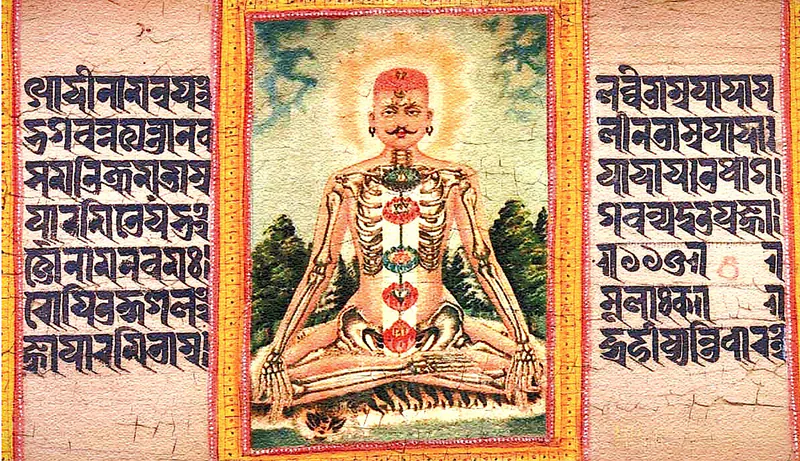
Within Hindu tantra the picture is equally varied. The Kubjikāmata tradition is often cited for an early presentation of six centres. Other works list nine, ten, twelve or sixteen, sometimes including points above the head or within the palate. Some texts call these points ādhāra ("supports"), granthi ("knots") or lakṣya ("targets of meditation") rather than cakra, and different schools located them according to their own ritual needs. The scholar of tantra Christopher Wallis has stressed that these systems were prescriptive rather than descriptive: each was a template for a particular practice, not a claim that the body objectively contains exactly that many centres.
The hatha yoga synthesis§
Hatha yoga texts from roughly the eleventh to fifteenth centuries absorbed the chakras along with the practice of raising kundalini. Here the centres became stations on kundalini's ascent through the central channel (suṣumnā). Even so, hatha texts disagree on details, and some mention chakras only in passing. The Gorakṣaśataka and later works attributed to the Nāth tradition give lists of six or nine centres, and the Siddha Siddhānta Paddhati names nine.
The Ṣaṭ-cakra-nirūpaṇa and the six-centre system§
The single text most responsible for today's standard sequence is the Ṣaṭ-cakra-nirūpaṇa ("Description of the Six Centres"), composed in 1577 by Pūrṇānanda, a Bengali Shakta tantric. It forms one chapter of a larger work, the Śrītattvacintāmaṇi. The text describes six centres plus the thousand-petalled lotus at the crown:
- Mūlādhāra ("root support") at the base of the spine, a four-petalled lotus containing the square of earth and the coiled kuṇḍalinī.
- Svādhiṣṭhāna ("own seat") near the genitals, six petals, water.
- Maṇipūra ("city of jewels") at the navel, ten petals, fire.
- Anāhata ("unstruck," referring to unstruck sound) at the heart, twelve petals, air.
- Viśuddha ("purified") at the throat, sixteen petals, ether or space.
- Ājñā ("command") between the eyebrows, two petals, the mind.
- Sahasrāra, the thousand-petalled lotus above or at the crown, regarded in the text as the abode of Śiva rather than a seventh chakra on a par with the others.
Each lotus carries specific Sanskrit letters on its petals, a seed mantra, presiding deities, an animal vehicle and a geometric shape for its element. The colours in the text are not the rainbow sequence: the petals of the root lotus are described as red, those of the heart as a vermilion or deep red, the throat as smoky purple, and so on. The system is a liturgy of visualisation, with each centre meditated upon in turn as kuṇḍalinī dissolves the elements into one another.
Woodroffe's The Serpent Power§
Sir John Woodroffe (1865–1936), writing as Arthur Avalon, translated the Ṣaṭ-cakra-nirūpaṇa in The Serpent Power (1919), with a lengthy introduction and plates of the lotuses painted for the book. Because it was one of the few serious English studies of tantra available, it acquired enormous authority. The six-plus-one system became, for Western readers, "the" chakra system, and later writers reproduced Woodroffe's names, petal counts and diagrams without always realising that they came from one sixteenth-century Bengali lineage among many.
Theosophy and Leadbeater's chakras§
Before Woodroffe, the Theosophical Society had already begun to discuss subtle centres, mixing Indian terms with Western occult ideas of etheric and astral bodies. Helena Blavatsky referred to them sparingly and with warnings. The decisive Theosophical treatment came with C. W. Leadbeater's The Chakras (1927), which presented them as spinning vortices of etheric energy that he claimed to observe clairvoyantly.
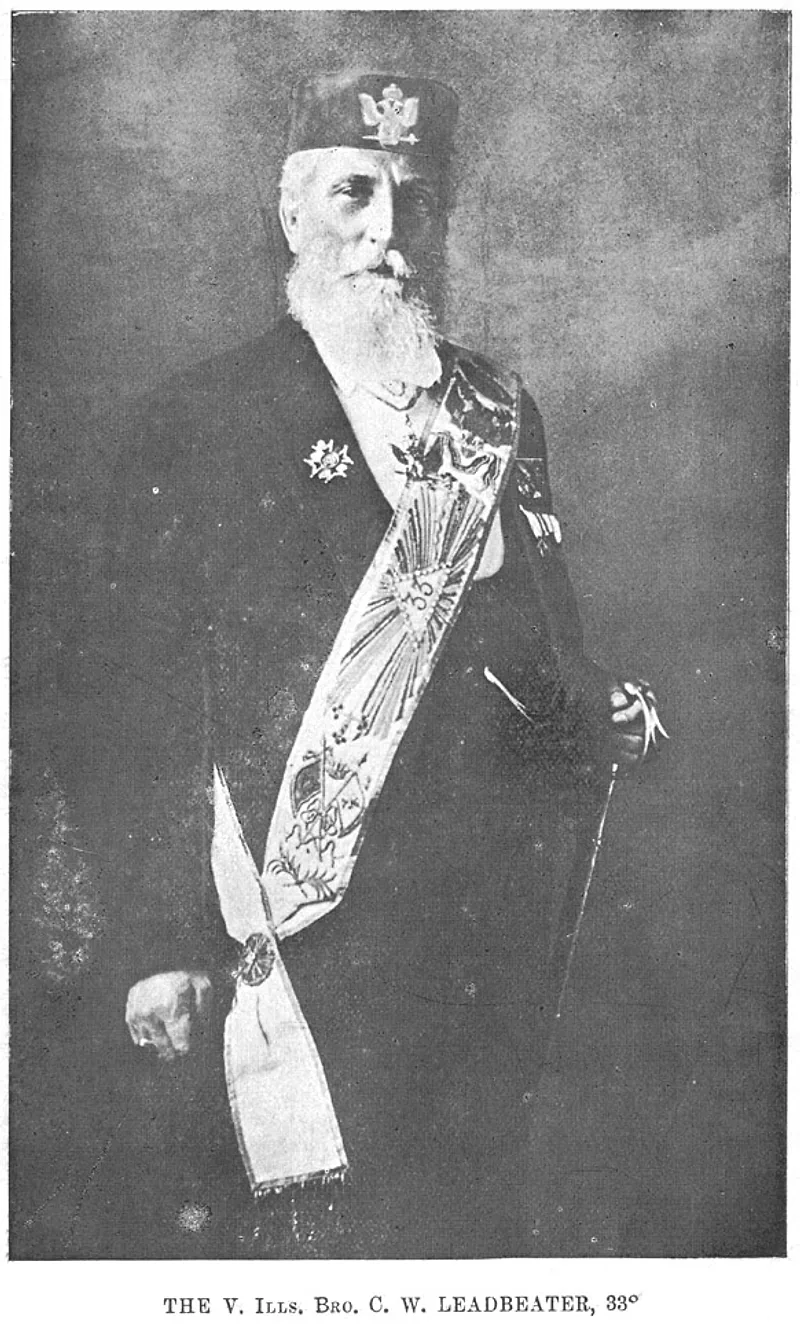
Leadbeater made several notable changes. He placed one centre at the spleen rather than the genitals, a choice he justified on moral grounds, and he described each centre in terms of colours and numbers of "spokes" based on his own visions. He related the centres to glands and nerve plexuses, a correlation also pursued by other writers of the period who wished to reconcile yoga with physiology. His book's coloured plates, painted by Edward Warner, became widely reproduced. The Theosophical idea that chakras are energy organs perceptible to the psychic eye, rather than visualisation templates, is a major source of the modern understanding.
The modern rainbow-coloured seven-chakra synthesis§
The system most people encounter today, in yoga studios, wellness books and online, typically assigns the seven centres the colours of the rainbow in order from red at the root to violet or white at the crown, and links each to a psychological or life theme: survival, sexuality, willpower, love, communication, intuition and spirituality. It often adds correspondences to endocrine glands, crystals, essential oils, musical notes and the stages of personal development.
Historians of modern esotericism trace this synthesis largely to the American alternative-spirituality scene of the 1970s. The rainbow colour sequence is generally associated with Christopher Hills, whose book Nuclear Evolution (in its expanded 1977 edition) correlated the chakras with the visible spectrum. The psychological mapping owes much to the Jungian reading of the chakras inaugurated in C. G. Jung's 1932 seminar, and to the human potential movement around the Esalen Institute. Later best-sellers such as Anodea Judith's Wheels of Life (1987) systematised these strands into the form now standard in popular literature. Each step is traceable, and none appears in the premodern Sanskrit sources.
Scholarly critique and how to read the chakras today§
Scholars of tantra and yoga, including Christopher Wallis, Mark Singleton, Gavin Flood and David Gordon White, have made several recurring points. First, there was never a single Indian chakra system; the six-plus-one model is one among dozens. Second, the original purpose of the chakras was ritual and meditative: they were installed and visualised to divinise the body and to guide kundalini, not diagnosed or "balanced" as energy organs. Third, the elements most familiar today, from rainbow colours to psychological themes and endocrine correlations, are modern additions with identifiable authors.
None of this need diminish modern practice. Traditions change, and the modern chakra system is now itself a living part of global spirituality. But clarity about history helps readers distinguish between what the Sanskrit sources say and what contemporary teachers have built upon them. Comparable maps of inner centres exist elsewhere, notably the dantian of Taoist internal alchemy and the subtle centres (laṭāʾif) of some Sufi orders, but each belongs to its own tradition and history.
Frequently asked questions§
How many chakras are there?§
There is no single answer in the traditional sources. Buddhist tantras often describe four or five centres, Hindu tantras list anywhere from five to more than twelve, and the now-standard seven derives from the six centres plus crown lotus of the Ṣaṭ-cakra-nirūpaṇa (1577).
Where do the rainbow chakra colours come from?§
They are a modern Western development, usually traced to 1970s writers such as Christopher Hills. The Sanskrit texts assign colours to the lotus petals and elements, but these do not follow the rainbow spectrum from red to violet.
What did Leadbeater contribute to chakra theory?§
C. W. Leadbeater's The Chakras (1927) reframed the centres as spinning etheric vortices he claimed to see clairvoyantly. He moved one centre to the spleen, linked the chakras to glands and nerves, and supplied colour plates that strongly influenced later Western depictions.
Are chakras mentioned in the Vedas?§
The Vedas use the word cakra for a wheel, but not for a series of centres in the body. Body-centred chakra systems are a tantric development of roughly the second half of the first millennium CE onward.
Sources and further reading§
- The Serpent Power — Arthur Avalon (Sir John Woodroffe), 1919
- The Chakras — C. W. Leadbeater, 1927
- The Psychology of Kundalini Yoga — C. G. Jung, ed. Sonu Shamdasani, 1996
- Tantra Illuminated — Christopher D. Wallis, 2012
- Roots of Yoga — James Mallinson and Mark Singleton, 2017
- The Tantric Body: The Secret Tradition of Hindu Religion — Gavin Flood, 2006
- Wheels of Life — Anodea Judith, 1987
- Yoga Body: The Origins of Modern Posture Practice — Mark Singleton, 2010