Liber VIII · Eastern Mysticism · Chapter I: Chakras & Subtle Body
Chakra Meditation: History, Tradition and a Simple Practice
Chakra meditation explained: its roots in tantric nyasa and bhuta-shuddhi, the bija mantras, modern colour practice and a simple, safe practice with cautions.

Chakra meditation is the practice of placing attention, mantra or visualisation on a series of centres in the body, usually from the base of the spine to the crown of the head. It descends from tantric rituals in which practitioners installed syllables and deities in the body and meditatively dissolved the elements one into another; modern forms, which often add rainbow colours and psychological themes, date from the twentieth century. A simple version, with gentle attention and natural breathing, can be practised calmly and safely.
What Chakra Meditation Is§
In the broad sense, chakra meditation means any contemplative practice that uses the centres of the subtle body as supports for attention. In the history of the chakras these centres were never simply anatomical points: they were places in a ritual body, where the practitioner set mantras, imagined deities and traced the ascent of the goddess Kuṇḍalinī from the root to the crown. Chakra meditation, in this older sense, was a way of transforming one's sense of the body into a divine body.
Today the phrase covers a wide range of practices: silent attention to each region in turn, chanting the seed syllables, visualising coloured light, guided meditations with music, and therapeutic exercises in which each chakra stands for a psychological theme. Some of these are close to traditional forms; others are modern inventions. Distinguishing them does not mean dismissing the newer forms, but it helps practitioners understand what they are doing and where it comes from. For meditation more broadly, see meditation across traditions.
Tantric Roots: Nyasa, Bhuta-shuddhi and Visualisation§
The earliest practices that resemble chakra meditation are tantric rites of preparation. In nyāsa, the practitioner touches or attends to parts of the body while reciting mantras, "placing" the letters of the alphabet, the names of deities or the parts of a mantra on the limbs and organs. The purpose, as Gavin Flood has shown in his study of the tantric body, was to replace the ordinary, impure body with a body made of mantra, fit to worship the deity and, in a sense, to become it.
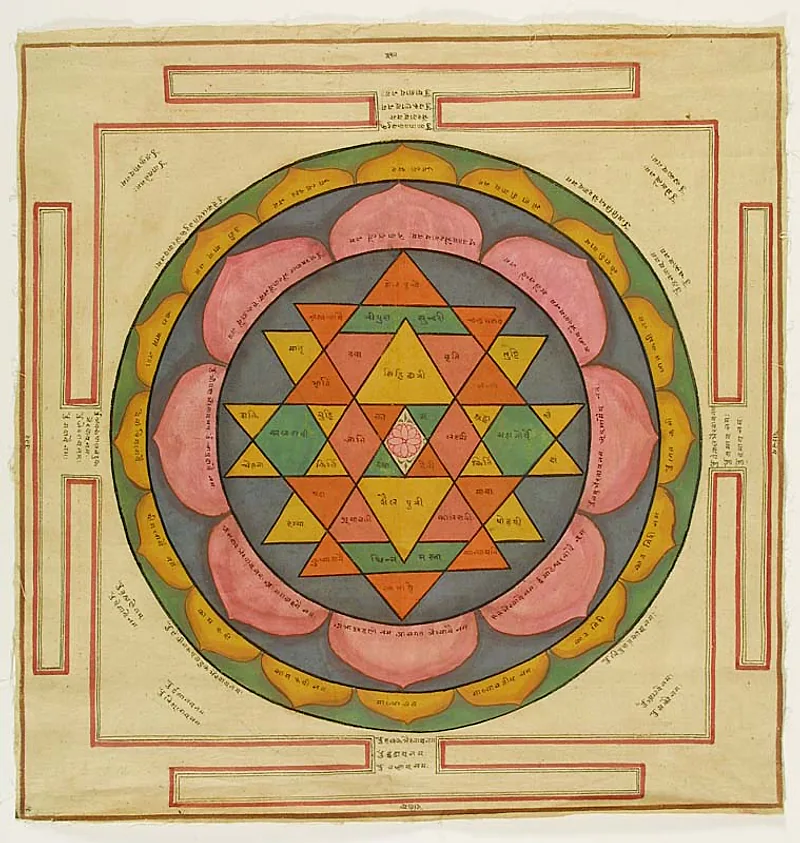
Closely related is bhūta-śuddhi, "the purification of the elements", a standard part of tantric worship described in ritual manuals such as the Śāradātilaka. The worshipper imagines the five elements in ascending order within the body, each with its geometric shape and seed syllable: a yellow square for earth (laṃ), a white crescent for water (vaṃ), a red triangle for fire (raṃ), a smoky hexagonal or six-pointed figure for air (yaṃ) and a circle for space (haṃ). Each element is dissolved into the next, subtler one, until all are absorbed into consciousness; then a new, purified body is imaginatively re-created. These are the same syllables and shapes later attached to the first five chakras.
In Buddhist tantra, comparable practices use the centres of the head, throat, heart and navel, often with the syllables oṃ āḥ hūṃ at crown, throat and heart. The deity yoga of Vajrayana Buddhism and the completion-stage yogas of the Tibetan traditions work with the centres and channels in ways that parallel, but do not copy, the Hindu systems.
The Sat-cakra-nirupana as a Meditation Manual§
The text from which the modern seven-chakra system derives, Pūrṇānanda's Ṣaṭ-cakra-nirūpaṇa of 1577, translated by John Woodroffe in The Serpent Power (1919), is essentially a guide to meditation. For each centre it describes the colour of the lotus and its petals, the letters on them, the shape and seed syllable of the element, the deity riding the seed syllable's animal, the presiding god and goddess, and the fruits of meditation. The practitioner is meant to visualise each in turn, from Muladhara through Vishuddha and Ajna to the thousand-petalled Sahasrara.
The work then describes the ascent of Kuṇḍalinī, in which each element is dissolved into the next as she passes through the lotuses: earth into water, water into fire, fire into air, air into ether, and ether into mind, until she unites with Śiva at the crown and then returns, re-creating the elements on her way down. This sequence is called laya, "dissolution", and modern authors sometimes use the term laya yoga for this kind of practice.
Two points about the traditional setting matter. First, such meditations were given within a lineage, after initiation (dīkṣā), with a teacher who supplied the mantras and corrected the practice. Second, they formed part of a disciplined way of life that included ethical rules, ritual and study. The hatha yoga texts that adopted the chakras, together with the nadis and vital breaths, added powerful techniques of breath retention and locks, practices the texts themselves said required a teacher's supervision.
Modern Chakra Meditation: Bija Mantras, Colours and Guided Practice§
In the twentieth century, chakra meditation was simplified and detached from initiation. Theosophical writers such as C. W. Leadbeater encouraged the visualisation of luminous centres, and from the 1970s writers in the human potential and New Age movements developed guided practices in which each chakra is pictured in a rainbow colour and linked with a quality such as security, creativity, will, love, expression, intuition and spiritual connection. These developments are traced in Chakras in the West.

Popular forms now include chanting the bīja syllables in sequence (laṃ, vaṃ, raṃ, yaṃ, haṃ, Oṃ, sometimes with silence for the crown), visualising coloured light, sound baths with tuned bowls, and guided recordings. Teachers in Indian lineages, such as Swami Satyananda Saraswati of the Bihar School of Yoga in Kundalini Tantra (1984), have also published systematic chakra practices that combine traditional elements with modern teaching methods. The seed syllables are traditional; the rainbow colours, the link with musical notes and the psychological themes are modern.
A Simple Chakra Meditation§
The following practice keeps to the calm, attentional side of the tradition. It uses natural breathing and silent or softly spoken syllables, and requires no special postures, fasting or breath-holding. Ten to twenty minutes is enough.
- Settle. Sit comfortably on a chair or cushion with the back upright but not rigid. Close the eyes or lower the gaze. Let the breath move naturally for a minute, without controlling it.
- Begin at the base. Rest attention lightly at the base of the spine. If you wish, repeat the syllable laṃ silently a few times, or simply notice sensation there for several breaths.
- Move upward. Shift attention to the lower abdomen (vaṃ), the navel (raṃ), the centre of the chest (yaṃ), the throat (haṃ) and the point between the eyebrows (Oṃ), spending about a minute at each. Keep the attention soft; nothing needs to be forced or "opened".
- Rest at the crown. Let attention rest at the top of the head in silence for a minute or two, with no syllable.
- Return. Bring attention back down to the heart or the base, feel the weight of the body on the seat, and open the eyes slowly before getting up.
Some practitioners prefer to stay at one centre for the whole session, often the heart, which many teachers regard as a gentle and stable place to rest. The older history of gazing and concentration at the brow is traced in Ajna and the third eye.
Safety and What the Evidence Shows§
Most people find quiet, attentional meditation of this kind calming. It is not, however, free of risk for everyone. Research on adverse effects of meditation, including a 2017 study led by Jared Lindahl and Willoughby Britton, has documented that some meditators experience anxiety, disturbing perceptions, or the re-emergence of traumatic memories, especially with intensive practice. Accounts of "kundalini" experiences, discussed in the article on kundalini yoga, describe heat, involuntary movements and strong emotions. Sensible precautions are simple: keep sessions short, avoid breath retention and forceful techniques, do not combine meditation with fasting or substances, stop if you feel distressed or unwell, and consult a doctor or mental-health professional first if you have a history of psychosis, severe trauma or seizures.
Scientific studies of meditation have measured effects on stress, attention and wellbeing, with mixed and often modest results. They do not show that chakras exist as physical structures, and there is no scientific evidence for that; claims that a meditation "balances" or "unblocks" particular chakras are statements of belief rather than findings. The traditions that created chakra meditation did not, in any case, present it as a health technique, but as a way of reimagining the body as sacred and turning attention towards the divine.
Frequently asked questions§
What are the bija mantras of the chakras?§
In the classic tantric system the seed syllables of the five elemental centres are laṃ (root), vaṃ (sacral), raṃ (navel), yaṃ (heart) and haṃ (throat), and the brow centre's seed is Oṃ. The crown lotus has no seed syllable in the Ṣaṭ-cakra-nirūpaṇa, so modern teachers often use silence there.
Is chakra meditation safe?§
Gentle attention to the centres with natural breathing is generally regarded as safe for most people. Intensive practice, breath retention and forceful techniques carry more risk, and anyone with a history of psychosis, severe trauma or seizures should seek professional advice before starting.
Is chakra meditation traditional or modern?§
Both. Visualising centres with seed syllables and dissolving the elements comes from medieval tantric practice, while rainbow colours, psychological themes, crystals and recorded guided meditations are twentieth-century additions.
Sources and further reading§
- The Serpent Power — Arthur Avalon (Sir John Woodroffe), 1919
- Introduction to Tantra Sastra — Sir John Woodroffe, 1913
- The Tantric Body: The Secret Tradition of Hindu Religion — Gavin Flood, 2006
- Layayoga: An Advanced Method of Concentration — Shyam Sundar Goswami, 1980
- Kundalini Tantra — Swami Satyananda Saraswati, 1984
- Roots of Yoga — James Mallinson and Mark Singleton, 2017
- Altered Traits — Daniel Goleman and Richard J. Davidson, 2017
- The Buddha Pill: Can Meditation Change You? — Miguel Farias and Catherine Wikholm, 2015