Liber VIII · Eastern Mysticism · Chapter I: Chakras & Subtle Body
Ajna: The Brow or Third-Eye Chakra in Tantra, Yoga and History
Ajna, the brow chakra: its two-petalled lotus, the syllables Ham and Ksham, Om, Hakini and the Itara linga in tantra, and the modern Western third-eye chakra.

Ajna (Sanskrit ājñā, "command") is the sixth of the six chakras of the classic tantric system: a two-petalled lotus between the eyebrows that is the seat of the mind (manas) rather than of any physical element. In the sixteenth-century Ṣaṭ-cakra-nirūpaṇa its white petals bear the syllables haṃ and kṣaṃ, its seed is the sacred syllable Oṃ, and it holds the Itara liṅga of Śiva and the six-faced goddess Hākinī. Its identification with the "third eye", intuition and the colour indigo belongs to the modern Western layer of chakra teaching.
Name and Meaning of Ajna§
The Sanskrit ājñā comes from the verbal root jñā, "to know", with the prefix ā-, and in ordinary usage means an order, an instruction or the authority to give one. Royal edicts and a teacher's directions are both ājñā. Woodroffe, following the commentary on the Ṣaṭ-cakra-nirūpaṇa, explains that the centre bears this name because here the command of the guru is received from above. The image is of a threshold: below it lie the elemental centres, above it the realms of subtle sound and the thousand-petalled Sahasrara, and it is at this point that the practitioner's mind becomes receptive to what comes from beyond it.
The region is also called bhrūmadhya, "the middle of the brows", a term older than the chakra systems. In some later yoga and devotional literature, especially among the Sant poets and the movements descended from them, words such as trikuṭī ("triple peak") are used for a region at or above the brow, though their meaning differs between schools. In modern English the centre is often called simply "the third eye", an identification discussed below and traced in the third eye across traditions.
Place in the Body: Between the Eyebrows§
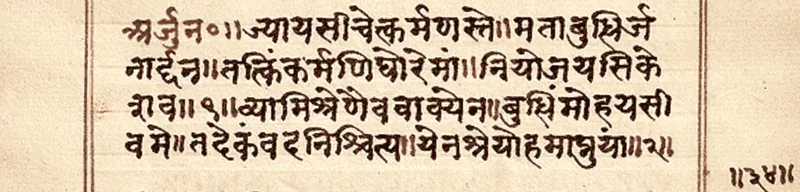
The Ṣaṭ-cakra-nirūpaṇa places the lotus between the eyebrows, within the central channel. Attention to this point is far older than Pūrṇānanda's text, as Ajna and the third eye in yoga and tantra explains in more detail. The Bhagavad Gītā (5.27) describes the sage who shuts out external contacts and fixes his gaze between the brows, and in a later passage (8.10) speaks of the dying yogin who, with steady mind, draws the vital breath to the place between the eyebrows and so reaches the supreme Person. The Ṣaṭ-cakra-nirūpaṇa echoes this when it says that the yogin who at the time of death places his breath here passes into the Supreme.
Hatha yoga texts make the brow a focus of gaze and meditation. The Haṭhapradīpikā describes śāmbhavī mudrā, in which attention is held on an inner target while the eyes remain open and unblinking, and the Gheraṇḍa Saṃhitā includes a meditation on light (jyotir-dhyāna) placed between the eyebrows. In the subtle-body anatomy of many texts, the side channels iḍā and piṅgalā, which run on either side of the central channel from the base of the spine, part at the brow towards the nostrils; commentators call this point the "released confluence" (mukta-triveṇī), as opposed to the "joined confluence" at the root. Many accounts also locate here the third and highest of the three knots (granthi) that obstruct the rising kundalini, the knot of Rudra.
Twentieth-century writers paired Ajna with the pituitary or the pineal gland, depending on the author. The pineal gland is a real endocrine organ that produces melatonin; the chakra is a feature of the tantric subtle body. There is no scientific evidence for chakras as physical structures.
The Lotus: Petals, Syllables and Bija§
The text describes the lotus as "like the moon", beautifully white, with two petals bearing the letters ha and kṣa, which are also white. These are the last two letters in the arrangement of the alphabet across the six lotuses, which together carry fifty letters: four, six, ten, twelve, sixteen and two. With Ajna the alphabet, understood in tantra as the body of the goddess as speech, is complete.
In the pericarp is a downward-pointing triangle (yoni), and within it the Itara liṅga, the third of the three liṅgas of Śiva in the subtle body (after the Svayambhū liṅga at the root and the Bāṇa liṅga at the heart). The text says it shines like a chain of lightning flashes. Also present is "the first bīja of the Vedas", the praṇava Oṃ, described as the abode of the highest power and as illuminating the central thread of the subtle body. Oṃ is therefore the seed syllable of the centre, in contrast to the element-syllables laṃ, vaṃ, raṃ, yaṃ and haṃ of the five centres below.
Above the praṇava the text and its commentators describe a series of increasingly subtle stages of sound and light: the point (bindu), the crescent (ardhacandra), the "obstructress" (nirodhikā), resonance (nāda), and further refinements leading towards the crown. Woodroffe's introduction also mentions minor lotuses above Ajna drawn from other sources. These details show that, for the tantric authors, the brow was not an end point but the entrance to a graded ascent of sound into silence.
Element, Deity and Shakti§
Ajna holds no gross element. Earth, water, fire, air and ether belong to the five lotuses below; here dwells the subtle mind (manas), and in the meditative dissolution the work describes, the elements and their qualities are absorbed into mind at this point. Later tables sometimes assign the centre mahat (the "great principle" of Sāṃkhya philosophy) or, in modern books, "light", but the Ṣaṭ-cakra-nirūpaṇa simply names it as mind's seat.
The śakti of the lotus is Hākinī. She has six faces, "like so many moons", and six arms: she holds a book, a skull, a small drum and a rosary, and makes the gestures of granting boons and dispelling fear. The text calls her pure-minded. The book and rosary point to learning and recitation, the skull and drum to the ascetic and Shaiva world of tantra. The presiding form of Śiva is the luminous Itara liṅga, and some commentators speak of the supreme Śiva (Paramaśiva) as present here in subtle form. For the wider theology of god and goddess in these texts, see tantra in Hinduism.
As with every centre, the verses end with the fruits of meditation. The yogin whose whole self is absorbed in this lotus, the text says, becomes the best of sages, all-knowing and all-seeing, versed in every scripture, and able to enter another's body at will. Such promises belong to the genre of tantric praise; they describe the prestige of the practice rather than predict ordinary results.
How the Texts Differ§
The brow lotus is far from universal in Indian subtle-body systems. The Buddhist Hevajra Tantra and related works use four main centres, at navel, heart, throat and crown, with no separate brow lotus; the head centre carries the functions that Hindu systems divide between brow and crown. Among Hindu texts, too, the number of points in the head varies, and several add further centres between brow and crown.
The Nāth Siddha Siddhānta Paddhati, with nine centres, places a centre at the palate below the brow and two further centres above it. In the Kashmir Shaiva tradition, the Vijñāna Bhairava Tantra includes several contemplations centred between the eyebrows, but frames them as momentary techniques for recognising consciousness rather than as stations on a fixed ladder. The colours also differ: Pūrṇānanda's lotus is white, while other texts and later paintings show it in various hues.
The popular equation of Ajna with Śiva's third eye, the eye of fire with which he burned the god of desire, also joins together originally separate strands. The tilaka and bindi worn on the forehead mark this point in Hindu practice, and Śiva's third eye is an ancient image, but the Ṣaṭ-cakra-nirūpaṇa does not describe the lotus as an eye.
The Modern Western Layer§
The Western "third eye chakra" was built in stages. Helena Blavatsky's The Secret Doctrine (1888) argued that the pineal gland was the atrophied remnant of an ancient organ of spiritual sight. C. W. Leadbeater's The Chakras (1927) described the brow centre as having ninety-six "spokes", divided into two halves of different colours, and associated it with clairvoyance; Theosophical and later writers variously linked it with the pituitary or the pineal. Through Tuesday Lobsang Rampa's The Third Eye (1956), a best-seller presented as a Tibetan lama's memoir but written by an Englishman, Cyril Hoskin, the idea of a surgically "opened" third eye entered popular culture.
C. G. Jung, in his 1932 seminar, read Ajna as a stage at which the psyche is experienced as the only reality and the self is united with the divine, while admitting that it lay beyond what he could describe from experience. From the 1970s the rainbow scheme gave the centre the colour indigo, and writers such as Anodea Judith in Wheels of Life (1987) linked it with light, seeing, intuition and imagination, with illusion as its characteristic distortion. Today "third eye" meditation, indigo visualisation and talk of "opening" Ajna are widespread. They are modern adaptations, best read alongside the older sources, which describe a white two-petalled lotus of mind, mantra and command. For the wider story, see Chakras in the West, and for a calm practice in the traditional manner, Chakra Meditation.
Frequently asked questions§
What does Ajna mean?§
Ājñā is Sanskrit for "command", "order" or "authority". Tradition explains the name as the place where the guru's command is received from above, at the threshold between the elemental centres and the higher states of the crown.
What is the bija mantra of the Ajna chakra?§
In the Ṣaṭ-cakra-nirūpaṇa the seed syllable of Ajna is Oṃ, "the first bīja of the Vedas". The two petals carry the syllables haṃ and kṣaṃ, which some modern books also treat as mantras of the centre.
Is the Ajna chakra the third eye?§
Modern writers commonly call it the third eye, and Hindu practice marks the brow with the tilaka or bindi. The tantric texts, however, describe Ajna as a lotus of mind rather than an eye; the "third eye chakra" of intuition and indigo light is largely a Theosophical and twentieth-century idea.
Is the Ajna chakra the pineal gland?§
No. Theosophical and later writers linked the brow centre with the pineal or pituitary gland, but the texts describe a centre in the subtle body. The pineal is a real gland that produces melatonin, and there is no scientific evidence for chakras as physical structures.
Sources and further reading§
- The Serpent Power — Arthur Avalon (Sir John Woodroffe), 1919
- The Bhagavad-Gita: Krishna's Counsel in Time of War — Barbara Stoler Miller, 1986
- The Gheranda Samhita — James Mallinson, 2004
- Vijñānabhairava or Divine Consciousness — Jaideva Singh, 1979
- Tantra Illuminated — Christopher D. Wallis, 2012
- The Secret Doctrine — Helena P. Blavatsky, 1888
- The Chakras — C. W. Leadbeater, 1927
- Rainbow Body: A History of the Western Chakra System from Blavatsky to Brennan — Kurt Leland, 2016