Liber VIII · Eastern Mysticism · Chapter X: The Third Eye
The Third Eye: History and Meaning Across Traditions
The third eye across traditions: Shiva's eye of fire, the ajna centre, the Buddha's urna, Daoist inner sight, the pineal gland and the Western occult revival.

The "third eye" is a symbol of inner or spiritual sight, usually placed on the forehead between the eyebrows. It takes many historical forms: the fiery eye of the Hindu god Śiva, the ājñā centre of yoga and tantra, the luminous tuft (ūrṇā) between the Buddha's brows, the "upper elixir field" of Daoist meditation and, in the modern West, an occult organ that Theosophists identified with the pineal gland. These ideas are related by image rather than by a single origin, and much of what is now said about "opening the third eye" dates from the late nineteenth and twentieth centuries.
What the Third Eye Means: Inner Sight and the Brow§
Almost every religious culture distinguishes between ordinary seeing and a deeper perception of the divine, of the truth of things or of what is hidden. Placing that faculty on the brow is natural enough: the forehead sits between the two physical eyes, it is where attention seems to gather in concentration, and in many cultures it is where people are marked, anointed or blessed.
"Third eye" is not a technical term in most source traditions. Sanskrit texts speak of Śiva as trinetra or trilocana, "three-eyed"; yoga texts speak of the point "between the brows" (bhrūmadhya) and of the ājñā lotus; Buddhist texts speak of the ūrṇā and of the "divine eye" (divya-cakṣus). The English expression became popular through Theosophical writing in the 1880s and was fixed in the popular imagination by a best-selling book of 1956. When reading older material it is worth asking which of these quite different ideas a writer actually means.
The Third Eye in Hinduism: Shiva, Ajna and the Forehead Mark§
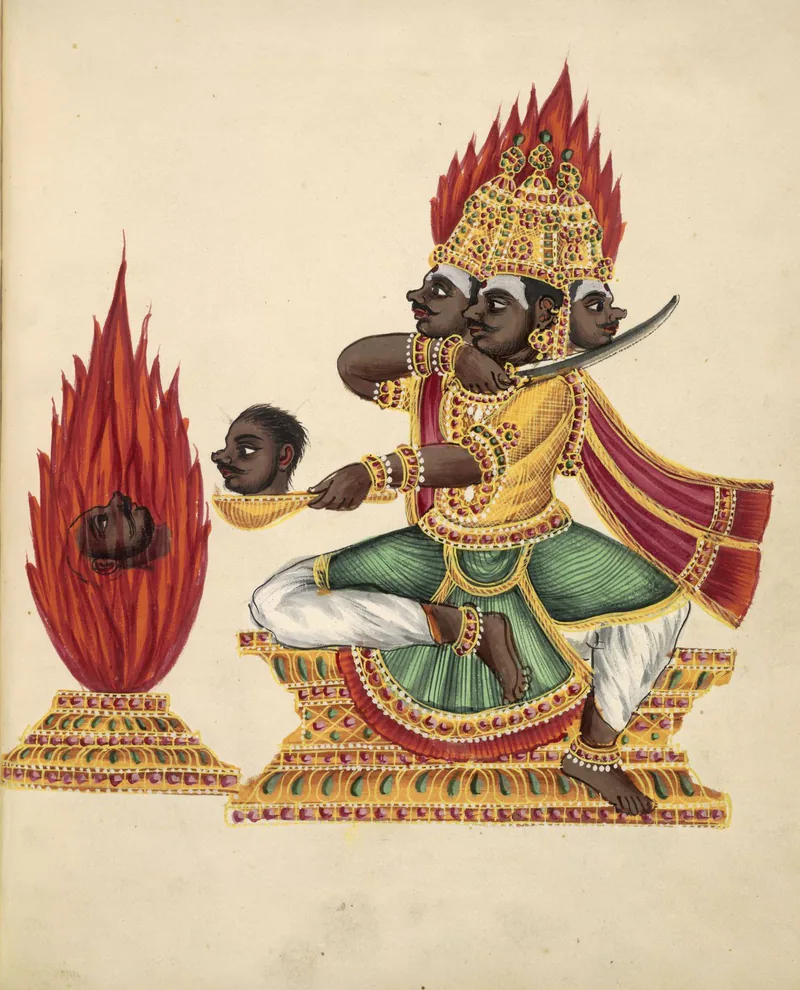
The oldest and most vivid Indian third eye belongs to Śiva. The Ṛgveda already invokes a god called Tryambaka in the verse later known as the Mahāmṛtyuñjaya mantra; the name was traditionally read as "three-eyed", although some scholars prefer "having three mothers". In epic and Purāṇic mythology the image is unambiguous. When Kāma, the god of desire, disturbs Śiva's meditation, a flame from the god's brow reduces him to ashes, a story told memorably in Kālidāsa's poem Kumārasambhava. The third eye is thus a weapon of fire and of ascetic insight that sees through desire. These myths are explored in Shiva's third eye, the bindi and the tilaka and in the wider study of Shaivism.
A second strand is yogic. The Bhagavad Gītā describes the meditator fixing the gaze, and at death the vital breath, between the eyebrows. Tantric and haṭha yoga texts later installed a two-petalled lotus called ājñā, "command", at this point, as one of the centres in the subtle body through which the goddess Kuṇḍalinī rises. Ājñā is the meeting-place of the subtle channels and the last station before the crown. Its role as a focus of meditation is the subject of ajna and the third eye in yoga and tantra, while the chakra itself, with its petals, syllables and deities, is described in Ajna, the brow chakra and in the history of the chakras.
The third strand is ritual and social. Hindus of many communities mark the forehead with a tilaka of ash, sandal paste, clay or vermilion, and many women wear a bindi. These marks have their own histories of sectarian identity, auspiciousness and marital status. Linking them to the ājñā centre is a common explanation, but it is one interpretation among several rather than their sole origin.
Buddhist Inner Sight: The Urna and the Divine Eye§
Buddhist art marks the Buddha's forehead with the ūrṇā, a small curl of white hair between the brows that is one of the thirty-two bodily marks of a "great man" listed in the early discourses. In the Lotus Sūtra the Buddha emits a ray of light from this point that illuminates countless worlds. In sculpture it appears as a raised dot or an inset crystal.
Buddhist doctrine also speaks of several "eyes": the physical eye, a "divine eye" that perceives beings dying and being reborn according to their actions, and the eyes of wisdom, of the dharma and of a buddha. These are forms of knowledge cultivated through meditation, not organs. Tibetan and other Vajrayāna traditions give many wrathful and peaceful deities a vertical third eye, and the great stupas of the Kathmandu Valley gaze out with painted eyes. These themes are the subject of the urna and inner sight in Buddhism.
Daoist and Chinese Parallels: The Upper Dantian and the Heavenly Eye§
Chinese traditions developed their own maps of the head. Daoist meditation texts of the Shangqing (Highest Clarity) school, from the fourth century onward, describe palaces inside the head inhabited by deities, beginning with the "Hall of Light" (mingtang) about an inch behind the point between the brows and leading back to the niwan, the central palace of the brain. In later internal alchemy the "upper elixir field" (dantian) in the same region is associated with spirit (shen), and some authors speak of an "ancestral opening" between the eyes as the place where the practitioner's attention is gathered.
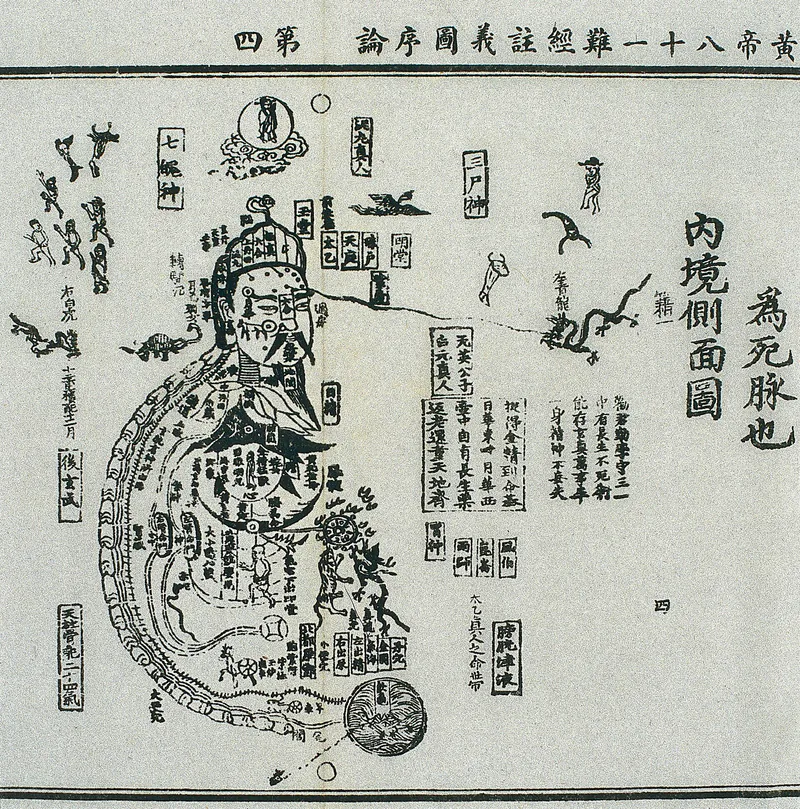
Chinese medicine names the point between the eyebrows yintang, "hall of the seal", and modern qigong teachers sometimes call the area the tianmu, "heavenly eye". These ideas resemble the Indian ones but have independent histories; equating the dantian with the chakras is a modern comparison, not an ancient equivalence.
The Eye of the Soul in Western Thought§
The West had no third eye on the forehead before modern times, but it had a long tradition of an "inner eye". Plato's Republic speaks of the "eye of the soul" sunk in a kind of mire, which philosophy gently lifts upward. Christian writers inherited the image: the medieval theologian Hugh of Saint Victor distinguished an eye of the flesh, an eye of reason and an eye of contemplation, the last dimmed by sin. A saying of Jesus in the Gospel of Matthew was often read in the same spirit: "The light of the body is the eye: if therefore thine eye be single, thy whole body shall be full of light" (Matthew 6:22). Later esoteric writers took the "single eye" as a reference to the third eye, a reading the original context does not require.
The Eye of Providence, the eye in a triangle on churches and Masonic emblems, symbolises God's watchfulness rather than human inner vision. Claims that the Egyptian Eye of Horus or the Vatican's bronze pine cone "represent the pineal gland" are modern speculations; the Horus eye stands for healing and restoration, and the Roman pine cone once belonged to a fountain. See myths and misconceptions.
The Modern Western Third Eye: Theosophy, the Pineal Gland and Lobsang Rampa§
The modern idea of the third eye was assembled in the late nineteenth century. Natural scientists had recently described the "parietal eye", a light-sensitive organ on the top of the head in some lizards and in the tuatara of New Zealand, and connected it with the pineal gland. Helena Blavatsky's The Secret Doctrine (1888) wove this discovery into an occult history of humanity: the third eye, she taught, had once been an active organ of spiritual vision in earlier races and had withered into the pineal gland as humanity sank into materiality.
Her successors in the Theosophical Society, especially C. W. Leadbeater, combined this idea with the Indian chakras, presenting the brow centre as an organ of clairvoyance. In 1956 a book called The Third Eye, purportedly the autobiography of a Tibetan lama named Lobsang Rampa, described a surgical operation to open the eye; its author was soon revealed to be Cyril Hoskin, an Englishman who had never been to Tibet. These developments are traced in Theosophy, Lobsang Rampa and the Western third eye. The scientific history of the pineal gland, from Galen and Descartes to the discovery of melatonin, is told in the pineal gland from Descartes to modern science.
What the Third Eye Is, and Is Not: Reading the Symbol Today§
In contemporary New Age writing the third eye has become a general name for intuition, imagination and psychic perception, typically paired with the sixth chakra, the colour indigo and the pineal gland. This is a modern synthesis that draws on all the strands above. The pairing of chakras with glands and colours is a twentieth-century Western development, and there is no scientific evidence that chakras exist as physical structures or that the pineal gland is an organ of spiritual sight.
That does not make the symbol empty. Traditionally the third eye stands for a shift from scattered, outward-facing attention to a steadier and more penetrating awareness. The practices associated with it, such as gazing at a flame or resting attention lightly at the brow, are described historically and with sensible cautions in third eye meditation. Reading each tradition in its own terms is the surest way to understand what each was trying to see.
Frequently asked questions§
What is the third eye?§
The third eye is a symbol of inner or spiritual perception located between the eyebrows. In Hinduism it is associated with Śiva and with the ājñā centre of yoga, in Buddhism with the ūrṇā and the "divine eye", and in modern Western esotericism with the pineal gland and psychic perception.
Where does the idea of the third eye come from?§
There is no single origin. The Indian image of three-eyed Śiva is ancient, the yogic ājñā centre is medieval, and the modern Western idea combining the third eye with the pineal gland comes from Theosophy in the 1880s and from popular books of the twentieth century.
Is the third eye the pineal gland?§
Not in the traditional Asian sources, which do not mention the pineal gland at all. The identification was made by Helena Blavatsky in 1888, inspired by zoologists' discoveries about the "parietal eye" of lizards. Modern science knows the pineal as a small gland that secretes melatonin.
Is the third eye the same as the ajna chakra?§
In modern usage the two are often treated as the same, and the ājñā centre does sit at the point between the brows. Historically, however, ājñā is one centre in a particular tantric system, while the third eye of Śiva and the Buddha's ūrṇā have separate histories.
Sources and further reading§
- The Serpent Power — Arthur Avalon (Sir John Woodroffe), 1919
- The Presence of Śiva — Stella Kramrisch, 1981
- Mahayana Buddhism: The Doctrinal Foundations — Paul Williams, 1989
- Taoist Meditation: The Mao-shan Tradition of Great Purity — Isabelle Robinet, 1993
- The Secret Doctrine — Helena P. Blavatsky, 1888
- The Chakras — C. W. Leadbeater, 1927
- Prisoners of Shangri-La: Tibetan Buddhism and the West — Donald S. Lopez Jr., 1998
- Tantra Illuminated — Christopher D. Wallis, 2012