Liber VIII · Eastern Mysticism · Chapter X: The Third Eye
Third Eye Meditation: Trataka, Brow Focus and Their History
Third eye meditation explained: the history of trataka and brow focus in yoga and Buddhism, a simple and safe candle-gazing practice, and sensible cautions.

"Third eye meditation" usually means one of two practices: trāṭaka, steady gazing at a small object such as a candle flame, followed by attention to its after-image, or resting attention lightly at the point between the eyebrows. Both have roots in Indian yoga, where the Bhagavad Gītā already mentions the brow and the fifteenth-century Haṭhayogapradīpikā describes trāṭaka, and both are simple concentration exercises. Practised gently and briefly, they are safe for most people, though there are real cautions for those with epilepsy, eye conditions or certain mental-health histories.
Origins of Brow Meditation in Indian Yoga§
The point between the eyebrows (bhrūmadhya) appears as a focus of meditation well before the developed chakra systems. The Bhagavad Gītā describes the meditator shutting out external contacts and fixing the gaze between the brows while balancing the breath, and the dying yogin drawing the life breath to the same point. Later yoga texts list the brow among several places, together with the tip of the nose, the navel and the heart, on which attention can be fixed.
In tantric and hatha yoga the brow became the site of ājñā, the two-petalled lotus where the subtle channels meet and the mind is said to reside. Meditation there could involve elaborate visualisation of letters, deities and light; its history is described in ajna and the third eye, and the wider symbolism in the third eye: history and meaning. The practices in this article belong to a simpler layer: the use of the eyes and attention to gather a scattered mind.
Trataka in the Hatha Yoga Texts§
The Haṭhayogapradīpikā of Svātmārāma, usually dated to the fifteenth century, lists trāṭaka as one of six cleansing practices (ṣaṭkarma), alongside methods for cleaning the stomach, nose and intestines. Its instruction is brief: with a concentrated mind, gaze with unmoving eyes at a small target until tears flow. The text says that this destroys diseases of the eyes and "closes the door" on sloth, and that it was kept secret by the teachers. The Gheraṇḍa Saṃhitā, a later compendium, gives a similar instruction and adds that trāṭaka leads to inner vision.
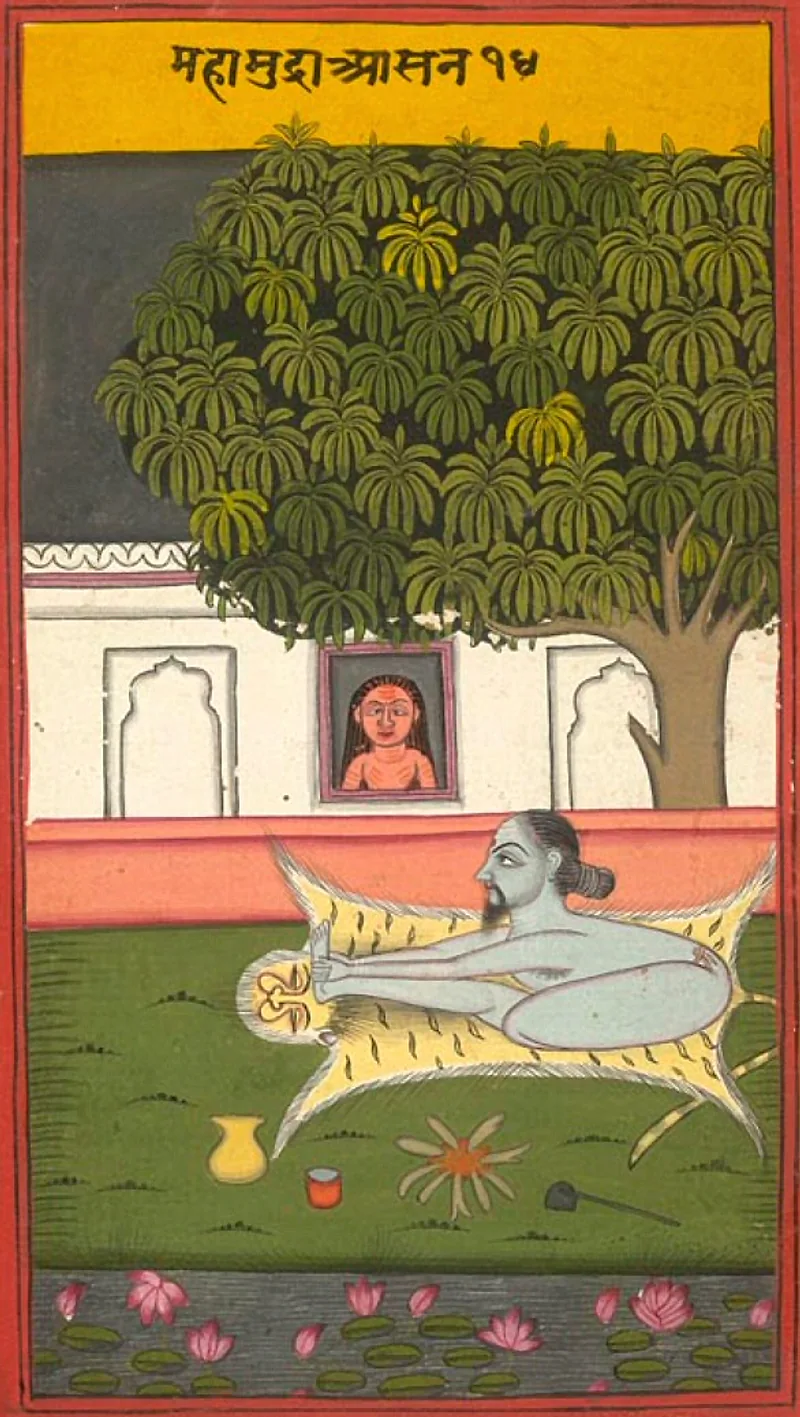
In the same tradition, śāmbhavī mudrā joins outward and inward attention: the eyes are open and still, but awareness rests on an inner object. Later teachers often describe this as a gaze turned upward toward the brow. The Gheraṇḍa Saṃhitā also describes a meditation on light (jyotir-dhyāna). Taken together, these texts present a progression from fixing the physical gaze to holding an inner image and finally to absorption without an object. See hatha yoga for the wider tradition.
Parallels: Kasina Gazing and Light Meditation in Buddhism§
Buddhism developed a closely comparable method. The kasiṇa exercises, described in detail in Buddhaghosa's fifth-century Visuddhimagga (The Path of Purification), use a visual device to develop concentration: a disc of earth or clay, a bowl of water, a coloured disc, a patch of light or a fire seen through a small hole in a screen. The meditator gazes at the device calmly until its image can be seen clearly with the eyes closed, the "learning sign". With continued practice this gives way to a brighter, purified "counterpart sign" that becomes the object of deep absorption (jhāna).
The fire kasiṇa in particular resembles candle trāṭaka, and the after-image phase of modern trāṭaka resembles the arising of the learning sign. Buddhaghosa stresses balance: the meditator should not stare intently or anxiously, nor look too casually, but gaze evenly and moderately, much as one glances at one's reflection in a mirror. It is a useful corrective to the idea that third eye meditation requires effortful straining. Tibetan traditions also practise meditation on visualised light and on deities with a third eye, but these are taught within initiatory lineages.
Trataka in Modern Yoga§
In the twentieth century trāṭaka moved from a little-known cleansing practice to a staple of modern yoga. Swami Sivananda of Rishikesh and his disciple Swami Satyananda Saraswati, founder of the Bihar School of Yoga in the 1960s, taught it widely. Satyananda's manual Asana Pranayama Mudra Bandha (1969) presented candle trāṭaka in the form now familiar: gazing at a flame, then closing the eyes and holding the after-image at the eyebrow centre. The Bihar School connected this explicitly with ājñā and with the "third eye", reflecting the influence of the Western language of chakras by that time.
Modern teachers generally soften the old instruction to gaze "until tears flow", advising students to blink when necessary and avoid strain. Trāṭaka is now taught as a concentration exercise and a preparation for sitting meditation rather than as a cleansing of the eyes, and it is often presented with promises of improved memory or psychic ability that go well beyond what the evidence shows. For meditation more generally, see the meditation guide.
A Simple Third Eye Meditation: Candle Gazing and Brow Focus§
The following is a gentle form of the practice as it is commonly taught today. It involves no breath retention, no fasting and no substances, and is offered as a description rather than a promise of results.
- Prepare the space. Sit in a quiet, dim room free of draughts. Place a candle on a stable, non-flammable surface about an arm's length away, with the flame at eye level. Sit comfortably upright, on a cushion or a chair.
- Settle. Close the eyes for a minute and let the breath move naturally. Do not hold or control it.
- Gaze. Open the eyes and look softly at the flame, or just at the tip of the wick, without staring. Keep the face and eyes relaxed and blink whenever you need to. Continue for about thirty seconds to a minute.
- Turn inward. Close the eyes and notice the after-image of the flame. Let attention rest lightly in the space between the eyebrows, as if looking at the image rather than pushing toward it. When the image fades, simply rest there for a few breaths.
- Repeat. Repeat the gazing and inner phases two or three times. Ten minutes is ample.
- Finish. Rub the palms together and rest them over the closed eyes for a few moments. Sit quietly, then extinguish the candle.
Those who cannot or should not gaze at a flame can practise the inner part alone: sit with the eyes closed and allow attention to rest lightly at the brow, perhaps silently repeating a word or the syllable Oṃ as some traditions do. If a feeling of pressure or headache arises, let attention move down to the breath at the nostrils or the chest instead.
Cautions: Eyes, Epilepsy, Fire and Mental Health§
Several cautions apply. People with epilepsy, especially photosensitive epilepsy, should not gaze at a flickering flame; a fixed dot on a card, or the closed-eye version, is preferable, and medical advice is wise. Anyone with glaucoma, recent eye surgery, an eye infection or significant dry eye should consult an eye specialist first, and contact-lens wearers may find gazing uncomfortable. Never gaze at the sun: "sun-gazing" is sometimes promoted as a third eye practice, but looking at the sun can cause permanent retinal damage. Never leave a candle unattended.
Concentration on the brow can produce tension in the forehead, headaches or a sense of pressure if it is forced; this is a sign to lighten the effort. More rarely, intensive meditation of any kind can bring up anxiety, disturbing imagery or a sense of unreality. Research on meditators has documented such difficult experiences, and traditions that speak of kundalini awakening have long warned against forcing the process. People with a history of psychosis, dissociation, severe anxiety or trauma should practise briefly, with an experienced teacher, and stop if distress arises.
What Research Says and What to Expect§
Scientific research on trāṭaka specifically is limited. A handful of small studies, mostly from Indian yoga research institutions, report improvements on tests of attention, memory or sleep after periods of regular practice, but the samples are small and the designs are not strong enough to draw firm conclusions. Broader reviews of meditation research suggest modest benefits for attention and stress, while cautioning against inflated claims. There is no evidence that trāṭaka "activates" the pineal gland or confers psychic powers, and no scientific evidence that the ājñā chakra exists as a physical structure.
Traditional teachers would add that the lights and colours some people see during brow concentration are not the goal. In both yoga and Buddhism the aim of such practices is a mind that is steady, clear and quiet. If third eye meditation helps to cultivate that, it is doing what its long history intended.
Frequently asked questions§
What is trataka?§
Trāṭaka is a yogic practice of steady gazing at a small object, most often a candle flame today. The Haṭhayogapradīpikā lists it among six cleansing practices, and modern yoga teaches it as a concentration exercise that leads into meditation at the brow.
How long should third eye meditation last?§
For beginners a few minutes is enough, with gazing phases of thirty seconds to a minute and no more than about ten minutes in total. It is better to practise briefly and without strain than to force long sessions.
Is third eye meditation safe?§
For most people, gentle practice is safe. People with epilepsy, eye conditions or a history of serious mental illness should take advice first, sun-gazing should never be attempted, and any practice that causes pain or distress should be stopped.
Will third eye meditation give me psychic abilities?§
There is no evidence that it does. The traditional purpose of trāṭaka and brow concentration is steadiness of mind, and many teachers regarded visions and powers as distractions rather than goals.
Sources and further reading§
- Haṭhayogapradīpikā — Svātmārāma, 1450
- The Gheranda Samhita — trans. James Mallinson, 2004
- The Path of Purification (Visuddhimagga) — Buddhaghosa, 1956
- Asana Pranayama Mudra Bandha — Swami Satyananda Saraswati, 1969
- Roots of Yoga — James Mallinson & Mark Singleton, 2017
- Altered Traits: Science Reveals How Meditation Changes Your Mind, Brain, and Body — Daniel Goleman and Richard J. Davidson, 2017
- The Bhagavad-Gita: Krishna's Counsel in Time of War — Barbara Stoler Miller, 1986