Liber VIII · Eastern Mysticism · Chapter X: The Third Eye
The Pineal Gland: From Descartes to Modern Science
The pineal gland from Galen and Descartes' seat of the soul to melatonin and the body clock, and what science says about calcification, DMT and the third eye.

The pineal gland is a small, pine-cone-shaped gland near the centre of the brain that produces the hormone melatonin, which signals night-time to the body and helps regulate daily and seasonal rhythms. René Descartes famously called it the principal seat of the soul, and since the late nineteenth century occultists have identified it with the "third eye". Modern science confirms that the pineal is evolutionarily related to a light-sensing organ in some animals, but there is no evidence that it is an organ of spiritual perception in humans.
What the Pineal Gland Is§
The human pineal gland is roughly the size of a grain of rice, usually between five and eight millimetres long. It sits deep in the brain, attached by a stalk to the roof of the third ventricle, between the two halves of the thalamus. Unlike most structures in the brain it is single rather than paired, it has a rich blood supply, and it lies outside the blood–brain barrier. Its cells, called pinealocytes, are specialised for producing melatonin.
Its name comes from Latin pinea, "pine cone", translating the Greek kōnarion, which had the same meaning. The shape, the central position and the fact that it is unpaired have made it a natural focus of speculation for nearly two thousand years. The story of that speculation is part of the history of the third eye, but it is also a chapter in the history of anatomy and of the mind–body problem.
Galen and the Ancient Konarion§
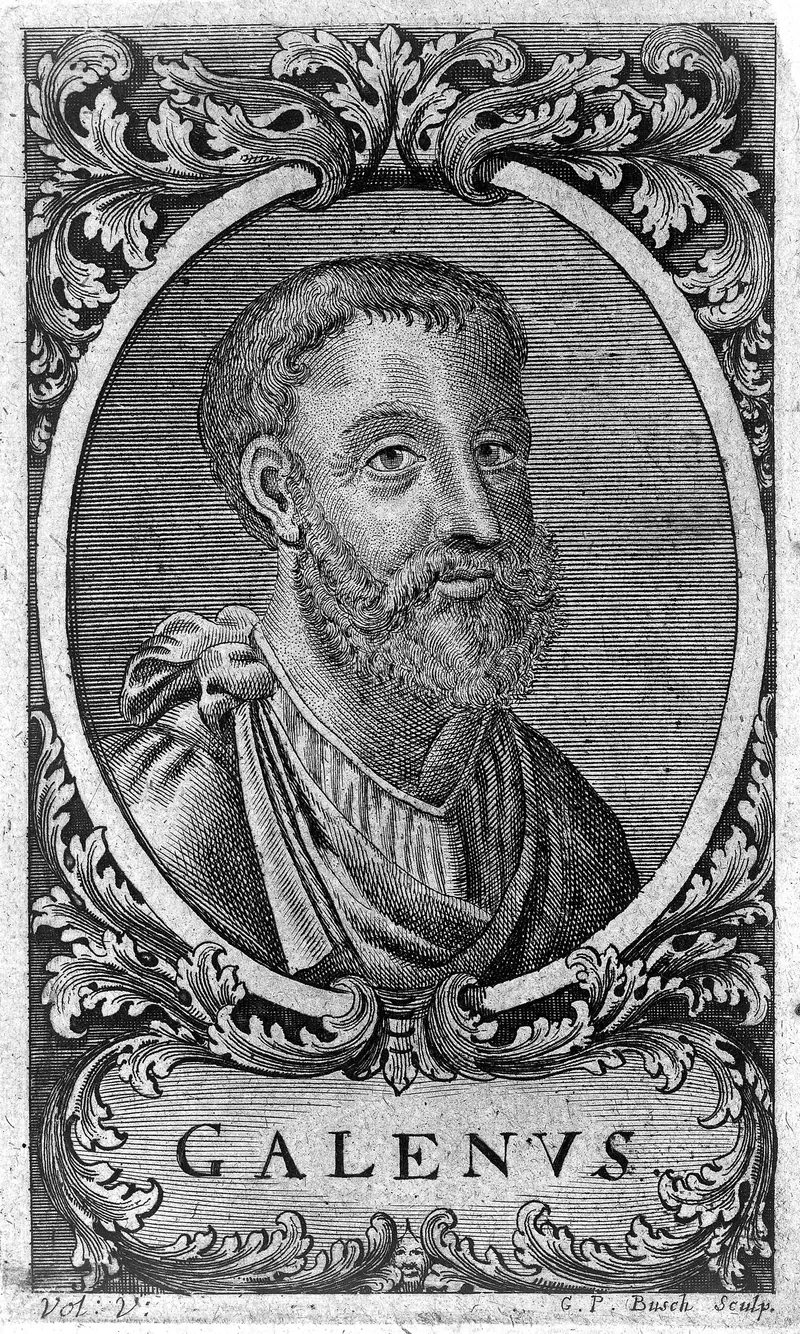
The physician Galen of Pergamon (c. 129 – c. 216 CE) gave the most influential ancient account. In his treatise On the Usefulness of the Parts of the Body, he reports that some anatomists regarded the kōnarion as a kind of valve or guardian controlling the passage of "psychic pneuma", the subtle spirit thought to carry sensation and thought, between the cavities of the brain. Galen rejected this. He argued that the structure is a gland, that it lies outside the brain substance proper, and that its function is to support the branching of the great vein over it; the valve-like role, he suggested, belonged rather to a worm-shaped part of the cerebellum.
Medieval and Renaissance physicians inherited a theory that placed the mental faculties, such as common sense, imagination, reason and memory, in the ventricles of the brain. Some revived the idea of the pineal as a valve regulating the movement of spirits between them. Andreas Vesalius depicted the gland carefully in his anatomical atlas of 1543 without assigning it any special psychological importance.
Descartes and the Seat of the Soul§
René Descartes (1596–1650) made the pineal gland famous. In his Treatise of Man, written in the early 1630s but withheld from publication after the condemnation of Galileo and printed only after his death (in Latin in 1662 and French in 1664), he described the body as a hydraulic machine in which fine "animal spirits", derived from the blood, flow through the nerves. At the centre of the system he placed the gland, which he believed was suspended in the ventricles and could tilt in response to the flow of spirits and, conversely, direct them.
In The Passions of the Soul (1649) Descartes explained why the soul should act most directly at this point. The soul, he argued, is joined to the whole body, but it exercises its functions most particularly in one small gland. All other parts of the brain are double, as are the eyes and ears, while thought is single; there must therefore be a place where the two images from the eyes and the impressions from the paired senses are united before reaching the soul, and the pineal, being single and central, is the only candidate. In letters he called it the principal seat of the soul.
The theory was ingenious but immediately troubled. Princess Elisabeth of Bohemia, in her correspondence with Descartes from 1643, pressed him on how an immaterial mind could move matter at all. That question, of how mind and body interact, has outlived the pineal theory and remains central to philosophy of mind.
Critics of Descartes and the Early Modern Brain§
Anatomists soon tested Descartes' claims against dissection. The Danish anatomist Niels Stensen (Steno), in a lecture given in Paris in 1669, pointed out that the gland is not freely suspended in the ventricles and is not attached in a way that would allow the movements Descartes required. Thomas Willis, whose Cerebri anatome (1664) laid foundations for modern neuroanatomy, gave it only a modest role. By the eighteenth century anatomists had also noticed the gritty deposits often found in the gland, later called "brain sand".

Descartes' pineal theory thus became a historical curiosity in anatomy, even as his dualism of mind and body remained a reference point for philosophy. The gland's association with the soul, however, never quite disappeared from popular imagination, and it was revived in a very different form two centuries later.
The Parietal Eye: The Pineal's Evolutionary History§
In 1886 two zoologists working independently, Henri de Graaf in the Netherlands and Walter Baldwin Spencer in England, described a structure on the top of the head in certain lizards that had a lens and a retina-like layer and was connected to the pineal complex: a "parietal eye". The tuatara of New Zealand has a particularly well-developed example, covered by scales in the adult. Later research showed that in lampreys, fish, amphibians and many reptiles parts of the pineal complex are directly sensitive to light, and that pinealocytes are evolutionarily related to the light-sensing cells of the eye.
This was a genuine scientific discovery, and it is the real kernel of the idea that the pineal is a "third eye": in the evolutionary history of vertebrates it was, in a sense, a light-sensing organ. In mammals, including humans, it is no longer directly photosensitive. Helena Blavatsky drew on the zoologists' reports in The Secret Doctrine (1888) to argue that the pineal was the atrophied organ of a spiritual third eye once active in earlier humanity. That occult interpretation, and its later development, is traced in Theosophy, Lobsang Rampa and the Western third eye.
Melatonin and the Body Clock: The Modern Science§
The pineal's modern role was established in the twentieth century. In 1917 researchers observed that extracts of cattle pineal glands lightened the skin of tadpoles, and in 1958 the American dermatologist Aaron Lerner and his colleagues isolated the responsible substance from bovine pineals and named it melatonin. Melatonin is made from serotonin, chiefly at night, and its production is suppressed by light.
In mammals light reaches the pineal only indirectly. Special light-sensitive cells in the retina signal to the suprachiasmatic nucleus of the hypothalamus, the body's master clock, which in turn controls the pineal through a pathway that runs down into the spinal cord and back up through the sympathetic nerves of the neck. The result is a hormonal signal of darkness: melatonin rises in the evening and falls in the morning, and the length of the nightly signal tells many animals what season it is, which governs breeding in species such as sheep and hamsters. In humans melatonin helps time sleep and other daily rhythms, and it is used medically for some disorders of sleep timing and for jet lag. Its many other proposed roles are still being studied.
Calcification, Fluoride and DMT: What the Evidence Supports§
Calcium deposits ("brain sand", or corpora arenacea) accumulate in the pineal of many people from childhood onward and become more common with age; they are often visible on X-rays and CT scans, and radiologists once used the calcified gland as a landmark for detecting shifts of the brain's midline. Some studies associate heavy calcification with lower melatonin output and with certain sleep and neurological conditions, but cause and effect are unclear. A small study of elderly cadavers published in 2001 found fluoride concentrated in calcified pineal tissue; it did not show effects on health or perception in living people. Claims that particular diets, supplements, cleanses or practices can "decalcify" the pineal and thereby "open the third eye" have no scientific support, and nothing links calcification to spiritual experience.
A second popular idea concerns DMT, a powerful psychedelic compound found in many plants and in traces in animals. The psychiatrist Rick Strassman, in DMT: The Spirit Molecule (2001), speculated that the pineal might release DMT at birth, death and in mystical states. Later studies detected DMT in the pineal gland and elsewhere in the brains of rats. Whether the human pineal produces meaningful amounts, and whether this plays any role in visionary experience, has not been shown; the hypothesis remains speculative. On the wider history of such substances in religion, see entheogens and sacred plants. The pineal's real story, from Galen's vein-support to the hormone of darkness, is remarkable enough without these modern myths.
Frequently asked questions§
What does the pineal gland do?§
It produces melatonin, mainly at night, under the control of the brain's master clock. Melatonin acts as a signal of darkness that helps regulate sleep timing and daily rhythms, and in many animals the seasonal timing of reproduction.
Why did Descartes call the pineal gland the seat of the soul?§
Descartes noted that the pineal is single while most brain structures are paired, and reasoned that the double impressions of the senses must be unified in one place before reaching the soul. He also believed, wrongly, that the gland hung freely in the brain's cavities and could move to direct the "animal spirits".
Is the pineal gland really a third eye?§
In some lizards and other animals a related organ, the parietal eye, is sensitive to light, and the pineal shares an evolutionary history with light-sensing cells. In humans it is not directly sensitive to light, and there is no evidence that it is an organ of spiritual or psychic perception.
Can the pineal gland be decalcified?§
Pineal calcification is common and increases with age. There is no scientific evidence that diets, supplements or practices marketed to "decalcify" the pineal have that effect, or that calcification has anything to do with spiritual experience.
Sources and further reading§
- On the Usefulness of the Parts of the Body — Galen, trans. Margaret Tallmadge May, 1968
- Treatise of Man — René Descartes, trans. Thomas Steele Hall, 1972
- The Passions of the Soul — René Descartes, 1649
- The Correspondence between Princess Elisabeth of Bohemia and René Descartes — Lisa Shapiro (ed. and trans.), 2007
- The Secret Doctrine — Helena P. Blavatsky, 1888
- DMT: The Spirit Molecule — Rick Strassman, 2001