Liber XXXIV · Vodou & Hoodoo · Chapter VI: Myths & Misconceptions
Voodoo Myths and Misconceptions: Zombies, Dolls and Curses
The truth behind Voodoo myths: devil worship, pin-stuck dolls, zombies, curses and human sacrifice, and how colonial fear and Hollywood created them.

Most of what people "know" about Voodoo comes from novels, travel books and films, not from the religions themselves. Haitian Vodou, West African Vodun and Louisiana Voodoo are faiths of healing, ancestral memory and community, whose followers serve spirits under one supreme God. The pin-stuck doll, the flesh-eating zombie, the devil-worshipping cult and the bloodthirsty priest were largely invented or distorted by outsiders between the colonial era and the age of Hollywood, often to justify domination of Black people and of the Haitian republic.
Where the Myths Came From: Colonial Fear and the Haitian Revolution§
In colonial Saint-Domingue, French authorities feared gatherings of enslaved Africans, suspecting them of plotting rebellion or poisoning. When the Haitian Revolution began in 1791, traditionally linked to the Vodou ceremony at Bois Caïman, Vodou was cast as the dark force behind the overthrow of slavery. After independence in 1804 the world's first Black republic faced diplomatic isolation, and its religion became a convenient symbol of supposed savagery.
Three moments shaped the modern stereotype. In 1864 a notorious trial, the Affaire de Bizoton, convicted several people of murdering and eating a child; confessions were reportedly obtained under duress and historians treat the case with great caution. Sir Spenser St John, a British diplomat, nonetheless made it the centrepiece of Hayti, or the Black Republic (1884), which spread the image of Haitian cannibalism through the English-speaking world. Then, during the United States occupation of Haiti (1915–1934), American marines and journalists produced a stream of lurid accounts, among them William Seabrook's The Magic Island (1929). Hollywood took over from there, starting with White Zombie (1932). The historian Kate Ramsey's The Spirits and the Law (2011) shows how these images were tied to laws against "spells" (sortilèges) that criminalised popular religion.
Myth: Voodoo Is Devil Worship§
Vodou is often described in sermons and films as Satanism. This is false. Vodouisants affirm a single creator, Bondye, and serve the lwa as his intermediaries, much as Catholics ask saints to intercede. Many practitioners are baptised Catholics, and ceremonies frequently begin with Catholic prayers. There is no figure of Satan in Vodou theology to be worshipped.
The confusion arises partly from Christian polemic, which has labelled all non-Christian spirits as demons, and partly from misreadings of specific spirits. Fiery Petwo lwa, the bawdy Gede, or the Yoruba messenger Exu (in Brazil) and Eshu (in Nigeria) were described by missionaries as devils, but in their own traditions they are guardians, messengers and healers. The "anti-superstition campaign" (campagne antisuperstitieuse) of 1941–1942 in Haiti, backed by the Catholic Church and the government of Élie Lescot, burned temples and sacred objects on the premise that Vodou was satanic. After the 2010 earthquake, a prominent American televangelist publicly claimed that Haiti had made a "pact with the devil" at Bois Caïman, a statement widely condemned as historically baseless.
Myth: Voodoo Dolls and Pins§
The image of a priest sticking pins into a doll to cause pain to an enemy is the most recognisable "voodoo" cliché, yet it is not a characteristic Haitian practice. Dolls do appear in Vodou, for example on altars, hung in trees near cemeteries, or as images representing spirits, but they are not primarily instruments for harming people.
The pierced figure has a much clearer history in Europe and the ancient Mediterranean. Greek and Roman binding spells used pierced figurines, and European witch-trial records repeatedly describe wax or clay images, called "poppets" in English, stuck with pins or melted to harm a victim (see Maleficium, Curses and Protective Magic). In twentieth-century New Orleans, the "voodoo doll" became a souvenir sold to tourists, reinforced by films and comics. Its modern association with Vodou is therefore a European practice relabelled as African. Some New Orleans and Hoodoo practitioners do use dolls today, often for healing, love or blessing, and this reflects the influence of the popular image as much as old tradition.
Myth: Zombies Are the Undead§
The zonbi is a genuine figure of Haitian belief, but quite unlike the monster of horror films. In Haitian understanding a sorcerer (bòkò) may capture a person's soul, the ti bonnanj, and keep it in a bottle, or may raise a body from the grave after apparent death and force it to labour without will or memory. The fear is not of being eaten by a zombie but of becoming one: losing one's freedom and selfhood, a fear that historians connect closely to the experience of slavery.
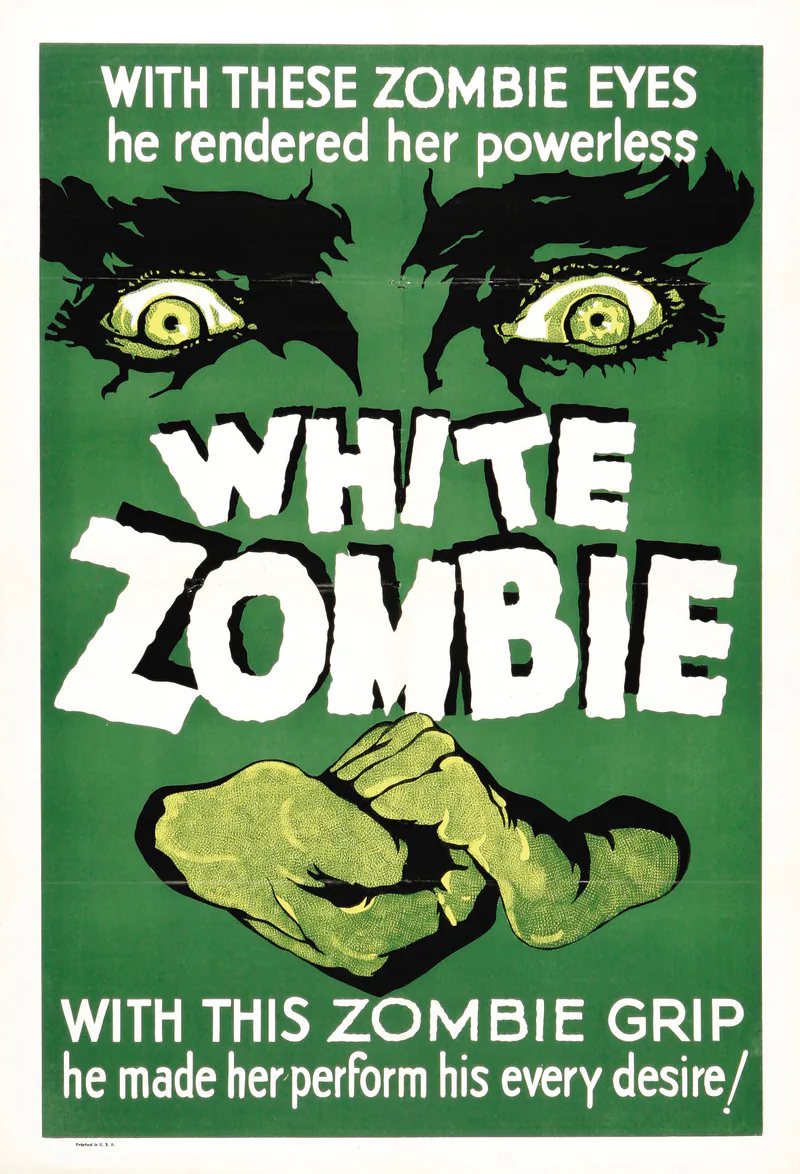
Haitian law reflected this belief. An article of the Haitian penal code (often cited as Article 246) treated the use of substances to induce a death-like state followed by burial as attempted murder. In the 1980s the ethnobotanist Wade Davis, in The Serpent and the Rainbow (1985), proposed that a powder containing tetrodotoxin from pufferfish might explain some reported cases, including that of Clairvius Narcisse, who reappeared in his village in 1980 years after being pronounced dead. Davis's thesis remains controversial among toxicologists and anthropologists. Either way, the shambling, flesh-eating zombie is an American invention, reshaped by George A. Romero's Night of the Living Dead (1968), which has nothing to do with Vodou at all.
Myth: Human Sacrifice and Cannibalism§
Claims that Vodou demands human sacrifice, often of a "goat without horns" (a child), circulated in the nineteenth century and were repeated by writers for decades. There is no credible evidence of such practices as part of Vodou. The few cases cited, chiefly the Bizoton trial of 1864, rest on confessions obtained in questionable circumstances and were seized on for political reasons. Similar accusations have been made against minorities throughout history, including Jews in medieval blood-libel myths and early Christians in the Roman Empire.
The royal court of Dahomey did perform human sacrifices in state ceremonies before the French conquest of the 1890s, as described in West African Vodun. These were political rites of a kingdom, not practices of Haitian Vodou or of ordinary Vodun communities, and they ended more than a century ago.
Animal Offerings, Law and Religious Freedom§
Some ceremonies in Vodou, Vodun, Santería and Candomblé include the ritual killing of animals such as chickens or goats as offerings to the spirits. This is described here historically, not as instruction. In these traditions the animal is usually killed quickly by a specialist, and its meat is cooked and shared by the community, as in many religions that have practised sacrifice, including ancient Judaism and Greek religion, and as in halal and kosher slaughter today.
In the United States the question reached the Supreme Court. In Church of the Lukumi Babalu Aye v. City of Hialeah (1993) the Court unanimously struck down city ordinances that targeted Santería animal sacrifice, holding that they violated the free exercise of religion. See Santería, Lucumí and the Orishas. In the 1980s and early 1990s, during the Satanic panic, crimes committed by individuals were sometimes wrongly attributed to Afro-Caribbean religions, reinforcing prejudice against innocent communities.
How Scholars and Practitioners Tell the Story Now§
From the 1920s onward, Haitian intellectuals began to reclaim Vodou. Jean Price-Mars, in Ainsi parla l'oncle (1928), argued that Haitian popular religion deserved serious study as part of the nation's heritage. Ethnographers including Zora Neale Hurston, Maya Deren, Alfred Métraux and later Karen McCarthy Brown described Vodou from within the communities that practised it. Haitian scholars such as Laënnec Hurbon have traced how stereotypes served colonial and political ends.
Practitioners themselves now speak through temples, organisations and public festivals in Haiti, New York, Miami, Montreal and New Orleans. Haiti's 1987 Constitution guaranteed religious freedom, and a 2003 government decision recognised Vodou as a religion. The best antidote to the myths remains to listen to those who serve the spirits; for an introduction see What Is Voodoo? and Haitian Vodou, and for New Orleans Louisiana Voodoo and Marie Laveau.
Frequently asked questions§
Are voodoo dolls real?§
Dolls exist in some Vodou and New Orleans practices, but the pin-stuck doll used to hurt an enemy is mainly a European image-magic tradition and a twentieth-century tourist product. It is not central to Haitian Vodou.
Do Vodou practitioners put curses on people?§
Vodou recognises that sorcery exists and that a bòkò may "serve with both hands", for harm as well as help. But most religious activity is concerned with healing, protection and the service of the spirits, and harmful magic is condemned within the religion.
Is the zombie a Haitian idea?§
The concept of the zonbi, a person whose soul or body has been enslaved by a sorcerer, is Haitian. The flesh-eating undead monster is a creation of American cinema, especially from 1968 onward.
Why is Voodoo associated with evil in films?§
Because its image in the West was shaped by colonial fear, anti-Haitian propaganda and occupation-era travel writing, which Hollywood adopted from the 1930s. Scholars regard these portrayals as stereotypes with little basis in the religion.
Sources and further reading§
- The Spirits and the Law: Vodou and Power in Haiti — Kate Ramsey, 2011
- Voodoo: Search for the Spirit — Laënnec Hurbon, 1995
- The Serpent and the Rainbow — Wade Davis, 1985
- Hayti, or the Black Republic — Spenser St John, 1884
- The Magic Island — William Seabrook, 1929
- Ainsi parla l'oncle — Jean Price-Mars, 1928
- Taking Haiti: Military Occupation and the Culture of U.S. Imperialism, 1915–1940 — Mary A. Renda, 2001
- Voodoo in Haiti — Alfred Métraux, 1959