Liber III · Black & White Magic · Chapter II: Maleficium & Curses
Maleficium, Curses and Protective Magic: A Complete History
History of maleficium, curses and protective magic: Greek and Roman curse tablets, the evil eye, witch-trial law, witch bottles, hidden shoes and witch marks.

Maleficium, Latin for "evil-doing," is the historical term for harm believed to be caused by magic, such as illness, death, infertility, failed crops or ruined livestock. For as long as people have feared such harm they have also sought protection from it, and the record runs from Greek and Roman curse tablets and evil-eye amulets to the witch-trial courts of early modern Europe and the witch bottles, hidden shoes and carved marks that archaeologists now find in old houses.
Curse Tablets and Binding Spells in the Ancient World§
The most abundant evidence for harmful magic in antiquity is the curse tablet. Greeks called these katadesmoi, "bindings," and Romans defixiones, from a verb meaning "to fix" or "to pin down." Typically a thin sheet of lead was inscribed with the name of the target and a formula consigning that person to the gods of the underworld or to the restless dead, then rolled or folded, sometimes pierced with a nail, and deposited in a grave, a well, a spring or a sanctuary. The earliest known examples come from Greek Sicily and Attica in the fifth century BCE, and well over 1,500 are now known from across the Mediterranean and the Roman provinces.
John Gager's Curse Tablets and Binding Spells from the Ancient World (1992) and the work of Christopher Faraone have shown that most tablets arose from situations of competition. They targeted rival athletes and charioteers, opponents in lawsuits, business competitors, and the objects or rivals of erotic desire. The aim was usually to "bind" the target's tongue, limbs or mind, to make them fail at a crucial moment, rather than simply to kill. Some deposits included small figurines with twisted or bound limbs; a well-known example in the Louvre, from Roman Egypt, is a clay female figure pierced with pins and found with an inscribed lead tablet.
A distinct group, which H. S. Versnel called "prayers for justice," appealed to a deity to punish a wrongdoer, often a thief. The finest collection comes from the sacred spring of Sulis Minerva at Bath in Roman Britain, where around 130 tablets, published by R. S. O. Tomlin in 1988, ask the goddess to afflict whoever stole a cloak, gloves or a few coins until the goods are returned. Such texts blur the line between curse and petition and show ordinary people using ritual to seek redress where law could not help.
The Evil Eye in the Ancient Mediterranean§
Alongside deliberate cursing stood a fear of harm that might be involuntary. The Greeks called it baskania and the Romans fascinatio or invidia: the belief that envious or admiring looks could injure, especially children, animals and anyone enjoying good fortune. Plutarch devoted a discussion in his Table Talk to whether some people's eyes really emit harmful effluences, and Pliny the Elder reported peoples said to kill with a glance.
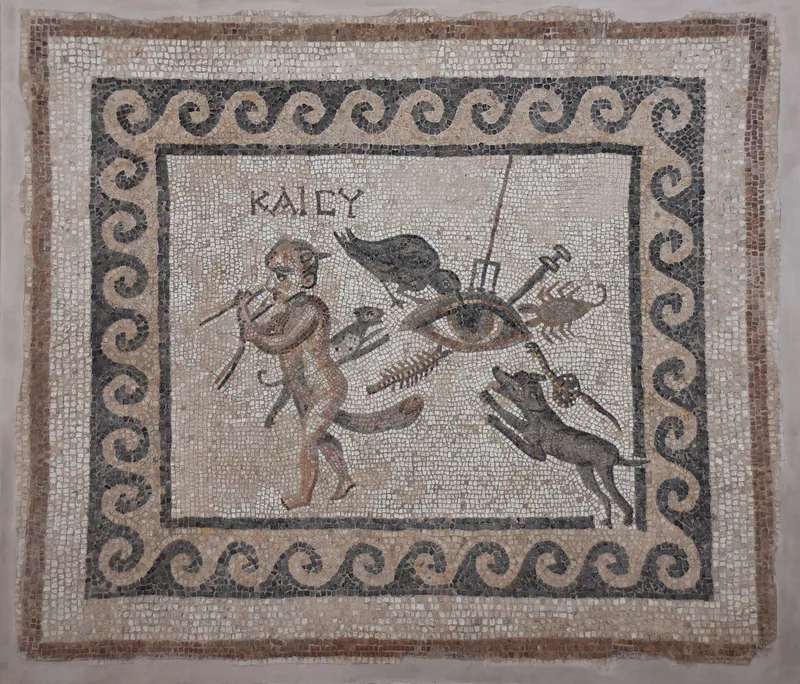
Protection took many forms. Romans hung the fascinum, a phallic amulet, on children and animals and placed it on buildings, on the theory that a striking or obscene image would catch and deflect the dangerous gaze. Mosaics, such as one from a house at Antioch, show the eye itself under attack from animals and weapons. Similar beliefs and remedies are found across the Middle East, North Africa and South Asia, from blue eye-beads to the hand-shaped hamsa. Alan Dundes' anthology The Evil Eye: A Casebook surveyed this vast distribution and the competing theories offered to explain it.
Maleficium in Medieval and Early Modern Law§
Late Roman law already used maleficium as the general term for criminal magic, and the term passed into medieval canon and secular law. For centuries, accusations of harmful magic were heard sporadically, often as part of disputes between neighbours or as political charges against courtiers. From the fifteenth century, however, maleficium was combined with the learned idea of a pact with the Devil, creating the composite figure of the witch whose history is traced in our article on the history of black magic.
In legal practice the alleged harm was crucial. The Holy Roman Empire's criminal code, the Constitutio Criminalis Carolina of 1532, specified death by fire for those who injured others by sorcery, while leaving magic without harm to the judges' discretion. English law, under the statutes of 1563 and 1604, treated killing by witchcraft as a capital felony and lesser injuries more leniently, at least for a first offence. Typical accusations concerned the sudden illness or death of a child, the wasting of cattle, butter that would not churn, or impotence; the "tying of the knot" (nouer l'aiguillette in French) to prevent consummation was a widely feared form of marital maleficium.
Historians such as Alan Macfarlane, Keith Thomas and Robin Briggs have stressed the social pattern behind many cases: an encounter in which a poorer neighbour, often an older woman, was refused help, followed by a misfortune that the refuser attributed to her resentment. Accusation was in this sense a way of explaining misfortune and of managing guilt. The scale and regional variation of the resulting prosecutions are discussed in our article on the European witch trials.
Amulets, Psalms and Written Charms§
Medieval and early modern people did not rely only on courts. Protective objects and words were part of everyday religious life. Don Skemer's Binding Words (2006) documents Christian textual amulets: strips of parchment bearing Gospel passages, divine names, crosses and prayers, worn on the body or placed in houses and stables. Anglo-Saxon remedy collections such as Bald's Leechbook and the Lacnunga combine herbal remedies with charms against elf-shot, sudden pains and theft. The SATOR word square, known from Pompeii onward, was used in later centuries as a protective formula.

The Psalms held a special place. Jewish tradition developed a text known as Shimmush Tehillim, "the use of the Psalms," prescribing particular psalms for protection, healing and safe travel, and Christians similarly used the Psalter for blessing and defence. Islamic protective practice employs Qur'anic verses, divine names and written amulets. Among the most widespread symbols in all three traditions was the seal or ring of Solomon, whose protective uses are traced in our article on Solomon's ring and the Seal of Solomon.
Church authorities accepted some of these practices as sacramentals, condemned others as superstition, and argued constantly about where the line lay. Reformers often dismissed all of them as popish magic, though in practice protective customs persisted across confessions.
Cunning Folk and Counter-Magic§
When someone believed they were bewitched, a common recourse in early modern Britain and much of Europe was a cunning man or woman. As Owen Davies has shown, these practitioners offered to diagnose witchcraft, identify the witch, often by scrying or by turning a sieve and shears, and prescribe counter-measures. Their work, part of what contemporaries sometimes called "white witchcraft," is discussed further in our article on the history of white magic.
Counter-magic often turned the supposed connection between witch and victim against the witch. A popular belief held that drawing blood from the suspected witch by scratching her broke the spell, a practice that led to assaults and occasional prosecutions. Another approach targeted a sympathetic link, such as the victim's urine, on the assumption that the witch's power was bound up with it. The astrologer-physician Joseph Blagrave described such a remedy in his Astrological Practice of Physick (1671), and it is to this logic that historians connect the witch bottle. Folklorists recording nineteenth-century rural belief found many of these ideas still current, and they have influenced modern traditional witchcraft movements.
The Archaeology of House Protection§
The material traces of counter-magic were long overlooked. The London archaeologist Ralph Merrifield, in The Archaeology of Ritual and Magic (1987), argued that objects found buried under hearths, thresholds and floors deserved interpretation as deliberate ritual deposits rather than rubbish. Brian Hoggard's Magical House Protection: The Archaeology of Counter-Witchcraft (2019) built a survey of such finds across Britain and beyond.
Witch Bottles§
Witch bottles are vessels, often seventeenth-century German stoneware "Bellarmine" jugs decorated with a bearded face, that contain items such as bent pins, nails, hair, fingernail clippings and urine, and that were buried beneath hearths or thresholds. Some two hundred are known. A rare sealed example found in Greenwich and analysed by a team led by Alan Massey in 2009 contained urine, iron nails, brass pins, hair, nail clippings and a leather heart pierced by a nail. Interpreted through contemporary sources, such bottles were meant to cause pain to the witch through the sympathetic link with the victim, forcing her to lift the spell.
Concealed Shoes, Cats and Other Deposits§
Worn shoes, usually single and often children's, are among the most frequent finds in walls, chimneys and roof spaces. Northampton Museum's Concealed Shoe Index, begun by the footwear historian June Swann, has recorded well over a thousand examples, most from the sixteenth to nineteenth centuries. Their purpose is undocumented by those who hid them, and interpretations range from protection against evil spirits to good luck. Dried cats, horse skulls and written charms have also been recovered, though some cats may have died accidentally.
Apotropaic Marks§
Carved and scorched marks on doorways, beams and fireplaces form another category. Common designs include compass-drawn hexafoils or "daisy wheels," interlaced Vs often read as Virgo Virginum or a Marian invocation, and teardrop-shaped burn marks; experiments suggest many burns were made deliberately with a candle or taper. In 2016 Historic England invited the public to record such "witch marks," and Matthew Champion's survey of medieval church graffiti has shown that similar symbols appear in religious buildings. Scholars caution that dating and intention are often uncertain.
The Modern Reception of Curses and Protection§
The study of protective magic has moved from antiquarian curiosity to mainstream archaeology and history. Museums such as the Museum of Witchcraft and Magic at Boscastle and the Pitt Rivers Museum in Oxford display witch bottles and amulets, and new finds regularly attract public attention. Evil-eye charms remain everyday objects in much of the world, and some modern pagans and witches have revived witch bottles and protective marks as contemporary practices, often reinterpreting them in terms of personal ethics and intention.
Scholars also emphasise the moral language involved. Labelling magic as harmful or protective has always depended on who is speaking: one person's counter-curse was another's maleficium, and the cunning woman who removed a spell could herself be accused. Modern categories of "black" and "white" magic, examined in the related articles on this site, inherit those ambiguities, along with the racialised overtones that colonial writers attached to the word "black."
Frequently asked questions§
What does maleficium mean?§
Maleficium is Latin for "evil-doing" or "mischief." In late Roman and later European law it referred to harm caused by magic, and in the witch trials it described the concrete injuries attributed to a witch, such as illness or death.
What were Roman curse tablets used for?§
They were used to "bind" opponents in competitions, lawsuits, business and love, and to seek divine punishment for thieves. They were written on lead and deposited in graves, wells, springs or sanctuaries.
What is a witch bottle?§
A witch bottle is a vessel, typically a seventeenth-century stoneware jug, containing pins, nails, hair, nail clippings and urine, buried under a hearth or threshold. Historians interpret it as counter-magic meant to harm a witch and break her spell.
Why were shoes hidden in old houses?§
No one who concealed them left a clear explanation, so their purpose is inferred. Historians and archaeologists commonly suggest they were thought to protect the household from evil spirits or witches, or to bring good fortune.
Sources and further reading§
- Curse Tablets and Binding Spells from the Ancient World — John G. Gager, 1992
- Tabellae Sulis: Roman Inscribed Tablets of Tin and Lead from the Sacred Spring at Bath — R. S. O. Tomlin, 1988
- Ancient Greek Love Magic — Christopher A. Faraone, 1999
- The Evil Eye: A Casebook — ed. Alan Dundes, 1981
- Witchcraft in Tudor and Stuart England — Alan Macfarlane, 1970
- Witches and Neighbours — Robin Briggs, 1996
- Binding Words: Textual Amulets in the Middle Ages — Don C. Skemer, 2006
- Cunning-Folk: Popular Magic in English History — Owen Davies, 2003
- The Archaeology of Ritual and Magic — Ralph Merrifield, 1987
- Magical House Protection: The Archaeology of Counter-Witchcraft — Brian Hoggard, 2019