Liber XX · Kabbalah · Chapter VII: Practical Kabbalah
Shimmush Tehillim: The Magical Use of the Psalms in Judaism
Shimmush Tehillim, the Jewish manual for the magical use of the Psalms: origins, holy names, rabbinic debate, Selig's 1788 translation and its life in hoodoo.

Shimmush Tehillim ("The Use of the Psalms") is a medieval Hebrew handbook that assigns each of the 150 Psalms a practical purpose, such as protection on a journey, recovery from illness or safety in childbirth, together with a divine name and a short prayer to accompany its recitation or writing. Part of the literature of practical Kabbalah, it shows how the most familiar book of Jewish prayer was also used as a source of protective power. Through an eighteenth-century German translation it later entered American folk magic.
Psalms as Prayer and Protection§
The Psalms occupy a unique place in Jewish life. They are the backbone of the daily liturgy, recited at the bedside of the sick, at funerals and in times of danger, and many pious Jews read the entire book in regular cycles. From early times particular psalms were also believed to protect. The Babylonian Talmud (Shevuot 15b) speaks of a "song against afflictions," usually identified with Psalm 91, with its promise that "no evil shall befall thee" (Psalm 91), and with Psalm 3. Psalm 121, "I will lift up mine eyes unto the mountains" (Psalm 121), became a standard text on amulets for childbirth.
The magical use of scripture was not unique to Judaism. Late antique Greek magical papyri quote the Septuagint, Christian amulets cite psalms and gospel passages, and a Christian Magical Psalter tradition circulated in Greek and other languages. Shimmush Tehillim is the most systematic Jewish expression of this widespread conviction that sacred words carry power beyond their meaning.
Origins and Structure of Shimmush Tehillim§
The origins of Shimmush Tehillim are obscure. Material of this kind appears in fragments from the Cairo Genizah, the great storeroom of medieval manuscripts, which shows that lists of psalm uses circulated in the Near East in the early medieval period. Some versions and later printings attributed the work to famous sages, including the Geonim of Babylonia, but these attributions are not considered reliable. Bill Rebiger's critical edition (2010), based on the manuscripts, has shown that the text existed in several recensions that differ considerably from one another. The book was printed in Hebrew from the sixteenth century onward and frequently reprinted, often together with other practical works.

The structure is simple. The text goes through the Psalms in order. For each it states:
- the purpose: for example protection while travelling, against fear at night, for a sick person, for a woman in difficult labour, for success in study, for reconciliation, or for deliverance from enemies;
- a holy name, usually formed from letters of the psalm itself, sometimes from the initial or final letters of particular verses;
- a short prayer asking that, by the power of this psalm and this name, the request be granted;
- sometimes an action, such as writing the psalm and name on parchment as an amulet, or reciting it a set number of times.
The use of names derived from scripture connects Shimmush Tehillim with the wider tradition of divine names in practical Kabbalah, such as the seven names of God and the names drawn from biblical verses discussed in The 72 Names of God.
Rabbinic Debate: Protection or Healing?§
The magical use of the Psalms raised legal and theological questions. The Mishnah (Sanhedrin 10:1) records Rabbi Akiva's teaching that one who "whispers over a wound" with a verse from the Torah has no share in the world to come. The Talmud explains that it is forbidden to use the words of Torah as a medical remedy, but permits reciting verses for protection. Maimonides codified this distinction, condemning those who recite verses over the sick as if the Torah were a bodily cure, while allowing the reading of verses to protect the soul and guard against harm.
In practice the line was often blurred. Many authorities tolerated or encouraged the recitation of psalms for the sick, understood as prayer rather than incantation, and amulets with psalm verses were common throughout the Jewish world. Shimmush Tehillim itself frames its uses as petitions to God. Its critics, including some later rationalist rabbis, regarded such manuals as superstition; its users saw them as an extension of prayer. See Practical Kabbalah for the wider context.
Psalms in Kabbalistic and Hasidic Practice§
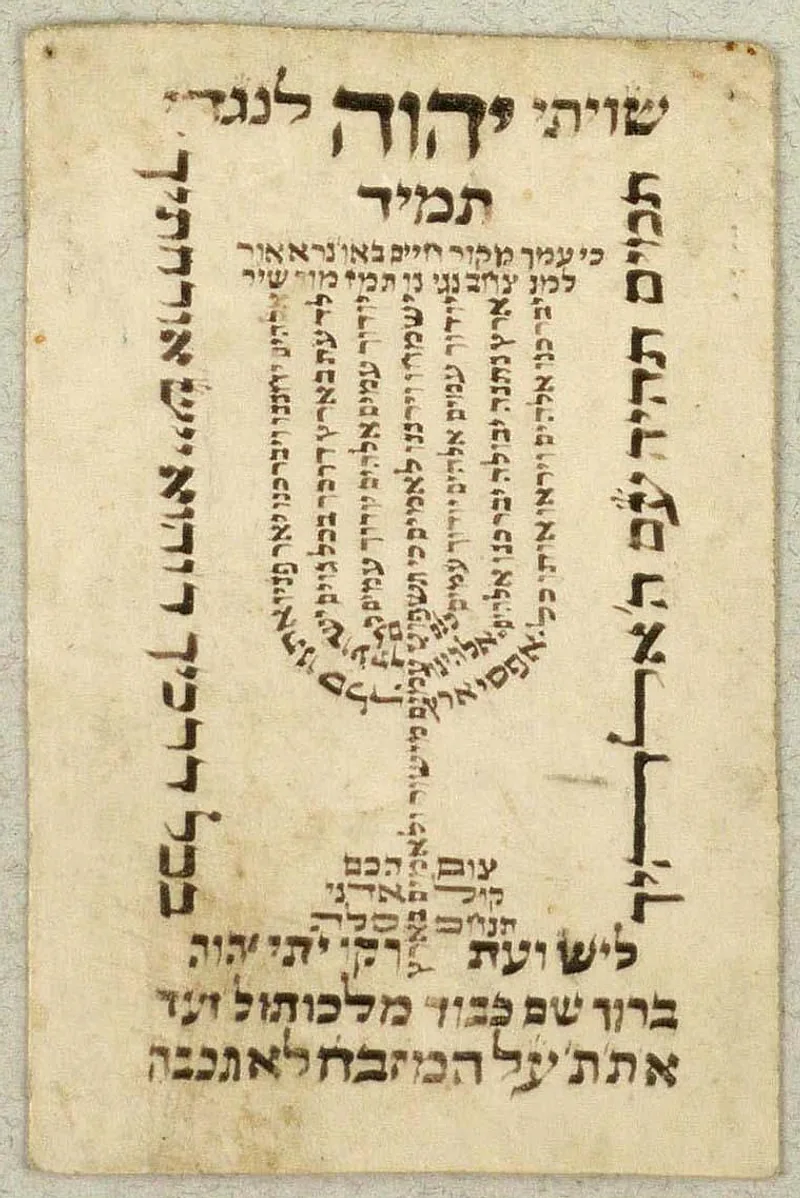
Beyond the manual itself, Kabbalists and Hasidim developed many devotional uses of the Psalms. The menorah psalm, Psalm 67 arranged in the shape of the seven-branched lampstand, appears on synagogue plaques, prayer books and amulets, especially in Sephardi and Mizrahi communities, often above the verse "I have set the Lord always before me," from which the shiviti plaque takes its name.
Rabbi Nachman of Breslov (1772–1810) taught the Tikkun ha-Klali, the "general remedy," a set of ten psalms (16, 32, 41, 42, 59, 77, 90, 105, 137 and 150) to be recited as spiritual repair, and his followers still recite them, especially at his grave in Uman. Many communities maintain groups that divide the Psalms among members so that the whole book is recited for a sick person or on behalf of the community. These practices are understood as prayer, but they share with Shimmush Tehillim the belief that particular psalms suit particular needs.
Godfrey Selig and the Secrets of the Psalms§
In 1788 Gottfried (Godfrey) Selig, a Jewish convert to Christianity who taught Hebrew in Leipzig, published a German translation of Shimmush Tehillim. His version, presented as revealing the "secrets" of the Psalms, was later translated into English and printed in America from the nineteenth century, sometimes bound with editions of the German grimoire The Sixth and Seventh Books of Moses. Selig's work was one of the main routes by which a Jewish magical text reached a wide Christian readership.
In the United States the "Secrets of the Psalms" became a staple of African American conjure and hoodoo, where reading particular psalms over candles, roots or written petitions is still widespread. Historians such as Jeffrey E. Anderson and Catherine Yronwode have documented how the Psalms, already central to Black Protestant spirituality, were combined with uses taken from Selig and from popular grimoires. The case shows how a medieval Hebrew text could travel through German print culture into the folk religion of the American South.
Modern Study and Continuing Use§
Modern scholars study Shimmush Tehillim as part of the history of Jewish magic, alongside amulets, incantation bowls and magical handbooks. Joshua Trachtenberg discussed its place in medieval Ashkenazi folk religion, Gideon Bohak traced the ancient background of scriptural magic, and Rebiger's edition clarified the text's transmission.
Among traditional Jews today the recitation of psalms for protection, healing and success remains a living practice, generally understood as prayer and accompanied by charity and good deeds rather than as a mechanical technique. Those who use the Psalms in this way usually stress that such prayer is no substitute for medical or other practical help. For the wider world of names and amulets, see Sefer Raziel ha-Malakh and Jewish magic and folklore.
Frequently asked questions§
What is Shimmush Tehillim?§
It is a medieval Hebrew handbook that lists a practical use for each of the Psalms, with a divine name and a short prayer. It belongs to the literature of practical Kabbalah and was printed many times from the sixteenth century.
Is it allowed in Judaism to use psalms for healing?§
Rabbinic law forbids using Torah verses as a medical cure but permits reciting them for protection, and reciting psalms for the sick as prayer is widely accepted. Authorities have long debated where the boundary lies.
Who was Godfrey Selig?§
Gottfried Selig was an eighteenth-century Hebrew teacher in Leipzig, a convert from Judaism, who translated Shimmush Tehillim into German in 1788. English versions of his translation spread in America as the "Secrets of the Psalms."
Which psalm is used for protection?§
Psalm 91 is the classic psalm of protection, already mentioned in the Talmud as a song against afflictions, and Psalm 121 is traditionally used on childbirth amulets. Usage varies between communities.
Sources and further reading§
- Sefer Shimmush Tehillim: Buch vom magischen Gebrauch der Psalmen — Bill Rebiger, 2010
- Secrets of the Psalms — Godfrey Selig, 1788
- Jewish Magic and Superstition — Joshua Trachtenberg, 1939
- Ancient Jewish Magic: A History — Gideon Bohak, 2008
- The Psalms through Three Thousand Years: Prayerbook of a Cloud of Witnesses — William L. Holladay, 1993
- Conjure in African American Society — Jeffrey E. Anderson, 2005
- Hoodoo Herb and Root Magic — Catherine Yronwode, 2002