Liber XX · Kabbalah · Chapter VIII: Sefer Yetzirah
Sefer Yetzirah: The Book of Formation and Its 32 Paths
Sefer Yetzirah, the Book of Formation, explained: the 32 paths, ten sefirot belimah, 22 Hebrew letters, recensions, dating, commentaries and the golem.

The Sefer Yetzirah ("Book of Formation" or "Book of Creation") is a brief, cryptic Hebrew text describing how God created the universe through "thirty-two wondrous paths of wisdom": the ten sefirot and the twenty-two letters of the Hebrew alphabet. Only a few pages long and of uncertain date, it became one of the most commented-upon works in Jewish thought and a foundation for later Kabbalah. Its letter classifications also passed, centuries later, into Western occultism.
What the Sefer Yetzirah Says§
The book opens with a statement that God engraved the world "with thirty-two wondrous paths of wisdom" and with three related terms often translated as "number, text and communication" (sefar, sefer, sippur), whose precise meaning has been debated since the Middle Ages. It then divides the thirty-two into ten and twenty-two.
The ten sefirot belimah§
The first chapter introduces ten sefirot belimah. The word sefirot here most naturally means "numbers" or "countings", and belimah is usually understood as "without anything" or "closed", that is, abstract or ineffable. The ten are described as five pairs of opposites forming a ten-dimensional field: beginning and end, good and evil, above and below, east and west, north and south. Another passage presents them as a sequence: the Spirit of the Living God, then air from spirit, water from air, and fire from water, followed by the six directions sealed with permutations of the divine name YHW.
The text commands the reader to understand them and to "restrain your mouth from speaking and your heart from thinking", and describes their appearance as like a flash of lightning without end. These sefirot are not yet the ten personified divine attributes of medieval Kabbalah, but kabbalists from the twelfth century onward read the two as identical, which is why this book stands at the root of the Tree of Life and the ten sefirot.
The twenty-two letters§
The remaining chapters treat the twenty-two letters as the building blocks of everything. God "engraved them, carved them, weighed them, permuted them and combined them" and formed with them all that was created and all that would be. The letters are arranged in "231 gates", the number of possible two-letter pairings of twenty-two letters, which can be read in both directions. This idea of permutation and combination later inspired letter-meditation techniques and broader traditions of gematria and letter mysticism.
The Three Mothers, Seven Doubles and Twelve Simples§
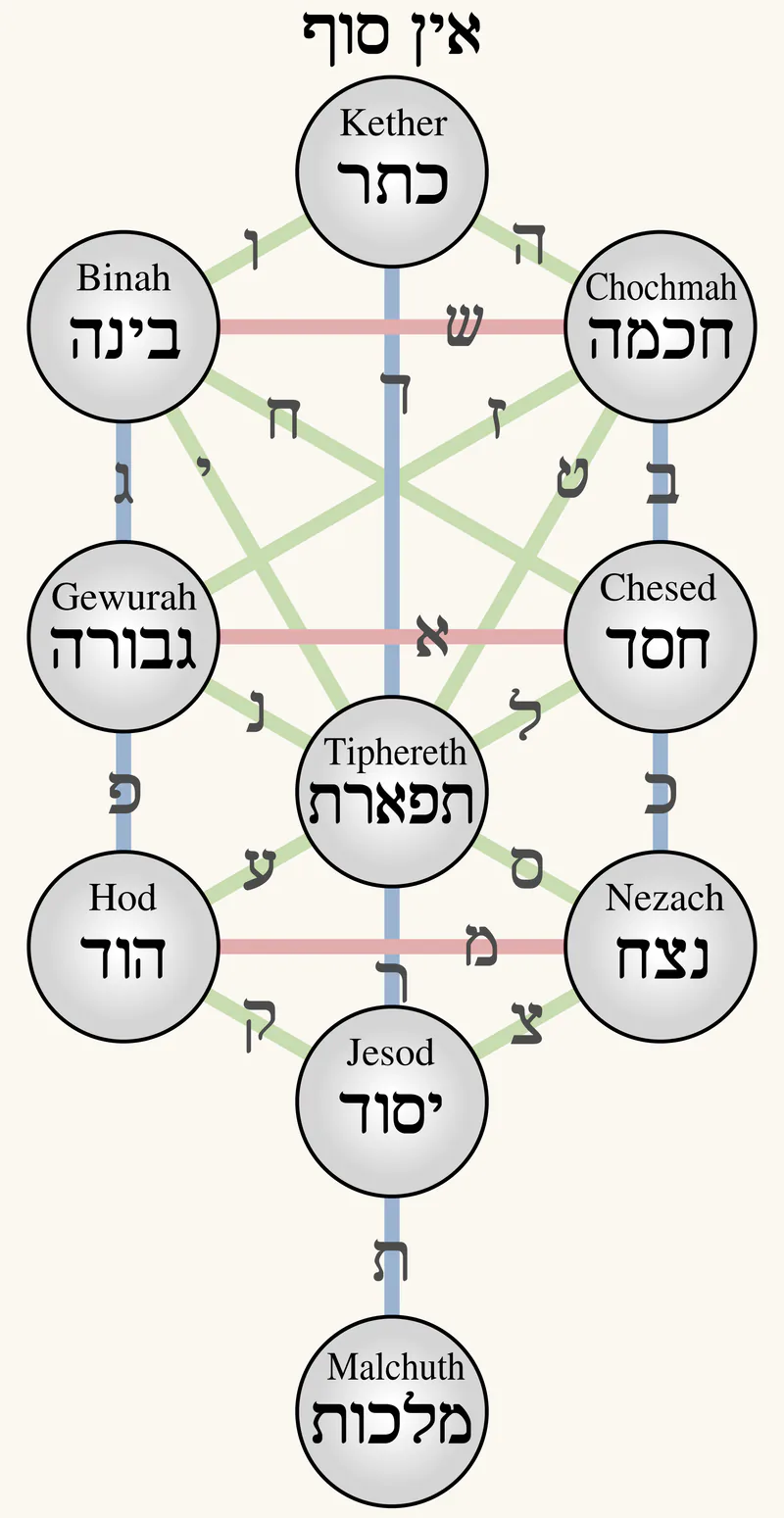
The book's most famous feature is its classification of the alphabet into three groups, each correlated with structures in the world (olam), the year (shanah) and the human body (nefesh).
The three mother letters§
The three "mothers" are Aleph, Mem and Shin. They correspond to air, water and fire respectively: Mem is silent or humming like water, Shin hissing like fire, and Aleph the airy balance between them. In the year they correspond to the temperate, cold and hot seasons; in the body to the chest, belly and head. The text calls them "a great, wondrous and hidden secret, sealed with six rings".
The seven double letters§
The seven "doubles" are Bet, Gimel, Dalet, Kaf, Peh, Resh and Tav. They are called double because they could be pronounced in two ways, hard and soft, a feature still marked in Hebrew grammar by the dagesh for most of them (the double pronunciation of Resh is attested in some traditions only). They correspond to the seven planets known in antiquity, the seven days of the week, seven openings of the head (two eyes, two ears, two nostrils, mouth), and seven pairs of opposites such as life and death, peace and war, wisdom and folly. The assignments of particular planets to particular letters differ between manuscripts.
The twelve simple letters§
The twelve "simples" are He, Vav, Zayin, Het, Tet, Yod, Lamed, Nun, Samekh, Ayin, Tsade and Qof. They correspond to the twelve signs of the zodiac, the twelve months, twelve diagonal boundaries of space, and twelve faculties or organs, including speech, thought, motion, sight, hearing, sexuality, smell, sleep, anger, taste and laughter. Here too the lists differ in detail from version to version.
This scheme shows the book's debt to late antique cosmology, in which elements, planets and zodiac formed a unified system of correspondences. It also anticipates the Hermetic method of correspondences that later occultists built upon. When the Golden Dawn assigned the twenty-two Hebrew letters to the Major Arcana and to paths on the Tree of Life, it used the Sefer Yetzirah's three-seven-twelve division as its framework, as discussed in the history of tarot.
Recensions and Textual History§
There is no single Sefer Yetzirah. The text survives in several recensions that differ substantially in length and arrangement:
- The short recension, roughly 1,300 words, is the version most often printed with traditional commentaries.
- The long recension, roughly 2,500 words, includes additional material and different orderings.
- The Saadian recension, which underlies Saadia Gaon's tenth-century commentary, broadly resembles the long version but with its own sequence of sections.
The earliest substantial manuscripts are medieval, though fragments from the Cairo Genizah take the text back before 1000. The first printed edition appeared in Mantua in 1562. A later "Gra version" established by the Vilna Gaon in the eighteenth century became authoritative in many communities. In 2004 A. Peter Hayman published a critical edition and argued that no single original can be recovered: the book grew through layers of redaction, so the very idea of an "original text" is problematic.
Dating and Authorship§
Tradition ascribes the Sefer Yetzirah to the patriarch Abraham; the text's final passage mentions Abraham contemplating and understanding what is described, and some sources call it Otiyot de-Avraham Avinu, "The Letters of Abraham our Father". The Talmud (Sanhedrin 65b and 67b) mentions sages who studied "Hilkhot Yetzirah" (laws of creation) and thereby created a calf which they ate on the Sabbath eve, but it is unclear whether this refers to our text.
Modern scholars disagree widely on date:
- Gershom Scholem suggested an origin between the third and sixth centuries, in a Jewish milieu influenced by Greek speculation on numbers and letters, possibly Neopythagorean.
- Some have argued for a still earlier date, near the beginning of the Common Era.
- Steven Wasserstrom and others have pointed to parallels with early Islamic letter speculation and proposed a date in the eighth or ninth century.
- Hayman's layered model suggests that early material underwent continuing redaction until the tenth century.
Its language includes features of Mishnaic Hebrew, but this does not settle the matter, since later authors could imitate the style. The safest statement is that the book existed in some form by the early tenth century, when it was the object of several commentaries.
The Great Commentaries: Saadia, Donnolo and After§
The tenth century saw an extraordinary burst of commentary. Saadia Gaon (882–942), the leading scholar of Babylonian Jewry, wrote a commentary in Judaeo-Arabic around 931, treating the book as a work of natural philosophy and cosmology, and translating its doctrines into the language of rational science. In southern Italy the physician Shabbetai Donnolo (913–c. 982) wrote Sefer Hakhmoni, which interprets the text in light of astronomy and astrology and links it to the creation of the human being in God's image. In North Africa, Dunash ibn Tamim of Kairouan composed a further commentary in the mid-tenth century. These works read the book scientifically rather than mystically.

From the twelfth century the situation changed. Judah ben Barzillai of Barcelona wrote a long commentary drawing on earlier philosophical readings, and in Provence and Gerona the book was reinterpreted kabbalistically. Isaac the Blind's commentary is among the earliest kabbalistic works; it identifies the ten sefirot with the divine attributes. The German Pietists, notably Eleazar of Worms (c. 1176–1238), wrote commentaries that include instructions concerning the creation of a golem. Later commentaries were written by Abraham Abulafia, Moses Botarel, the circle of Isaac Luria and the Vilna Gaon, making the Sefer Yetzirah a lens through which nearly every school of Kabbalah defined itself.
The Sefer Yetzirah and the Golem§
The golem legend is closely tied to this book. In medieval Ashkenaz, the Talmudic stories about sages creating a calf or an artificial man were connected to the Sefer Yetzirah's teaching that letters form all things. Eleazar of Worms and other Pietists described a ritual involving clay, letter combinations and the alphabet's 231 gates. Scholars such as Moshe Idel, in Golem (1990), argue that this was understood mainly as a mystical exercise demonstrating mastery of the creative power of language, not as practical engineering.
The famous story of Rabbi Judah Loew of Prague (the Maharal, c. 1520–1609) creating a golem to protect the Jewish community is a much later legend. It is not found in the Maharal's own writings and became widely known through nineteenth-century collections and literary retellings, as well as Gustav Meyrink's novel Der Golem (1915) and the 1920 film by Paul Wegener. A related legend tells of a golem created by Elijah of Chełm in the sixteenth century.
Influence Beyond Jewish Tradition§
The Sefer Yetzirah was translated into Latin during the Renaissance; Guillaume Postel published a Latin translation in 1552, and it was drawn into Christian Cabala. It shaped the theories of the thirty-two paths used by Hermetic writers, though the Hermetic "Thirty-Two Paths of Wisdom" text often attached to it is a separate, later medieval work. William Wynn Westcott published an English translation in 1887, and the Golden Dawn used its letter-correspondences extensively. In Jewish settings the book continues to be studied with traditional commentaries, and Aryeh Kaplan's annotated translation (1990) presented it for a modern audience, including its meditative dimensions alongside Merkavah traditions described in Merkavah and Hekhalot mysticism.
Frequently asked questions§
What are the 32 paths of wisdom?§
According to the Sefer Yetzirah, the thirty-two paths are the ten sefirot (originally numbers or dimensions) and the twenty-two letters of the Hebrew alphabet. Through these, God formed the cosmos. In later Hermetic Qabalah, the thirty-two paths became the ten sefirot plus the twenty-two connecting lines of the Tree of Life.
Who wrote the Sefer Yetzirah?§
Tradition attributes it to the patriarch Abraham. Modern scholars regard it as anonymous, with proposed dates ranging from the first centuries CE to the ninth century. Many now think it grew in layers over a long period rather than being composed at one time.
What are the three mother letters?§
The three mothers are Aleph, Mem and Shin, associated with air, water and fire. The Sefer Yetzirah treats them as the primary letters from which the elements, seasons and principal parts of the body are formed.
Is the Sefer Yetzirah connected to the golem?§
Yes. Medieval German Jewish mystics linked the Talmudic stories of sages creating artificial beings with the book's teaching on letter combination, and some commentaries describe a golem ritual. The famous Prague golem story of Rabbi Judah Loew is a later legend.
Sources and further reading§
- Sefer Yesira: Edition, Translation and Text-Critical Commentary — A. Peter Hayman, 2004
- Sefer Yetzirah: The Book of Creation in Theory and Practice — Aryeh Kaplan, 1990
- Golem: Jewish Magical and Mystical Traditions on the Artificial Anthropoid — Moshe Idel, 1990
- Origins of the Kabbalah — Gershom Scholem, 1987 (English translation)
- On the Kabbalah and Its Symbolism — Gershom Scholem, 1965 (includes "The Idea of the Golem")
- Sepher Yetzirah: The Book of Formation — William Wynn Westcott (trans.), 1887
- Kabbalah — Gershom Scholem, 1974