Liber XX · Kabbalah · Chapter VI: Merkavah & Hekhalot
Merkavah and Hekhalot Mysticism: Chariot Visions and Ascent
Merkavah and Hekhalot mysticism explained: Ezekiel's chariot, the heavenly palaces, the descenders to the chariot, Metatron, 3 Enoch and debates over dating.

Merkavah mysticism is the earliest well-documented form of Jewish mysticism, centred on the "chariot" (merkavah) throne of God seen by the prophet Ezekiel. Its main literary witnesses, the Hekhalot ("palaces") texts written in Hebrew and Aramaic between roughly late antiquity and the early medieval period, describe visionary ascents through seven heavenly palaces, angelic hymns, and techniques for invoking angels. This literature later fed directly into medieval Kabbalah.
Ezekiel's Vision and the Origins of Merkavah Speculation§
The foundation of chariot mysticism is the first chapter of the book of Ezekiel. By the river Chebar in Babylonia, the exiled priest sees a storm from the north, four living creatures each with four faces and four wings, wheels "full of eyes", a firmament like crystal, and above it a throne on which sits "the appearance of the likeness of the glory of the LORD" (Ezekiel 1:28, KJV). Chapter 10 returns to the vision, identifying the creatures as cherubim. Isaiah 6, with its seraphim crying "Holy, holy, holy", and Daniel 7, with its fiery throne and the "Ancient of Days", supplied further imagery.
Second Temple literature extended these visions. The Book of the Watchers in 1 Enoch (chapter 14) describes Enoch ascending to a heavenly house of fire and crystal, entering an inner house, and seeing a lofty throne. The Songs of the Sabbath Sacrifice found among the Dead Sea Scrolls describe angelic priests worshipping in a heavenly sanctuary and even refer to the chariot-throne. These texts show that speculation about the heavenly throne and its angelic liturgy was already well developed before rabbinic Judaism took shape.
Rabbinic caution: the "work of the chariot"§
The Mishnah (Hagigah 2:1) restricts teaching of two subjects: ma'aseh bereshit (the "work of creation", Genesis 1) and ma'aseh merkavah (the "work of the chariot", Ezekiel 1). The chariot may not be expounded even to a single student unless he is wise and understands on his own. The Talmud and Tosefta preserve stories of sages expounding the chariot, among them Yohanan ben Zakkai and his disciple Eleazar ben Arakh, with fire descending and angels gathering to listen.
The most famous of these stories is that of the four who "entered the pardes" (orchard): Ben Azzai looked and died, Ben Zoma looked and was harmed, Elisha ben Abuyah "cut the shoots" (became a heretic), and only Rabbi Akiva entered and left in peace. Whether this story originally described a mystical ascent or a metaphor for dangerous speculation is one of the classic scholarly questions in the field. Hekhalot texts certainly read it as an ascent and made Akiva one of their heroes.
The Hekhalot Literature: Main Texts§
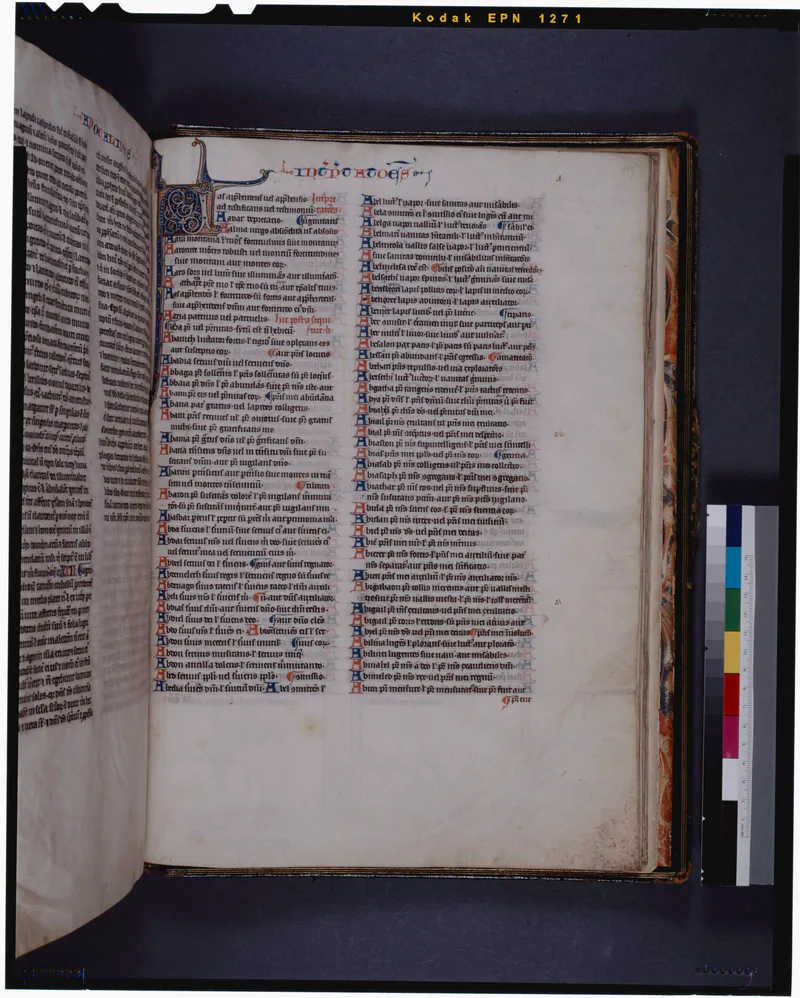
The Hekhalot writings are not tidy books with fixed boundaries. They survive in medieval manuscripts, mostly copied by the German Pietists (Hasidei Ashkenaz) in the twelfth and thirteenth centuries, and they consist of overlapping units, sometimes called "macroforms", that circulated in varying combinations. Peter Schäfer's Synopse zur Hekhalot-Literatur (1981) laid out the main manuscripts in parallel columns, showing how fluid the material is. The principal units include:
Hekhalot Rabbati ("The Greater Palaces")§
Associated chiefly with Rabbi Ishmael, Hekhalot Rabbati contains extensive hymns praising God as King, a detailed description of the seven palaces and their gatekeepers, and the account of how the yored merkavah passes the guardians by showing them "seals" (secret names). It also includes a dramatic narrative about the martyrdom of ten rabbis under Rome, in which Rabbi Nehunya ben ha-Kanah is recalled from his ecstatic state by touching him with a cloth carrying minimal impurity. Its hymns, with their repeated chains of praise words, became part of the background to later Jewish liturgy.
Hekhalot Zutarti ("The Lesser Palaces")§
Centred on Rabbi Akiva, Hekhalot Zutarti is rich in divine names and magical formulas. It includes a version of the pardes story and material on the dimensions of God, as well as incantations of the type found in the wider tradition of Jewish magic.
Ma'aseh Merkavah and Merkavah Rabbah§
Ma'aseh Merkavah ("The Work of the Chariot") is largely a collection of hymns and prayers framed as dialogue between Ishmael and Akiva. Merkavah Rabbah contains material on the Sar Torah (Prince of the Torah) and on Shi'ur Qomah.
Shi'ur Qomah§
The Shi'ur Qomah ("Measure of the Stature") texts describe the limbs of the divine body in astronomically large measurements with secret names for each part. Their anthropomorphism troubled later rationalists; Maimonides is reported to have rejected the work as spurious, while kabbalists read it symbolically.
Sefer Hekhalot (3 Enoch)§
Sefer Hekhalot, known in modern scholarship as 3 Enoch or the "Hebrew Book of Enoch", is narrated by Rabbi Ishmael, who ascends to heaven and is guided by Metatron. Metatron reveals that he was once the human Enoch, son of Jared, taken up and transformed into a fiery angel, enthroned, given seventy names, and called "the lesser YHWH". Hugo Odeberg published the first critical edition and translation in 1928, and Philip Alexander's English translation (1983) remains standard.
The Descenders to the Chariot§
The visionaries of this literature are repeatedly called yordei merkavah, "those who go down to the chariot", even though the texts describe rising through the heavens. The phrase has generated many explanations. Some scholars connect it to synagogue language, in which the prayer leader "goes down before the ark"; others suggest it reflects a posture of descent into oneself, or the image of descending into a chariot as one climbs into a vehicle. No explanation has won full agreement, and the texts also use the term olei merkavah ("those who ascend").
The ascent involves passing through seven palaces, each guarded by angels who test the traveller. The sixth palace was considered particularly dangerous: in one famous passage, the traveller sees what looks like water but is in fact the shining marble of the palace, and anyone who mistakes it for water is struck down. Commentators have linked this to Akiva's warning in the Talmud not to say "water, water" when reaching the stones of pure marble.
Preparatory practices§
Some texts describe preparation by fasting, ritual purification and the recitation of hymns and names. Hai Gaon, head of the academy at Pumbedita (d. 1038), wrote in a responsum that those seeking visions would fast for a number of days and sit with their heads between their knees, whispering praises; this description is often quoted in modern studies. Descriptions of this kind are literary and historical evidence about claimed practice; the texts themselves warn of serious danger to the unprepared.
Sar Torah and the magical dimension§
Alongside the ascent material, a strand called Sar Torah ("Prince of the Torah") describes adjuring an angel so that a student will acquire perfect memory of Torah learning without labour. This shows that Hekhalot literature combined mystical vision with practical, sometimes magical aims, a combination that also appears in Jewish incantation bowls and amulets of the period and in texts such as the Testament of Solomon from the wider late antique world.
Metatron, the Prince of the Presence§
Metatron is one of the most discussed figures in Jewish angelology. His name has no secure etymology; proposals include derivation from Greek meta thronos ("beside the throne") or from Latin metator ("guide" or "one who marks out the way"), but none is certain. In the Babylonian Talmud (Hagigah 15a), Elisha ben Abuyah sees Metatron seated in heaven and concludes, wrongly, that there are "two powers in heaven"; Metatron is then punished with sixty lashes of fire to show that he is not divine. In 3 Enoch, by contrast, Metatron is exalted as a vice-regent of extraordinary status.
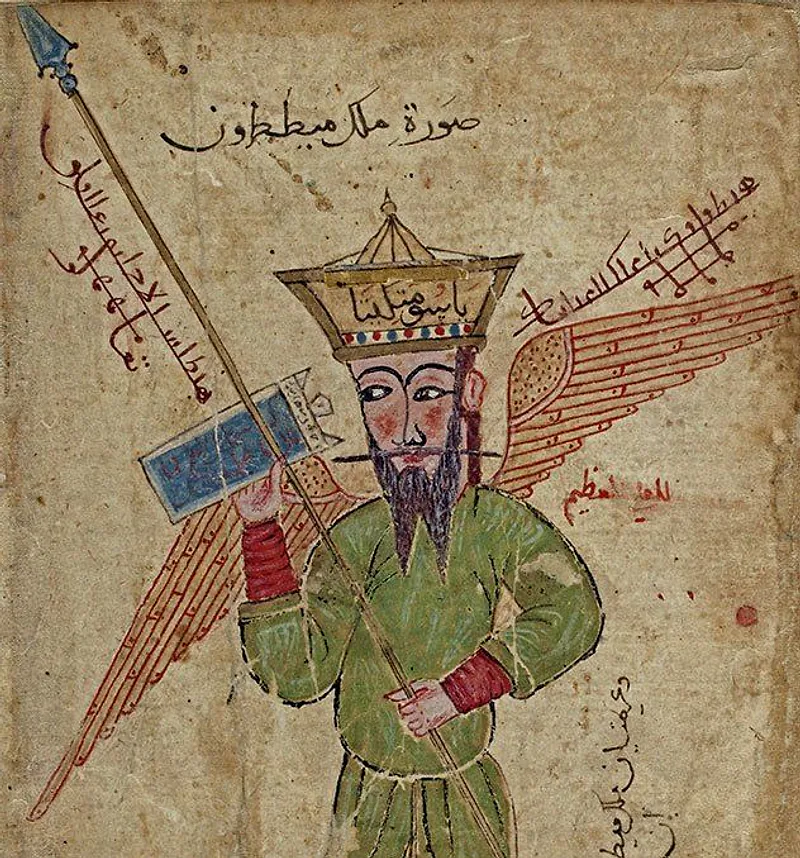
These two images reflect a tension within Jewish thought between the desire to describe the mediating angels who stand near God and the insistence on God's absolute uniqueness. Later Kabbalah inherited Metatron, sometimes identifying him with a lower level of the divine world, and Hermetic writers in turn assigned him to Keter on their Tree of Life, a much later use.
Dating Debates and Interpretation§
How old is Hekhalot mysticism? Gershom Scholem argued that its core goes back to the Tannaitic period (first and second centuries CE) and that it represented a Jewish form of Gnostic-type ascent mysticism. He saw it as the first major phase of Jewish mysticism, setting the pattern for later developments.
Later scholars have qualified this considerably. Peter Schäfer emphasised that the texts as we have them are late and fluid, that their final redaction is likely to belong to the post-Talmudic or early Islamic period, and that their purpose may lie as much in liturgy and magic as in ecstatic ascent. David Halperin, in The Faces of the Chariot (1988), read the material against synagogue exegesis of Ezekiel and proposed social tensions between scholars and the unlearned. Rachel Elior has connected the literature to priestly traditions and the memory of the destroyed Temple, describing the heavenly palaces as a replacement sanctuary. Michael Swartz has studied the ritual and magical setting, particularly the Sar Torah material.
A related debate concerns whether the ascents were real visionary practices or literary productions. Some scholars treat them as descriptions of altered states induced by ritual; others see them as primarily textual and liturgical. Most current work accepts that both elements are present and that the literature should be read on its own terms rather than through later kabbalistic categories.
Influence on Later Jewish Mysticism§
The Hekhalot material reached Europe through Italy and was copied and studied by the German Pietists, who integrated its hymns and names into their own piety and magic. Medieval kabbalists inherited its vocabulary of palaces, angels and divine glory; the Zohar contains sections called Hekhalot describing palaces of holiness and impurity. Speculation on divine names and letters, shared with the Sefer Yetzirah and later developed through techniques such as gematria, also has roots here. Above all, the Hekhalot texts left a model of mysticism as approach to the divine throne through praise, purity and knowledge of secret names, a model that the broader history of Kabbalah would transform but never entirely abandon.
Frequently asked questions§
What does Merkavah mean?§
Merkavah is the Hebrew word for "chariot". In Jewish tradition it refers to the throne-chariot of God described in Ezekiel 1 and 10, and by extension to the mystical speculation and visionary practices centred on that vision.
Why are they called "descenders" to the chariot?§
The texts call the visionaries yordei merkavah, "those who go down to the chariot", although they describe ascents. Scholars have proposed explanations from synagogue terminology, posture, or vehicle imagery, but there is no consensus, and some passages use the language of ascending instead.
Who is Metatron?§
Metatron is an exalted angel known as the Prince of the Presence. In 3 Enoch he is identified with the biblical Enoch, transformed into a fiery being and given the title "the lesser YHWH". In the Talmud, by contrast, he is punished to show that he is not a second divine power.
When were the Hekhalot texts written?§
Dating is disputed. Some material may draw on ideas from the early rabbinic period, but most scholars now place the redaction of the main texts between the late Talmudic era and the early Islamic period, roughly the fourth to ninth centuries, with the manuscripts themselves being medieval.
Sources and further reading§
- Synopse zur Hekhalot-Literatur — Peter Schäfer (ed.), 1981
- The Hidden and Manifest God: Some Major Themes in Early Jewish Mysticism — Peter Schäfer, 1992
- Jewish Gnosticism, Merkabah Mysticism, and Talmudic Tradition — Gershom Scholem, 1960
- The Faces of the Chariot — David J. Halperin, 1988
- The Three Temples: On the Emergence of Jewish Mysticism — Rachel Elior, 2004
- "3 (Hebrew Apocalypse of) Enoch" in The Old Testament Pseudepigrapha, vol. 1 — Philip Alexander (trans.), 1983
- 3 Enoch or the Hebrew Book of Enoch — Hugo Odeberg, 1928
- Scholastic Magic: Ritual and Revelation in Early Jewish Mysticism — Michael D. Swartz, 1996
- The Book of Ezekiel, chapters 1 and 10 (King James Version)