Liber XX · Kabbalah · Chapter VI: Merkavah & Hekhalot
Shiur Qomah: The Measure of the Divine Body in Jewish Mysticism
Shiur Qomah, the 'measure of the body' of God in Hekhalot mysticism: vast numbers, secret names, Song of Songs roots, dating debates and medieval critics.

Shiur Qomah ("The Measure of the Stature") is a body of late antique or early medieval Jewish mystical texts that describe the limbs of God's body, giving each a secret name and an immense size measured in heavenly parasangs. Preserved among the Hekhalot writings, it presents the vision of the divine form seated on the throne of glory as a revealed secret that promises salvation to those who know it. Its bold anthropomorphism made it one of the most controversial texts in Jewish history.
What the Shiur Qomah Describes§
The Shiur Qomah texts are short and strange. In the voice of Rabbi Ishmael or Rabbi Akiva, who learn the secret from the angel Metatron, they describe the "measure of the body" of the Creator, the figure who appears on the throne of glory in the visions of Merkavah mysticism. Beginning with the soles of the feet and moving upward through the ankles, legs, thighs, neck, head, beard, face, eyes and crown, the text gives each limb a secret name, often an unpronounceable sequence of letters, and a measurement in parasangs.
The numbers are deliberately overwhelming. In one well-known formulation, the height of the Creator is 236 myriads (ten-thousands) of parasangs, and each parasang is defined as so vast that it fills the world. The number 236 itself is the numerical value, by gematria, of the words ve-rav koaḥ, "and great in power," from Psalm 147:5, "Great is our Lord, and mighty in power." The measurements thus encode a verse of praise and at the same time make the divine body infinitely large, beyond any human scale.
The texts close with a promise. Whoever knows this measure of the Creator, they say, is assured of a place in the world to come, provided that he recites it in the right spirit. The knowledge of the divine form and its names is presented as a saving secret and as part of the liturgy of the heavenly court.
Song of Songs, Ezekiel and the Hekhalot Texts§
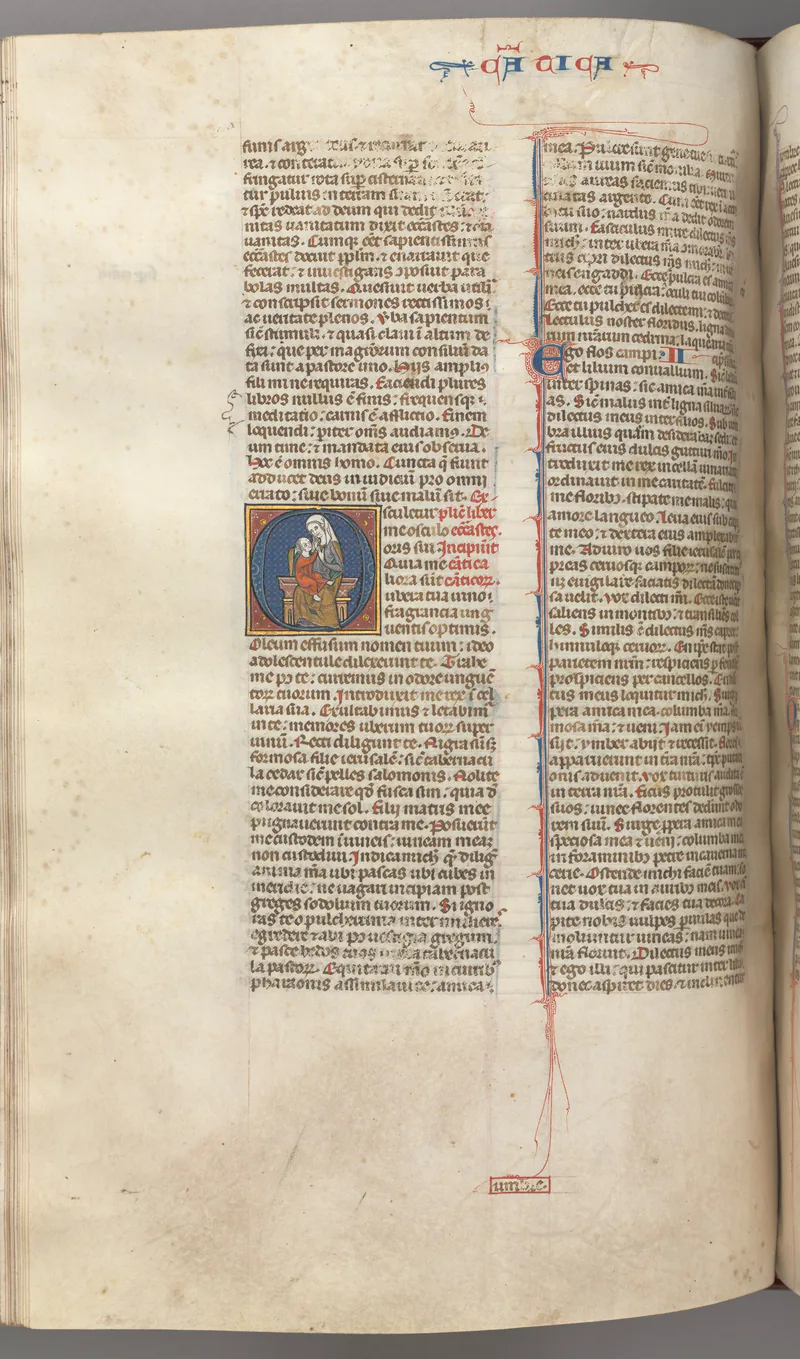
The imagery of the Shiur Qomah draws on two biblical passages. In Ezekiel's vision, the prophet sees above the firmament "a likeness as the appearance of a man" upon the throne. In the Song of Songs, the bride describes her beloved limb by limb: his head of fine gold, his locks, his eyes, his cheeks, his lips, his arms and legs (5:10–16). In rabbinic tradition the Song was read as an allegory of God and Israel, and Gershom Scholem and Saul Lieberman argued that the Shiur Qomah developed as an esoteric interpretation of this description of the beloved's body.
The texts survive within the Hekhalot corpus, the collection of writings on heavenly ascent and angelic adjuration that also includes Hekhalot Rabbati and 3 Enoch. Versions appear in works known as Sefer ha-Qomah, Merkavah Rabbah and Siddur Rabbah, and fragments are found among Genizah manuscripts. The text was also absorbed into later compilations, including the printed Sefer Raziel ha-Malakh. Martin Samuel Cohen's studies (1983 and 1985) collected and compared the recensions.
Dating and the Debate over Origins§
When the Shiur Qomah was composed is disputed. Scholem believed that its core ideas were ancient, possibly going back to the Tannaitic period of the second century, and that early church fathers may allude to similar Jewish speculations. He drew attention to parallels with Gnostic texts: the second-century teacher Marcus, according to Irenaeus, described the body of "Truth" as composed of the letters of the alphabet, and the Elchasaite movement spoke of a gigantic angel whose measurements were given in miles. These parallels shaped Scholem's description of Hekhalot mysticism as "Jewish Gnosticism" (see What Is Gnosticism?).
Others have argued for a later date. Cohen proposed that the Shiur Qomah texts in their present form belong to the late Talmudic or early Geonic period, perhaps between the sixth and eighth centuries. Peter Schäfer and his colleagues, working from the manuscripts, have stressed that the Hekhalot texts are fluid compositions edited over centuries, so that no single date can be assigned. Most scholars now see the Shiur Qomah as part of a long tradition of speculation on the divine body whose surviving forms are relatively late, even if the ideas behind them may be older.
Theology: Anthropomorphism or Paradox?§
At first reading the Shiur Qomah seems to describe God as a giant with a body. Many modern scholars, however, read it as a paradox. The measurements are so enormous and the names so unpronounceable that the text undermines any attempt to picture the body it describes. Its purpose may be to evoke awe at a God whose form is at once visible to the visionary and utterly beyond human measure, a theme that runs through the Hekhalot literature with its descriptions of the dazzling face and the danger of gazing on it.
The liturgical character of the texts is also important. They are full of hymns of praise, and the knowledge they convey is meant to be recited. Cohen described the Shiur Qomah as a form of "liturgy and theurgy," in which reciting the names and measures participates in the angelic praise of God and may affect the divine realm.
Karaites, Saadia and Maimonides§
In the early Middle Ages the Shiur Qomah became a weapon in religious polemic. Karaite writers, who rejected rabbinic tradition, cited it as proof that the rabbis believed in a corporeal God. Defenders of rabbinic Judaism had to respond. Saadia Gaon (882–942), the great philosopher and leader of Babylonian Jewry, did not deny the text's authority but interpreted it: the form seen by the prophets and mystics, he argued, was a created glory (kavod nivra), a radiance made by God to appear to human beings, not God's own essence.
Maimonides (1138–1204) took a harder line. Committed to the absolute incorporeality of God, he is reported in a responsum to have declared the Shiur Qomah a late forgery that deserved to be destroyed. Whether he held this view throughout his life has been debated, since a reference to the work seems to appear in an early draft of his commentary on the Mishnah and later to have been removed. In any case, the rationalist tradition after Maimonides regarded the Shiur Qomah with deep suspicion. See also Jewish philosophy from Philo to Maimonides.
Afterlife in the German Pietists and the Kabbalah§
Not all medieval thinkers rejected the text. The German Pietists of the twelfth and thirteenth centuries, especially Eleazar of Worms, adopted Saadia's idea of the created glory and incorporated Shiur Qomah material into their speculations on the divine form. The Kabbalists went further. For them, the measures and names of the divine body could be read as symbols of the sefirot, the structure of divine powers often depicted in human form, with the sefirot corresponding to head, arms, torso and legs (see the ten sefirot).
The most striking heir of the Shiur Qomah is the Idra Rabba of the Zohar, which describes in great detail the head, beard and face of the "Long-Suffering One" and the "Short-Faced One." Here the old speculation about the divine stature becomes a mythic portrait of the inner life of God. Through the Zohar and later Lurianic Kabbalah, the image of the divine body remained central to Jewish mysticism, despite the objections of the philosophers.
Frequently asked questions§
What does Shiur Qomah mean?§
Shiur Qomah means "measure of the stature" or "measure of the body." It is the name of mystical texts that describe the limbs of the divine figure on the throne of glory, with their secret names and immense dimensions.
Does the Shiur Qomah say God has a body?§
It describes a divine body, but its numbers are so vast and its names so mysterious that many scholars read it as a paradoxical way of expressing God's transcendence. Medieval interpreters such as Saadia said it referred to a created glory, not to God's essence.
How old is the Shiur Qomah?§
Scholars disagree. Scholem thought its ideas went back to the second century, while others date the surviving texts to the late Talmudic or Geonic period, perhaps the sixth to eighth centuries.
Why did Maimonides reject the Shiur Qomah?§
Maimonides held that God has no body or likeness of a body. A responsum attributed to him calls the Shiur Qomah a forgery that should be destroyed, because it appeared to teach that God is corporeal.
Sources and further reading§
- The Shi'ur Qomah: Liturgy and Theurgy in Pre-Kabbalistic Jewish Mysticism — Martin Samuel Cohen, 1983
- The Shi'ur Qomah: Texts and Recensions — Martin Samuel Cohen, 1985
- Jewish Gnosticism, Merkabah Mysticism, and Talmudic Tradition — Gershom Scholem, 1960
- On the Mystical Shape of the Godhead: Basic Concepts in the Kabbalah — Gershom Scholem, 1991
- The Hidden and Manifest God: Some Major Themes in Early Jewish Mysticism — Peter Schäfer, 1992
- The Origins of Jewish Mysticism — Peter Schäfer, 2009
- Through a Speculum That Shines: Vision and Imagination in Medieval Jewish Mysticism — Elliot R. Wolfson, 1994