Liber XIX · Judaism · Chapter VI: Jewish Philosophy
Jewish Philosophy: Philo, Saadia, Maimonides and Beyond
A history of Jewish philosophy from Philo of Alexandria through Saadia Gaon, Judah Halevi and Maimonides' Guide for the Perplexed to Spinoza and Buber.

Jewish philosophy is the attempt by Jewish thinkers to understand the teachings of the Torah through reason, usually in dialogue with Greek philosophy as it was received in each age. Its great figures include Philo of Alexandria in the first century, Saadia Gaon, Solomon ibn Gabirol and Judah Halevi in the early Middle Ages, and above all Moses Maimonides, whose Guide for the Perplexed (about 1190) is one of the masterpieces of medieval thought. In the modern era Spinoza, Mendelssohn, Rosenzweig, Buber and Heschel carried the conversation into new directions.
Philo of Alexandria and Jewish Hellenism§
The first major Jewish philosopher was Philo of Alexandria (about 20 BCE – about 50 CE), a member of the wealthy Greek-speaking Jewish community of Egypt. Writing in Greek, Philo interpreted the Torah allegorically, finding in its stories the truths of Platonic and Stoic philosophy: the patriarchs became types of the soul's progress, and the creation account a description of God's ideas. He taught that God, utterly transcendent, acts in the world through the Logos, the divine reason or word, and through powers that mediate between God and creation. Philo's works were preserved not by Jews but by Christians, for whom his doctrine of the Logos was of great interest, and they have also been read as background to Neoplatonism. The rabbis of the Talmud never mention him, and Jewish philosophy as a continuous tradition began only centuries later, in the Islamic world.
Saadia Gaon and the Jewish Kalam§
When the Abbasid caliphate became a centre of Greek learning in Arabic translation, Jews, Christians and Muslims began to defend their faiths with philosophical argument. Saadia Gaon (882–942), born in Egypt and head of the Babylonian academy of Sura, wrote The Book of Beliefs and Opinions (completed about 933) in Judeo-Arabic. Drawing on the methods of the Muslim theologians of the kalam, especially the rationalist Mu'tazila, he argued that reason and revelation lead to the same truths, offered proofs that the world was created from nothing, defended the unity and justice of God and discussed the soul, resurrection and redemption. Revelation, he held, was given so that people would not have to wait for the slow and uncertain conclusions of reason. Saadia also translated the Bible into Arabic, compiled a prayer book and polemicised against the Karaites.

Neoplatonism and Poetry in Muslim Spain§
In the tenth to twelfth centuries the Jews of al-Andalus, Muslim Spain, produced a golden age of poetry and thought. Solomon ibn Gabirol (about 1021 – about 1058) was both a great Hebrew poet — his Keter Malkhut ("Royal Crown") is still recited on Yom Kippur — and the author of The Fountain of Life, a Neoplatonic work describing how all things below God are composed of matter and form. Translated into Latin as Fons Vitae, it was cited by Christian scholastics under the name "Avicebron", who was assumed to be a Muslim or Christian; only in 1846 did the scholar Salomon Munk show that Avicebron was Ibn Gabirol. Bahya ibn Paquda, in Duties of the Heart (late eleventh century), drew on Islamic and Sufi devotional literature to teach the inner obligations of trust in God, humility and love.
Judah Halevi (about 1075–1141), the most celebrated Hebrew poet of medieval Spain, took a different path. His Kuzari, completed around 1140, is a dialogue in which the king of the Khazars hears a philosopher, a Christian, a Muslim and finally a rabbi, and chooses Judaism. Halevi argued that the God of Abraham is known not by philosophical proof but by historical revelation witnessed by a whole people at Sinai, and that the people and Land of Israel have a unique capacity for prophecy. Late in life he set out for the Land of Israel; he died around 1141, probably in Egypt or Palestine.
Maimonides and the Guide for the Perplexed§
Moses Maimonides (Rabbi Moses ben Maimon, known by the acronym Rambam, 1138–1204) was born in Córdoba. His family fled the Almohad persecutions, living in Fez before settling in Fustat (Old Cairo), where he became leader of the Jewish community and a physician at the court of Saladin's vizier. He wrote the great legal code Mishneh Torah (see Jewish law and ethics), a commentary on the Mishnah containing his Thirteen Principles of Faith, medical works and, around 1190, The Guide for the Perplexed in Judeo-Arabic.
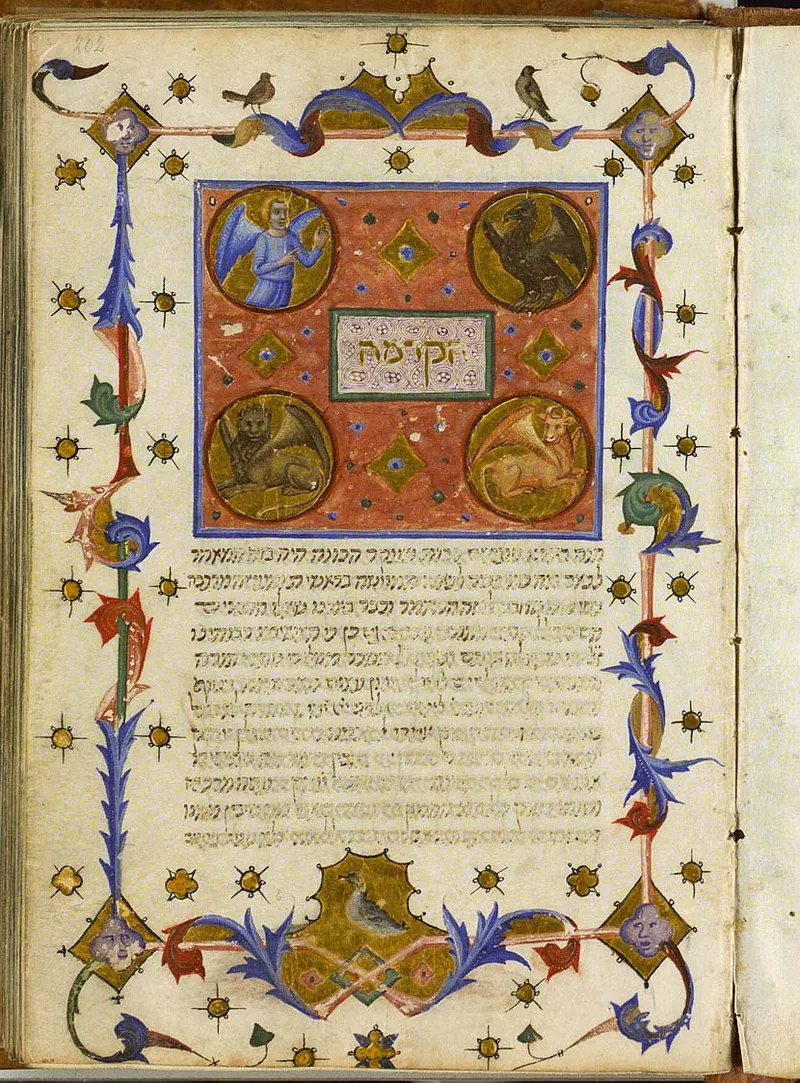
The Guide is addressed to a reader learned in both Torah and philosophy and troubled by apparent contradictions between them. Maimonides argues that the Bible's descriptions of God's body, emotions and actions must be read figuratively; that God is absolutely one and beyond all positive description, so that true knowledge of God consists in knowing what God is not — the "negative theology" for which he is famous; that prophecy is a natural perfection of the intellect and imagination, crowned by divine will, with Moses' prophecy unique; and that the commandments have rational purposes, some of which he explained historically as weaning Israel from ancient idolatrous practices. On the question of whether the world is eternal, as Aristotle taught, or created, he concluded that neither could be demonstrated and accepted creation on the authority of the Torah, though readers have long debated whether he concealed more radical views; he openly admits writing in a deliberately guarded way. Translated into Hebrew by Samuel ibn Tibbon in 1204 and into Latin soon after, the Guide influenced Christian thinkers including Thomas Aquinas, who cites "Rabbi Moses".
After Maimonides: Controversy, Gersonides and Crescas§
The Guide provoked bitter controversy. In the 1230s rabbis in Provence and northern France condemned the study of philosophy, and copies of Maimonides' philosophical writings were burned, reportedly by the Dominicans in Montpellier around 1233. Disputes over philosophical study flared again around 1305. The rise of Kabbalah in Provence and Spain in the same period is often seen in part as a response to philosophical rationalism, offering a different, mystical account of God and the commandments (see What Is Kabbalah?), though some kabbalists, such as Abraham Abulafia, were devoted readers of Maimonides.
Gersonides (Levi ben Gershom, 1288–1344), a philosopher, Bible commentator and astronomer in Provence, went further than Maimonides in his Wars of the Lord, arguing that God knows particulars only as general kinds and that the world was created from an eternal formless matter. Hasdai Crescas (about 1340–1411) of Barcelona attacked Aristotelian physics in The Light of the Lord, defending the possibility of an infinite and of a void and arguing that love, not intellect, unites the soul with God; his critique was later read by Spinoza. Joseph Albo's Book of Principles (1425) reduced the dogmas of Judaism to three: the existence of God, revelation and reward and punishment.
Modern Jewish Philosophy from Spinoza to Buber§
Baruch Spinoza (1632–1677), excommunicated by the Portuguese Jewish community of Amsterdam in 1656, identified God with nature and, in his Theological-Political Treatise (1670), treated the Bible as a human document to be read historically — a founding moment of modern biblical criticism. Moses Mendelssohn (1729–1786), the leading figure of the Jewish Enlightenment, argued in Jerusalem (1783) that Judaism is not a revealed religion of dogmas but revealed legislation, its truths available to reason; his career opened the debates described in modern Judaism.
In the late nineteenth and twentieth centuries, Hermann Cohen presented Judaism as a "religion of reason" centred on ethical monotheism; Franz Rosenzweig, in The Star of Redemption (1921), described the relations of God, world and humanity as creation, revelation and redemption; and Martin Buber, in I and Thou (1923), contrasted the instrumental "I–It" relation with the dialogical "I–Thou" encounter in which God is met. After the Holocaust, thinkers such as Abraham Joshua Heschel, Joseph B. Soloveitchik, Emmanuel Levinas and Emil Fackenheim explored divine pathos, the halakhic personality, ethics as "first philosophy" and the meaning of faith after catastrophe.
Frequently asked questions§
Who is the most important Jewish philosopher?§
Moses Maimonides is generally regarded as the greatest Jewish philosopher, combining unmatched authority in Jewish law with a systematic philosophy in The Guide for the Perplexed. Philo, Saadia, Halevi, Spinoza and Buber are also central figures.
What is negative theology in Maimonides?§
Maimonides taught that no positive attribute can properly be applied to God, who is utterly unlike anything created. We can only say what God is not, and each negation brings us closer to a true, if limited, understanding.
Was Spinoza a Jewish philosopher?§
Spinoza was born and educated in the Jewish community of Amsterdam but was excommunicated in 1656 and did not join another religion. Historians debate how far his thought is Jewish, but he is a crucial figure in modern Jewish intellectual history.
Sources and further reading§
- The Guide for the Perplexed — Moses Maimonides, c. 1190
- The Book of Beliefs and Opinions — Saadia Gaon, 933
- The Kuzari — Judah Halevi, c. 1140
- Philosophies of Judaism — Julius Guttmann, 1964
- A History of Jewish Philosophy in the Middle Ages — Colette Sirat, 1985
- The Cambridge Companion to Medieval Jewish Philosophy — Daniel H. Frank & Oliver Leaman (eds.), 2003
- I and Thou — Martin Buber, 1923