Liber XIX · Judaism · Chapter V: Jewish Law & Ethics
Halakha: Jewish Law and Ethics from the Torah to Today
Halakha, Jewish law, explained: the 613 commandments, the Talmud and the great codes, kosher food and the Sabbath, Jewish ethics and charity, and law today.

Halakha is the body of Jewish religious law, derived from the Torah and developed by the rabbis in the Talmud, the medieval codes and centuries of responsa. Its name means "the way" or "the path", and it covers the whole of life: prayer and the Sabbath, food and family, business, courts and the treatment of others. In Judaism law and ethics are not separate fields; the commandments are understood as the means by which a person and a community walk in God's ways.
The Meaning and Sources of Halakha§
The word halakha comes from the Hebrew root meaning "to walk", and it can refer to a single legal ruling or to the legal system as a whole. Its foundation is the written Torah, especially the legal chapters of Exodus, Leviticus, Numbers and Deuteronomy. But biblical laws are often brief: the Torah forbids work on the Sabbath without defining "work", and commands that God's words be bound as a sign upon the hand without describing the tefillin (phylacteries) through which Jews fulfil it. According to rabbinic Judaism, the meaning of such laws was given in the Oral Torah, which was eventually recorded in the Mishnah and the Talmud (see rabbinic Judaism and the Talmud).
The rabbis distinguished several layers of law. Laws de'oraita are considered biblical in authority; laws de-rabbanan are rabbinic enactments, including protective measures that the Mishnah calls a "fence around the Torah", designed to keep people from transgressing a biblical prohibition. Takkanot are formal ordinances made by rabbinic authorities, and minhag — custom — carries real weight, so that communities of different origins, such as Ashkenazim and Sephardim, can follow different practices with equal legitimacy.
The 613 Commandments and Rabbinic Law§
A Talmudic teaching attributed to Rabbi Simlai states that 613 commandments were given to Moses: 248 positive commands, corresponding to the limbs of the body, and 365 prohibitions, corresponding to the days of the solar year. Medieval scholars produced lists enumerating them, most influentially Maimonides' Book of the Commandments, though they disagreed over which verses counted. Many of the 613 concern the Temple, sacrifices or the Land of Israel and cannot be observed today.

Rabbinic tradition also holds that non-Jews are bound by seven "Noahide laws", given to all humanity through Noah: prohibitions of idolatry, blasphemy, murder, sexual immorality, theft and eating flesh from a living animal, and the obligation to establish courts of justice. Judaism therefore does not teach that one must be Jewish to be righteous.
The Great Codes: Maimonides, the Tur and the Shulchan Arukh§
The Talmud records arguments rather than final rulings, so later scholars produced codes to state the law clearly. The most ambitious was the Mishneh Torah of Moses Maimonides, completed around 1180, which arranged the whole of Jewish law, including the laws of the Temple and of kingship, in fourteen books written in clear Hebrew. Its first book, on the foundations of the Torah, opens with the knowledge of God, reflecting Maimonides' conviction that law and philosophy belong together (see Jewish philosophy).
In the fourteenth century Jacob ben Asher, a German-born rabbi living in Toledo, wrote the Arba'ah Turim ("Four Rows"), limited to laws applicable after the Temple and divided into four sections: daily life and prayer, ritual prohibitions, marriage and divorce, and civil law. Joseph Karo, a Sephardi scholar and kabbalist in Safed, wrote a vast commentary on it and then a concise digest, the Shulchan Arukh ("Set Table"), first printed in 1565. Because Karo generally followed Sephardi authorities, the Kraków rabbi Moses Isserles added glosses recording Ashkenazi custom, which he called the Mappah ("Tablecloth"). With its commentaries, the Shulchan Arukh became the standard code of Jewish law, supplemented by works such as the Mishnah Berurah of Israel Meir Kagan (published 1884–1907).
Alongside the codes runs the literature of responsa (she'elot u-teshuvot, "questions and answers"), in which rabbis answer specific questions put to them. Begun by the Geonim of Babylonia, the genre continues today, applying halakha to everything from electricity on the Sabbath to medical ethics.
Halakha in Daily Life: Food, Sabbath, Family and Business§
The most visible areas of halakha shape the Jewish home. The dietary laws, kashrut, permit only certain animals (Leviticus 11) — mammals that chew the cud and have split hooves, fish with fins and scales, and birds not listed as forbidden — require animals to be slaughtered in a prescribed manner and the blood removed, and forbid mixing meat and milk, a rule derived from the threefold biblical command not to boil a kid in its mother's milk (Exodus 23:19). Observant households keep separate dishes for meat and dairy.
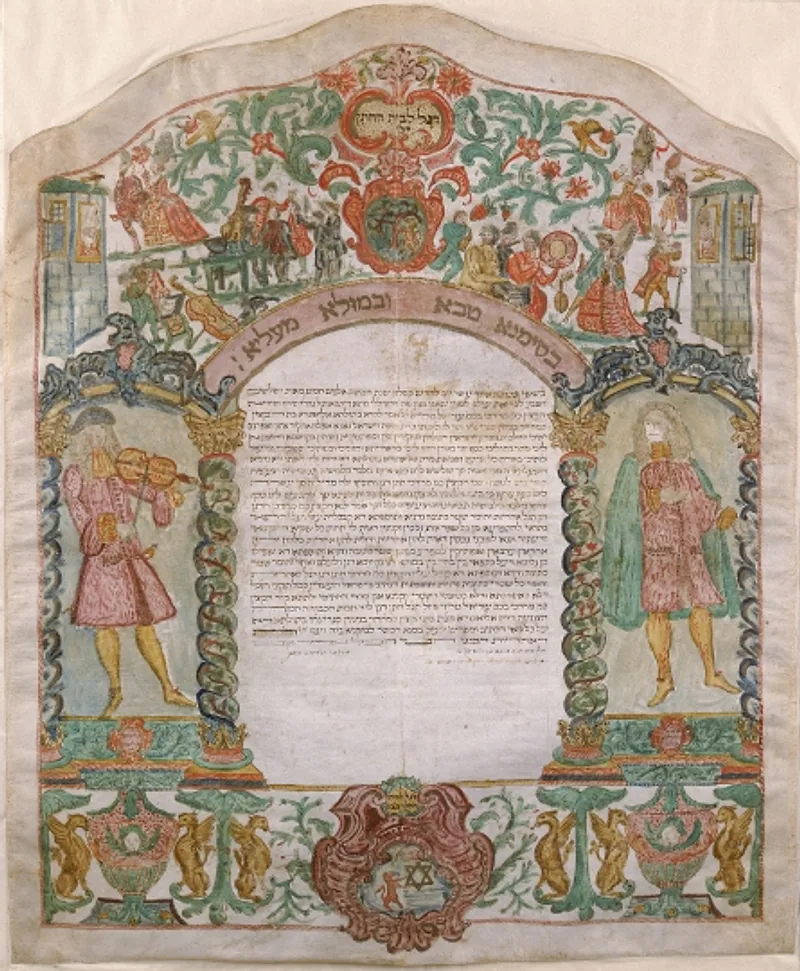
The laws of the Sabbath define thirty-nine categories of prohibited creative work, derived from the labours used to build the Tabernacle in the wilderness; they are described further in the Sabbath and Jewish festivals. Family law covers marriage, contracted with a written ketubah that sets out the husband's obligations to his wife, divorce by a written bill (get), and the laws of family purity, including immersion in a ritual bath (mikveh). The requirement that a husband grant a get has created the painful problem of the agunah, the "chained" wife whose husband will not release her, which modern rabbis have tried to address through prenuptial agreements and other means.
A large part of the Talmud and the codes concerns civil law: contracts, property, damages, inheritance, employment and honest trade. Jewish law requires accurate weights and measures, forbids overcharging and deceptive sales, requires prompt payment of workers' wages, and regulates lending at interest.
Jewish Ethics: Justice, Charity and the Value of Life§
Ethical duties are themselves commandments. Leviticus 19 joins ritual laws to commands to leave the corners of the field for the poor, to judge fairly and to "love thy neighbour as thyself" (Leviticus 19:18). The prophet Micah summed up God's demand as to "do justly, and to love mercy, and to walk humbly with thy God" (Micah 6:8). The Talmud tells that when a would-be convert asked Hillel to teach him the whole Torah while standing on one foot, Hillel replied that what is hateful to you, you should not do to your neighbour — the rest is commentary.
Tzedakah, usually translated "charity" but meaning "righteousness", is an obligation rather than a voluntary virtue. Maimonides ranked eight levels of giving, the highest being to help a person become self-supporting through a loan, partnership or work. Jewish ethics also condemns lashon hara, harmful speech about others even when true; Israel Meir Kagan's Chafetz Chaim (1873) codified these laws. The tractate Pirkei Avot collects the moral maxims of the early sages, and in the nineteenth century the Musar movement of Rabbi Israel Salanter promoted systematic ethical self-examination.
Above most commandments stands the duty of pikuach nefesh, saving life. The Talmud teaches that almost any law may be set aside to save a life, with three exceptions — idolatry, murder and forbidden sexual relations — which one must refuse even at the cost of one's life. Thus the Sabbath must be broken to treat the dangerously ill. Modern Jewish bioethics, on questions such as end-of-life care and organ donation, builds on this principle.
Jewish Law in the Modern World§
In the modern era Jews have divided over the authority of halakha, a story told more fully in modern Judaism. Orthodox Judaism holds halakha to be divinely binding, developed only through the established methods of rabbinic interpretation. Conservative (Masorti) Judaism also regards halakha as binding but stresses its historical development; its Committee on Jewish Law and Standards has, for example, permitted driving to synagogue on the Sabbath and the ordination of women. Reform Judaism, in its early Pittsburgh Platform of 1885, declared ritual laws not suited to modern life no longer binding, emphasising personal autonomy and the ethical teaching of the prophets, though many Reform Jews have since recovered traditional practices. Reconstructionist Judaism, following Mordecai Kaplan, treats Jewish law as the folkways of a living civilisation.
In the State of Israel, rabbinic courts have authority over marriage and divorce for Jewish citizens, which makes the relationship between religious law and a democratic state a continuing public debate. The modern Jewish idea of tikkun olam, "repairing the world" — originally a technical term in the Mishnah for legislation enacted for the public good — has become a watchword for social justice across many movements.
Frequently asked questions§
What does halakha mean?§
Halakha means "the way" or "the path to walk". It is the Jewish legal system as a whole, covering ritual, ethical, family and civil matters, and also refers to an individual legal ruling.
Are there really 613 commandments?§
Rabbinic tradition counts 613 commandments in the Torah, a figure first recorded in the Talmud. Medieval scholars disagreed about exactly which verses make up the list, and many of the commandments relate to the Temple and cannot be observed today.
What is the Shulchan Arukh?§
It is the most widely accepted code of Jewish law, written by Joseph Karo and first printed in 1565, with glosses by Moses Isserles recording Ashkenazi custom. Most later rulings in Orthodox Judaism build on it and its commentaries.
Can Jewish law be broken to save a life?§
Yes. The principle of pikuach nefesh requires that almost all commandments, including the Sabbath and dietary laws, be set aside to save a life. The only exceptions are idolatry, murder and forbidden sexual relations.
Sources and further reading§
- Mishneh Torah — Moses Maimonides, c. 1180
- Jewish Law: History, Sources, Principles — Menachem Elon, 1994
- An Introduction to the History and Sources of Jewish Law — N. S. Hecht, B. S. Jackson, S. M. Passamaneck, D. Piattelli & A. M. Rabello (eds.), 1996
- Halakhic Man — Joseph B. Soloveitchik, 1983
- A Code of Jewish Ethics, Volume 1: You Shall Be Holy — Joseph Telushkin, 2006
- To Be a Jew: A Guide to Jewish Observance in Contemporary Life — Hayim Halevy Donin, 1972