Liber XIX · Judaism · Chapter VIII: Prayer & the Synagogue
Jewish Prayer and the Synagogue: Shema, Amidah and the Siddur
How Jews pray: the three daily services, the Shema, Amidah and Kaddish, the siddur, and the history and layout of the synagogue from antiquity to today.

Jewish prayer is the fixed worship that Jews offer three times a day — morning, afternoon and evening — using the prayer book or siddur, either privately or with a congregation in the synagogue. Its core is the Shema, the declaration of God's oneness, and the Amidah, a series of blessings recited standing. The synagogue, a house of assembly, prayer and study, became the centre of Jewish communal life after the destruction of the Jerusalem Temple in 70 CE.
The Origins of Jewish Prayer§
The Hebrew Bible is full of prayers — Hannah's plea for a child, Solomon's prayer at the dedication of the Temple, the Psalms — but worship in ancient Israel centred on sacrifice in the Temple (see ancient Israel and the Temple). Fixed, communal word-prayer developed alongside the Temple in the Second Temple period, and became the main form of worship once the Temple was destroyed. The rabbis interpreted the biblical command to serve God "with all your heart" as referring to prayer, and they matched the morning and afternoon services to the Temple's daily offerings; another tradition credits the three services to Abraham, Isaac and Jacob.
The three daily services are Shacharit (morning), Minchah (afternoon) and Ma'ariv or Arvit (evening). On Sabbaths, festivals and the new moon an additional service, Musaf, recalls the extra Temple offering of those days, and on Yom Kippur a closing service, Ne'ilah, is recited as the day ends.
The Daily Services and Their Core Prayers§
The Shema consists of three biblical passages: Deuteronomy 6:4–9, beginning "Hear, O Israel", which commands love of God and the teaching of His words; Deuteronomy 11:13–21, on reward and punishment; and Numbers 15:37–41, the command of fringes (tzitzit) and the memory of the exodus. It is recited morning and evening, framed by blessings on creation, the gift of the Torah and redemption. Many Jews cover their eyes for its first verse, and it is traditionally the last words spoken before death.
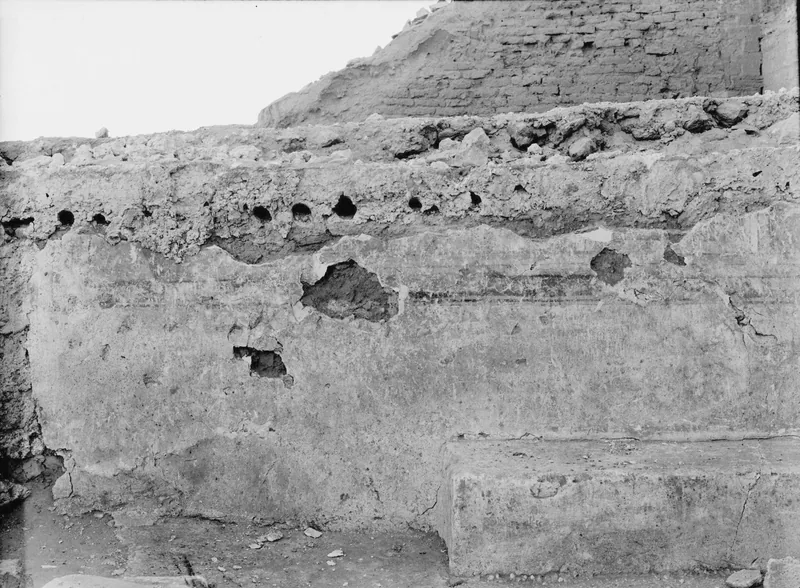
The Amidah, "standing prayer", is also called the Shemoneh Esreh, "Eighteen", although the weekday version has nineteen blessings, one having been added in the time of Rabban Gamaliel II at Yavneh. Its first three blessings praise God, the middle blessings petition for knowledge, forgiveness, healing, a good year, the ingathering of exiles, justice, the rebuilding of Jerusalem and the coming of the Messiah, and the last three give thanks and ask for peace. On Sabbaths and festivals the petitions are replaced by a blessing for the holiness of the day. Worshippers recite it silently, standing with feet together and facing Jerusalem; the prayer leader then repeats it aloud, adding the Kedushah, in which the congregation repeats the angels' cry of "Holy, holy, holy" from Isaiah's vision.
Other central prayers include the Kaddish, an Aramaic doxology praising God's name that divides the sections of the service and is recited by mourners in memory of the dead; and Aleinu, originally part of the Rosh Hashanah liturgy, which since the Middle Ages has concluded every service with the hope that all humanity will acknowledge God's kingship. Weekday morning prayer is accompanied by the prayer shawl (tallit) and the tefillin, small leather boxes containing scriptural passages bound on the arm and head; many Jews also cover their heads with a kippah.
On Mondays, Thursdays, Sabbaths and festivals the Torah scroll is taken from the Ark, carried in procession and read aloud (see the Hebrew Bible). Certain prayers — the Kaddish, the Kedushah, the public Torah reading — require a minyan of ten adults. Orthodox communities count only men; most Conservative, Reform and Reconstructionist congregations count women equally.
The Siddur and the Development of the Liturgy§
For centuries prayer was transmitted orally and in variant forms. The earliest surviving organised prayer book is the Seder Rav Amram, sent by Amram Gaon, head of the Babylonian academy of Sura, to a Spanish community around 860 CE. Saadia Gaon compiled another in the tenth century, with instructions in Arabic. From these grew the regional rites: the Ashkenazi rite of German and Eastern European Jews, the Sephardi rite of Spain and its diaspora, Italian, Yemenite and Romaniote rites, and later the Nusach Sefard of the Hasidim, which blends Ashkenazi tradition with the customs of the kabbalists of Safed. A separate volume, the machzor, contains the services for the High Holy Days and festivals.
The liturgy grew through additions. Between about the fifth and seventh centuries, poets in the Land of Israel such as Yannai and Eleazar Kallir composed piyyutim, elaborate liturgical poems; medieval Spanish poets such as Solomon ibn Gabirol and Judah Halevi contributed hymns still sung today. In sixteenth-century Safed the kabbalists created the Kabbalat Shabbat service for Friday evening, including the hymn Lekhah Dodi by Solomon Alkabetz, which welcomes the Sabbath as a bride. Women's devotional prayers in Yiddish, the tkhines, flourished in early modern Ashkenaz. In the nineteenth century the Reform movement introduced prayer in the vernacular, choirs and organs, and later movements produced their own prayer books revising or rewriting traditional texts.
The Synagogue: History and Architecture§
The word synagogue is Greek for "assembly"; the Hebrew is beit knesset, "house of assembly". Its origins are uncertain. Some scholars trace it to the Babylonian exile, but the first firm evidence comes from Ptolemaic Egypt in the third century BCE, where inscriptions mention Jewish "prayer houses" (proseuchai). In the Land of Israel, buildings identified as synagogues have been excavated at Gamla, Masada, Herodium and Magdala, dating from before 70 CE, and a Greek inscription from Jerusalem records that a priest named Theodotus built a synagogue for reading the Torah and teaching the commandments, with lodgings for visitors from abroad. The New Testament and Josephus also describe synagogues where scripture was read and expounded on the Sabbath.
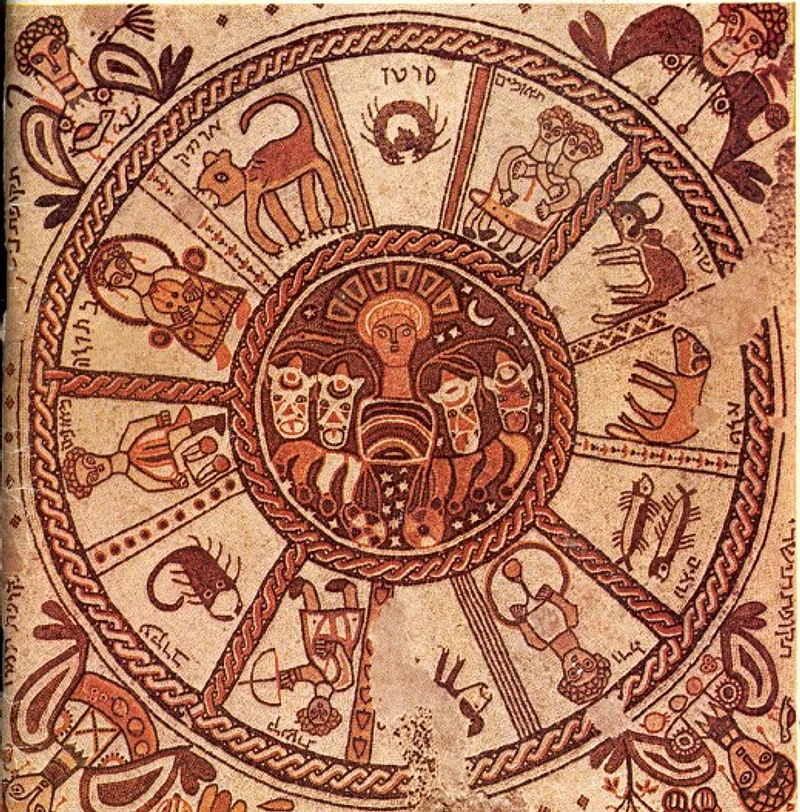
After 70 CE synagogues multiplied. In late antiquity many in Galilee were richly decorated; the floors at Hammat Tiberias (fourth century) and Beth Alpha (sixth century) show a zodiac wheel with the sun god Helios at its centre, surrounded by the seasons, alongside images of the Ark and the menorah — a striking example of Jewish use of astrological imagery. The synagogue of Dura-Europos in Syria, completed around 244 CE, preserves painted walls with scenes from the Bible. Medieval synagogues followed local architectural styles, from the Romanesque and Gothic Old-New Synagogue of Prague to the Moorish-style buildings of Toledo, and the great Sephardi synagogue of Amsterdam, completed in 1675.
Inside the Synagogue: Ark, Torah and Bimah§
The focal point of a synagogue is the Ark (aron ha-kodesh), a cabinet set in the wall that faces Jerusalem and holding the Torah scrolls, usually covered by a decorated curtain (parochet). Above it hangs the ner tamid, an ever-burning lamp recalling the Temple menorah. The bimah is the raised platform from which the Torah is read; in traditional Ashkenazi and Sephardi synagogues it stands in the centre of the hall, while many Reform synagogues place it at the front. Orthodox synagogues separate men and women by a partition (mechitzah) or a gallery; non-Orthodox synagogues have mixed seating.
The synagogue is also a place of study (beit midrash) and a community centre. Services may be led by any knowledgeable adult; the rabbi is a teacher and legal authority rather than a priest, and many congregations employ a cantor (hazzan) to chant the prayers.
Prayer, Intention and Mysticism§
The rabbis debated how fixed prayer should be and insisted on kavvanah, inner intention: a Mishnah warns against making prayer a fixed routine rather than a plea for mercy. Medieval mystics went further. The kabbalists taught that the words of prayer correspond to the divine powers of the sefirot, and the followers of Isaac Luria developed kavvanot, meditations on divine names to be held in mind while praying, which they believed helped restore cosmic harmony (see Lurianic Kabbalah). The Hasidic movement of the eighteenth century emphasised joyful, ecstatic prayer and attachment to God (devekut), a theme explored in Hasidism and the Baal Shem Tov. The rhythms of prayer through the week and year are described in the Sabbath and Jewish festivals.
Frequently asked questions§
How many times a day do Jews pray?§
Traditionally three times: the morning service (Shacharit), the afternoon service (Minchah) and the evening service (Ma'ariv). On Sabbaths and festivals an additional service (Musaf) is added.
What is the most important Jewish prayer?§
The Shema, the declaration that God is one, is the central affirmation of faith, and the Amidah is the central prayer of every service. Rabbinic texts often refer to the Amidah simply as "the prayer".
What is a minyan?§
A minyan is a quorum of ten adult Jews required for public prayer and for certain prayers such as the Kaddish. Orthodox Judaism counts only men, while most liberal movements count women and men equally.
Is a rabbi needed to lead prayer?§
No. Any knowledgeable adult member of the community may lead the service. A rabbi is a teacher and interpreter of Jewish law, and many synagogues also have a cantor who chants the liturgy.
Sources and further reading§
- Jewish Liturgy: A Comprehensive History — Ismar Elbogen, 1993
- The Authorised Daily Prayer Book — Simeon Singer, 1890
- The Ancient Synagogue: The First Thousand Years — Lee I. Levine, 2000
- Entering Jewish Prayer: A Guide to Personal Devotion and the Worship Service — Reuven Hammer, 1994
- My People's Prayer Book: Traditional Prayers, Modern Commentaries — Lawrence A. Hoffman (ed.), 1997
- To Be a Jew: A Guide to Jewish Observance in Contemporary Life — Hayim Halevy Donin, 1972