Liber XIX · Judaism · Chapter VIII: Prayer & the Synagogue
The Kaddish and Jewish Mourning: Shiva, Yahrzeit and Yizkor
The Mourner's Kaddish and Jewish mourning customs: the prayer's words and origins, burial, shiva and shloshim, eleven months of Kaddish, yahrzeit and Yizkor.

The Kaddish is an ancient Aramaic prayer that praises and sanctifies the name of God; in the form known as the Mourner's Kaddish it is recited by Jews for eleven months after the death of a parent and on each anniversary of the death (yahrzeit). Although it never mentions death, it has become the central prayer of Jewish mourning, framed by a sequence of customs that runs from the burial society's care of the body through the seven days of shiva, the thirty days of shloshim and the year of mourning, to the memorial prayers of Yizkor on festivals.
The Kaddish Prayer: Words and Meaning§
The Kaddish (Aramaic, "holy" or "sanctification") begins with words echoing Ezekiel's prophecy, "Thus will I magnify myself, and sanctify myself" (Ezekiel 38): Yitgadal ve-yitkadash shemeh rabba, "Magnified and sanctified be His great name in the world which He created according to His will." It goes on to pray that God establish His kingdom "speedily and soon", and the congregation responds with its core line, Yehei shemeh rabba mevarakh le-alam u-le-almei almaya, "May His great name be blessed for ever and to all eternity." A string of praises follows, with the admission that God is beyond all blessings and hymns, and the prayer closes, in Hebrew, with petitions for peace: "He who makes peace in His high places, may He make peace upon us and upon all Israel."
Its language is mostly Aramaic, the everyday tongue of Jews in the late Second Temple and Talmudic periods. Scholars have often noted its kinship with the Lord's Prayer of the Gospels, which also begins by hallowing God's name and praying for His kingdom. Several forms are used in the synagogue: the Half Kaddish, which marks divisions in the service; the Full Kaddish, said by the prayer leader after the Amidah; the Rabbis' Kaddish (Kaddish de-Rabbanan), recited after study and including a prayer for teachers and students; the Mourner's Kaddish; and a special burial Kaddish that speaks of the resurrection of the dead and the rebuilding of Jerusalem. Its place in the daily services is described in Jewish prayer and the synagogue.
Origins: From Study-House Doxology to Mourner's Prayer§
The Kaddish seems to have begun not in the synagogue service but in the house of study, as a closing praise after a sermon or lesson of Torah. The Talmud already treats the congregational response as supremely important: it teaches that whoever answers "Amen, may His great name be blessed" with all their strength has a harsh decree against them torn up. The prayer appears in the order of service in the geonic period, and the early medieval tractate Soferim describes its use.
Its association with mourners developed in medieval Europe. A widely told legend, preserved in several medieval versions, relates that Rabbi Akiva met a man carrying a heavy load of wood, who turned out to be a soul condemned to punishment for its sins. Akiva found the man's neglected son and taught him to lead the congregation in prayer; when the son recited the words that prompt the congregation's praise, the father was released. By the thirteenth century, in the Rhineland communities that had suffered the massacres of the Crusades, a separate Kaddish for orphans (Kaddish Yatom) was being recited at the end of the service, and the custom spread throughout Ashkenazi and later Sephardi Jewry. The underlying idea is that a child's public sanctification of God's name brings merit to the soul of the parent (see reincarnation and the afterlife).
Saying Kaddish: Eleven Months, Yahrzeit and Yizkor§
A child traditionally says Kaddish for a parent at every service for eleven months, beginning at the burial. The period is eleven months rather than twelve because rabbinic tradition held that the souls of the wicked are judged for twelve months; the Kraków authority Moses Isserles recorded the custom of stopping a month earlier so as not to imply that one's parent was among them. Kaddish may also be recited for other relatives, usually for thirty days.
Each year on the anniversary of the death by the Hebrew calendar — the yahrzeit, a Yiddish word meaning "year-time" — the mourner says Kaddish again, lights a memorial candle that burns for twenty-four hours and may lead the service or be called to the Torah. Among Hasidim the yahrzeit of a great master is celebrated as a hillula, a joyful festival of the soul's ascent. On Yom Kippur, Shemini Atzeret, the last day of Passover and Shavuot, Ashkenazi congregations recite Yizkor ("May He remember"), memorial prayers for departed relatives, often accompanied by pledges of charity in their memory.
From Death to Burial: The Chevra Kadisha and the Funeral§
Jewish law surrounds death with acts of respect for the body (kevod ha-met) and for the mourners. On hearing of a death, close relatives recite the blessing "Blessed be the true Judge" and tear a garment (keriah), as Jacob and David did in the Bible. Until the burial they are onenim, exempt from positive commandments so that they may attend to the dead. The body is cared for by the chevra kadisha, the "holy society" of volunteers found in Jewish communities since the sixteenth century — the society of Prague, founded in 1564, commissioned a famous series of paintings of its work around 1780. Its members wash and purify the body (taharah), dress it in simple white linen shrouds and watch over it until burial.
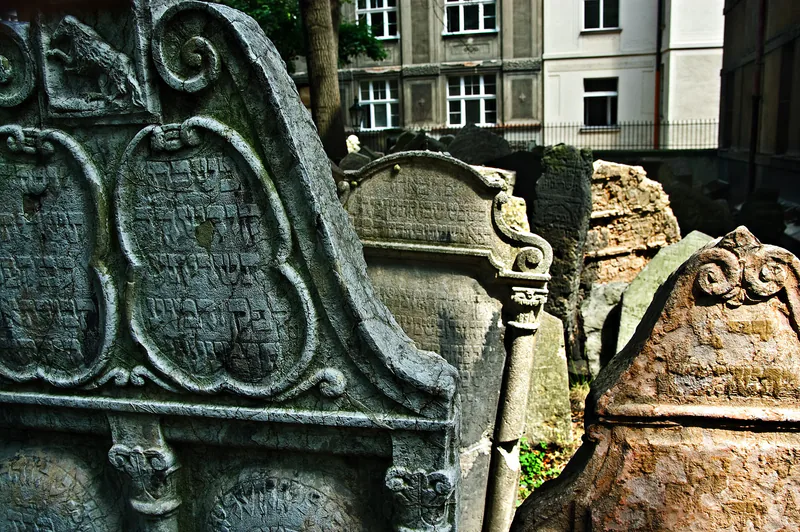
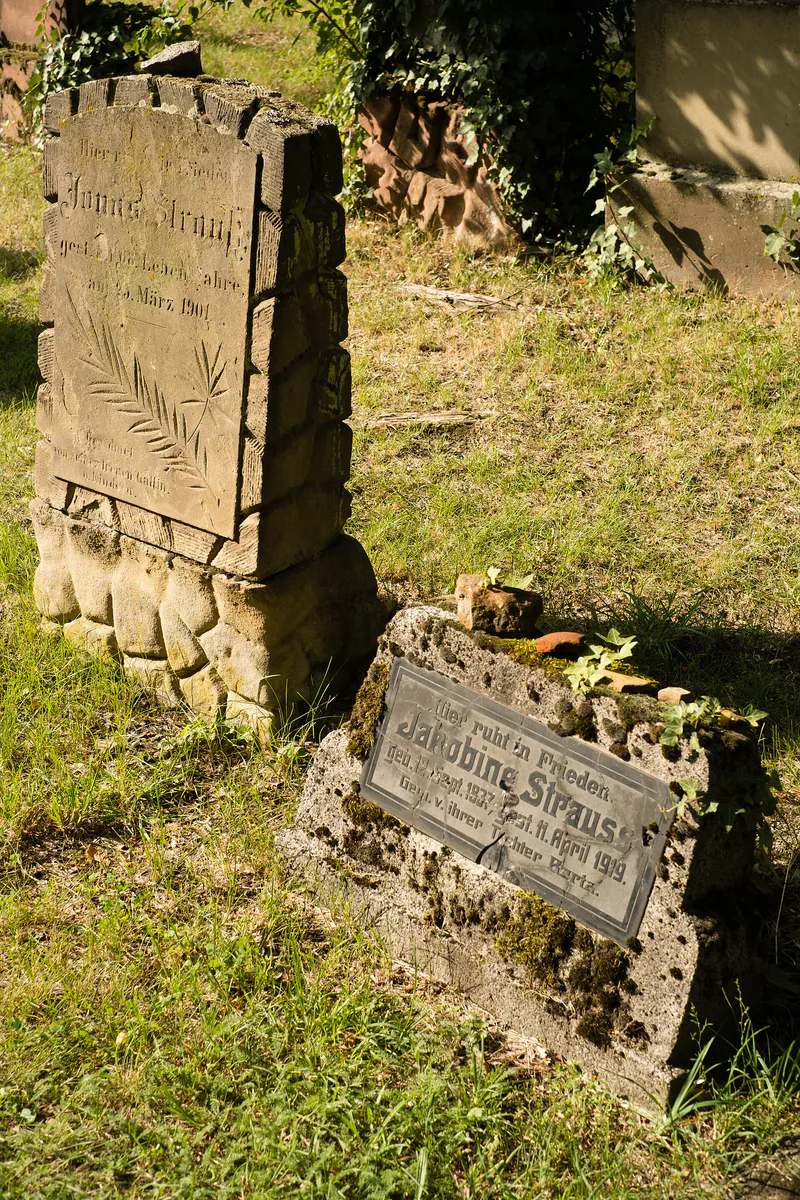
Burial takes place as soon as possible, ideally within a day, on the basis of a verse in Deuteronomy. The Talmud records that Rabban Gamaliel, to end the ruinous expense of funerals, asked to be buried in plain linen, and since then rich and poor have been buried alike. Traditional law requires burial in the earth, usually in a plain wooden coffin, and forbids embalming and cremation; liberal movements are more flexible. At the cemetery, mourners and friends shovel earth into the grave, and the burial Kaddish is said. A stone (matzevah) is set up, often at a ceremony around a year later, and visitors leave small stones on graves, a custom of uncertain origin.
Shiva, Shloshim and the Year of Mourning§
After the funeral the mourners — for father, mother, son, daughter, brother, sister or spouse — return home for a meal of condolence prepared by neighbours, traditionally including eggs or lentils, round foods associated with mourning. They then "sit shiva" (from sheva, "seven") for seven days, recalling Joseph's seven days of mourning for Jacob (Genesis 50) and the seven days Job's friends sat with him in silence. Mourners sit on low stools, do not work, bathe for pleasure, wear leather shoes or cut their hair, and in many homes mirrors are covered. Prayer services are held in the house so that the mourners can say Kaddish, and visitors come to comfort them, traditionally waiting for the mourner to speak first. On leaving they say, "May the Omnipresent comfort you among the mourners of Zion and Jerusalem." The Sabbath interrupts public mourning, and major festivals cut shiva short.
The first thirty days (shloshim) bring a lighter level of mourning: mourners return to work but avoid celebrations, music and haircuts. For a parent, restrictions on festivities continue for twelve months. The graduated structure is often described as a way of leading the mourner step by step from the shock of loss back into ordinary life. The legal details belong to halakha, and general European beliefs about death and mirrors are discussed in superstitions of birth, marriage and death.
Who Says Kaddish? Women, Communities and Modern Practice§
Because the Kaddish is a "sanctification", it may be said only in the presence of a minyan, a quorum of ten adults. Traditionally the obligation fell on sons, and a man with no sons was sometimes called a parent without a kaddish; in Yiddish a son could even be affectionately called "my kaddish". Where there was no son, communities paid a learned man to say Kaddish, a practice that continues. The question of daughters is old: in 1699 Rabbi Yair Bacharach responded to a case in Amsterdam of a man who had asked that his daughter say Kaddish for him, judging it possible in principle but discouraging it as a departure from custom. In 1916 the Zionist leader Henrietta Szold, in a much-quoted letter, thanked a friend for offering to say Kaddish for her mother but insisted that she would do so herself. Today women say Kaddish in Reform, Conservative and Reconstructionist synagogues and in many Modern Orthodox ones.
In many Reform congregations the whole congregation rises for the Mourner's Kaddish, in solidarity with mourners and in memory of those who have no one to say it for them, including the victims of the Holocaust (see Jewish theology after the Holocaust). The prayer has also entered literature: Allen Ginsberg's poem Kaddish (1961) for his mother and Leon Wieseltier's Kaddish (1998), a meditation written during his year of mourning for his father, are two of the best-known modern works shaped by it.
Frequently asked questions§
Why does the Mourner's Kaddish not mention death?§
The Kaddish was originally a doxology recited after study, and it was adopted by mourners because of its power as a public sanctification of God's name. Saying it at a time of loss is understood as an affirmation of faith and acceptance, and as a merit for the soul of the dead.
Why is Kaddish said for eleven months and not twelve?§
Rabbinic tradition held that the judgement of the souls of the wicked lasts up to twelve months. To avoid implying that a parent needed the full term, the custom recorded by Moses Isserles is to stop after eleven months.
What is the difference between shiva and shloshim?§
Shiva is the first, most intense week of mourning, when mourners stay at home and receive visitors. Shloshim covers the first thirty days, during which mourners return to normal activities but still avoid celebrations; for a parent some restrictions continue for a year.
Sources and further reading§
- The Jewish Way in Death and Mourning — Maurice Lamm, 1969
- Kaddish — Leon Wieseltier, 1998
- Saying Kaddish: How to Comfort the Dying, Bury the Dead, and Mourn as a Jew — Anita Diamant, 1998
- A Time to Mourn, a Time to Comfort — Ron Wolfson, 1993
- The Jewish Life Cycle: Rites of Passage from Biblical to Modern Times — Ivan G. Marcus, 2004
- Jewish Liturgy: A Comprehensive History — Ismar Elbogen, 1993