Liber XIX · Judaism · Chapter VII: Modern Judaism
Jewish Theology after the Holocaust: Faith after Auschwitz
How Jewish thinkers responded to the Holocaust: hester panim, Rubenstein, Fackenheim's 614th commandment, Berkovits, Wiesel, Jonas and Shoah remembrance.

Holocaust theology is the body of Jewish religious thought that asks how belief in a God who acts in history and has a covenant with Israel can be maintained after the murder of six million Jews in the Shoah. Responses range from traditional explanations — divine punishment, the "hiding of God's face", martyrdom — to radical claims that the God of history is dead, to the insistence that Jews must go on living as Jews precisely so as not to hand Hitler a posthumous victory. Alongside these ideas, Jewish communities created new rituals of remembrance that have reshaped the Jewish calendar.
The Holocaust as a Theological Problem§
Judaism has known catastrophe before: the destruction of the First Temple in 586 BCE and of the Second in 70 CE, the massacres of the Crusades in 1096, the expulsion from Spain in 1492 and the Cossack massacres of 1648. Each produced its literature of lament and explanation, from the Book of Lamentations to the medieval kinot (dirges). Many thinkers, however, have argued that the Holocaust (in Hebrew Shoah, "catastrophe"; in traditional Yiddish usage the churban, "destruction") was different in kind: a systematic, bureaucratic attempt to murder every Jew, defined by descent rather than belief, in which the pious and the secular, children and adults, died alike, and which was rooted in a modern racial antisemitism whose conspiracy myths are traced in the Protocols of the Elders of Zion.
The theological problem is the ancient one of theodicy — how a good and all-powerful God can permit great evil — sharpened by Judaism's particular claims. The Hebrew Bible proclaims a God who redeemed Israel from Egypt and who acts in history, and a covenant in which Israel is chosen. If God intervened at the Red Sea, why not at Auschwitz? Discussion of these questions by Jewish theologians began in earnest in the 1960s; in the first postwar years survivors and communities were more occupied with rebuilding, mourning and testimony.
Traditional Frameworks: Sin, Hidden Face and Martyrdom§
The oldest explanation of national disaster is that it is punishment for sin. The prophets interpreted the Babylonian conquest in this way (see the prophets of Israel), and the festival liturgy says, "because of our sins we were exiled from our land". A small number of rabbis applied this framework to the Holocaust, blaming assimilation, secularism, Reform or Zionism; the Satmar Rebbe, Joel Teitelbaum, argued in Va-Yoel Moshe (1961) that Zionism's rebellion against the exile had brought the catastrophe. Most Jewish thinkers, Orthodox and liberal, have rejected such explanations as morally intolerable, since no conceivable sin could justify the murder of a million and a half children.
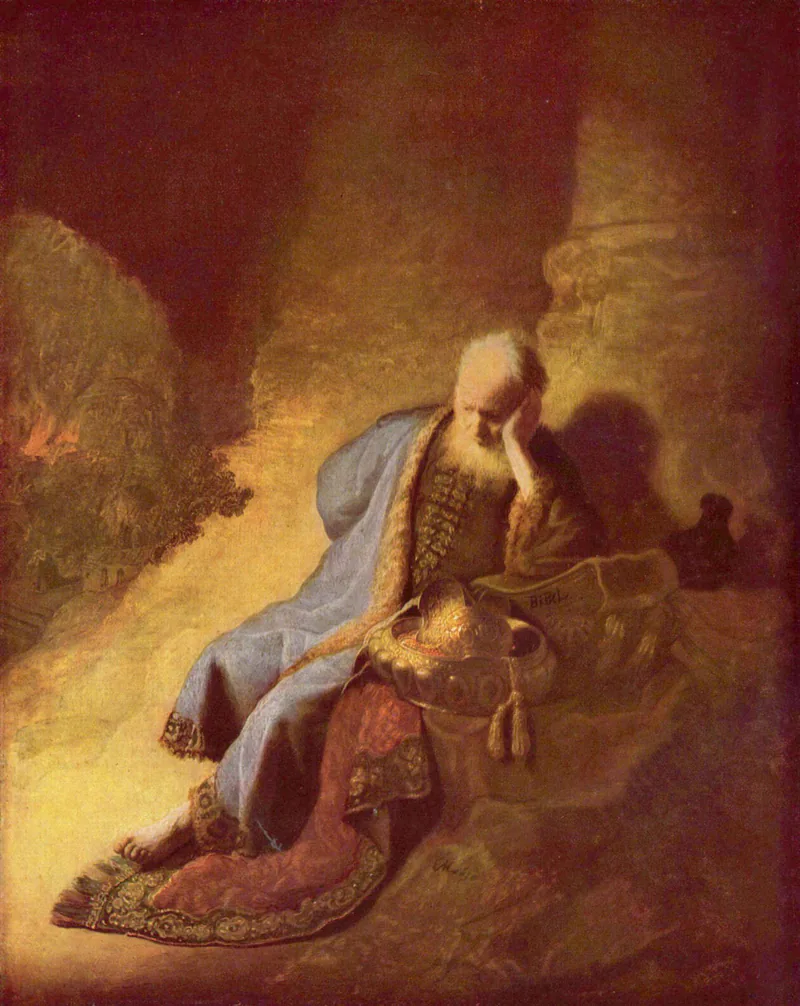
A second biblical idea is hester panim, the "hiding of the face": in Deuteronomy 31 God warns that He will hide His face from Israel, and Isaiah speaks of "a God that hidest thyself". Many religious thinkers have understood the Holocaust as a period of divine concealment, mysterious but not abandonment. A third framework is kiddush ha-Shem, the sanctification of God's name through martyrdom, central to the memory of the Crusade massacres. Some argued that every Jew murdered for being a Jew died al kiddush ha-Shem; others developed the idea of kiddush ha-chayim, sanctifying God by the struggle to stay alive, a phrase attributed to Rabbi Yitzhak Nissenbaum in the Warsaw Ghetto.
Voices from Within the Catastrophe§
Some of the most searching religious responses were written during the Holocaust itself. Rabbi Kalonymus Kalman Shapira, the Hasidic rebbe of Piaseczno, preached weekly sermons in the Warsaw Ghetto from 1939 to 1942. He buried the manuscripts, which were found after the war and published in 1960 as Esh Kodesh ("Holy Fire"). In them one can follow his faith under mounting pressure, from traditional explanations of suffering to the conviction that God Himself weeps and suffers with Israel, and that some suffering is beyond human understanding. Shapira was murdered in 1943.
In Budapest, the Hasidic rabbi Yissachar Shlomo Teichtal, formerly an opponent of Zionism, wrote Em ha-Banim Semeichah (1943), arguing that the exile had lasted because Jews had failed to return to the Land of Israel; he died in 1945. The great Hasidic tradition of telling stories (see Hasidism and the Baal Shem Tov) also continued in the camps and ghettos, and survivors' testimonies record prayer, secret observance of festivals and the study of Torah alongside despair and the loss of faith. A Yiddish story written in 1946 by Zvi Kolitz, Yossel Rakover Speaks to God, in which a fictional fighter in the burning ghetto affirms faith while protesting against God, was long mistaken for an authentic document and became one of the classic texts of this literature.
Radical Responses: Rubenstein, Fackenheim and the Death of God Debate§
The theological debate was opened in 1966 by the American rabbi Richard L. Rubenstein's After Auschwitz. Rubenstein argued that the traditional God who chose Israel and rules history could not be believed in after the death camps, since belief in such a God implied that Hitler was His instrument. He spoke of living in "the time of the death of God", while still valuing Jewish community and ritual as ways of sharing life's crises. His book was denounced by many, but it forced the question into the open.
The Canadian philosopher and rabbi Emil Fackenheim, who had been briefly interned at Sachsenhausen in 1938, gave the most famous answer. In 1967, and in God's Presence in History (1970), he argued that Auschwitz was not to be explained but responded to, and that from it issued a "commanding voice" — a 614th commandment added to the traditional 613: Jews are forbidden to hand Hitler posthumous victories by ceasing to be Jews, by despairing of God or of humanity, or by abandoning the world. For Fackenheim the survival of the Jewish people and the State of Israel was itself a response to that command.
The German-born British rabbi Ignaz Maybaum, in The Face of God after Auschwitz (1965), took the opposite path, describing the Holocaust as a third churban through which, as with Nebuchadnezzar, God used a destroyer to bring the Jews into the modern world. His interpretation found few followers.
Faith, Protest and the Limits of Theodicy§
Other thinkers sought ways between these positions. The Orthodox theologian Eliezer Berkovits, in Faith after the Holocaust (1973), argued that God's hiding is the price of human freedom: for human beings to be moral agents, God must restrain His power, even when they use their freedom for evil. Rabbi Joseph B. Soloveitchik, in his 1956 essay Kol Dodi Dofek, held that the question "why?" cannot be answered, but the question "what shall I do?" must be, and saw the founding of Israel as the knocking of the divine Beloved. Irving Greenberg argued that after the Holocaust the covenant has become voluntary, and that no theological statement should be made that could not stand in the presence of murdered children; faith is possible only in "moment faiths" alternating with doubt.
The philosopher Hans Jonas, in a lecture of 1984, proposed that God had renounced omnipotence in creating the world, a view he linked to the kabbalistic myth of divine self-contraction (tzimtzum). Arthur A. Cohen spoke of the Holocaust as the tremendum, an abyss of evil. Elie Wiesel, survivor of Auschwitz and Buchenwald, whose memoir Night (1958 in French; 1960 in English) is the most widely read book on the subject, did not offer a system but a stance: argument with God from within faith, in the tradition of Abraham, Job and the Hasidic master Levi Yitzhak of Berdichev, dramatised in his play The Trial of God (1979). Later voices include feminist theologians such as Melissa Raphael, who looked for God's presence in the care women gave one another in the camps.
Remembrance in Jewish Ritual and Calendar§
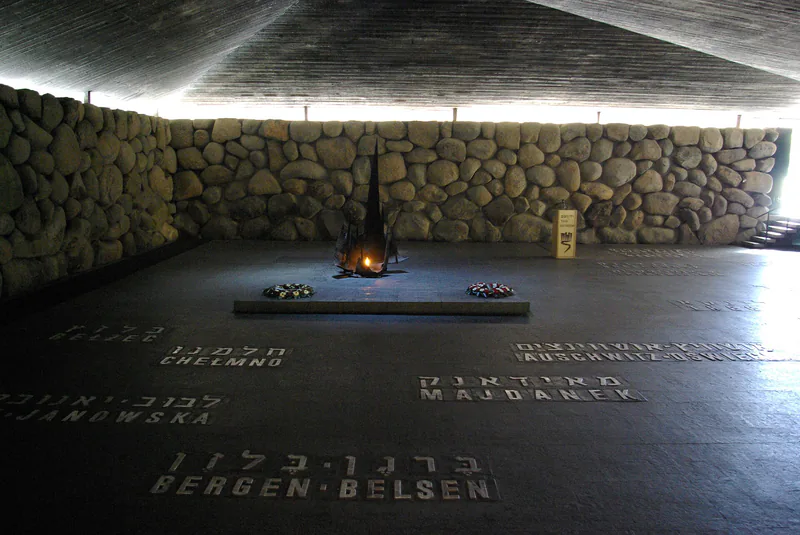
Alongside theology, communities created forms of remembrance. In 1949 Israel's Chief Rabbinate set the fast of the tenth of Tevet as a day for reciting Kaddish for victims whose date of death is unknown. In 1951 the Knesset established Yom HaShoah ve-HaGevurah, the Day of Holocaust and Heroism, on 27 Nisan, close to the anniversary of the Warsaw Ghetto Uprising; in Israel sirens sound and the country stands still. Many Haredi communities prefer to mourn the Holocaust on the ninth of Av, the traditional day of national mourning, with new dirges added to its liturgy. Holocaust memorial prayers and readings have entered the prayer books of every movement, and memorial institutions such as Yad Vashem in Jerusalem, founded in 1953, gather names and testimonies. The developments of the period are placed in context in modern Judaism.
Frequently asked questions§
What is the 614th commandment?§
The phrase was coined by Emil Fackenheim to describe what he called the commanding voice of Auschwitz: Jews are forbidden to hand Hitler posthumous victories. Added to the traditional count of 613 commandments, it obliges Jews to survive as Jews, to keep faith in God and humanity, and not to despair of the world.
What does hester panim mean?§
Hester panim, "hiding of the face", is a biblical phrase describing God's withdrawal of His visible presence from Israel. Many religious thinkers use it to describe the Holocaust as a time when God was hidden, without concluding that He had abandoned His people or ceased to exist.
What is the difference between Yom HaShoah and Tisha B'Av?§
Yom HaShoah, on 27 Nisan, is a modern memorial day for the Holocaust established by the Knesset in 1951. Tisha B'Av, on the ninth of Av, is the ancient fast for the destruction of the Temples and later catastrophes, on which many Haredi communities also remember the Holocaust.
Sources and further reading§
- After Auschwitz: Radical Theology and Contemporary Judaism — Richard L. Rubenstein, 1966
- God's Presence in History: Jewish Affirmations and Philosophical Reflections — Emil L. Fackenheim, 1970
- Faith after the Holocaust — Eliezer Berkovits, 1973
- Night — Elie Wiesel, 1960
- The Tremendum: A Theological Interpretation of the Holocaust — Arthur A. Cohen, 1981
- Sacred Fire: Torah from the Years of Fury 1939–1942 — Kalonymus Kalman Shapira, 2000
- Wrestling with God: Jewish Theological Responses during and after the Holocaust — Steven T. Katz, Shlomo Biderman & Gershon Greenberg (eds.), 2007
- Holocaust Theology: A Reader — Dan Cohn-Sherbok (ed.), 2002