Liber XIX · Judaism · Chapter III: The Hebrew Bible
The Hebrew Bible (Tanakh): Torah, Prophets and Writings
A guide to the Hebrew Bible or Tanakh: its Torah, Prophets and Writings, its languages and manuscripts, how scholars date it, and how Jews read it today.

The Hebrew Bible, called the Tanakh in Jewish tradition, is the scripture of Judaism: twenty-four books in three parts, the Torah (Teaching), the Nevi'im (Prophets) and the Ketuvim (Writings), written mostly in Hebrew over many centuries of the first millennium BCE. The same books, arranged differently, form the Old Testament of Christianity. For Jews the Torah, the Five Books of Moses, is the most sacred part, read aloud in the synagogue every week.
The Structure of the Tanakh: Torah, Prophets and Writings§
The Torah comprises Genesis, Exodus, Leviticus, Numbers and Deuteronomy. It tells the story of creation, of the patriarchs Abraham, Isaac and Jacob, of Israel's slavery in Egypt and the exodus, and of the revelation at Sinai, and it contains the great bodies of biblical law. In Hebrew the books are named from their opening words: Bereshit ("In the beginning"), Shemot, Vayikra, Bemidbar and Devarim.
The Nevi'im are divided into the Former Prophets — Joshua, Judges, Samuel and Kings, a continuous history from the conquest of Canaan to the Babylonian exile — and the Latter Prophets: Isaiah, Jeremiah, Ezekiel and the Book of the Twelve, the shorter prophetic books from Hosea to Malachi, counted as a single book.
The Ketuvim are the most varied part: Psalms, Proverbs and Job; the five megillot or scrolls (Song of Songs, Ruth, Lamentations, Ecclesiastes and Esther), each read on a particular festival or fast; Daniel; Ezra-Nehemiah; and Chronicles, which closes the Jewish Bible with the Persian king Cyrus permitting the exiles to return to Jerusalem. Because Samuel, Kings, Chronicles, Ezra-Nehemiah and the Twelve are each counted as one book, the Jewish total is twenty-four, against the thirty-nine of the Protestant Old Testament, which contains the same text.
Languages, Manuscripts and the Masoretic Text§
The Hebrew Bible is written almost entirely in Biblical Hebrew, with a few sections in Aramaic, the international language of the Persian empire: parts of Ezra and of Daniel (from Daniel 2:4 to the end of chapter 7), a verse of Jeremiah and two words in Genesis. Ancient Hebrew was written with consonants only. Between roughly the seventh and tenth centuries CE, scholars called the Masoretes ("transmitters"), working above all in Tiberias in Galilee, added vowel points, accent marks for chanting and marginal notes recording the exact spelling of every word. Their work produced the Masoretic Text, the authoritative Jewish text ever since.

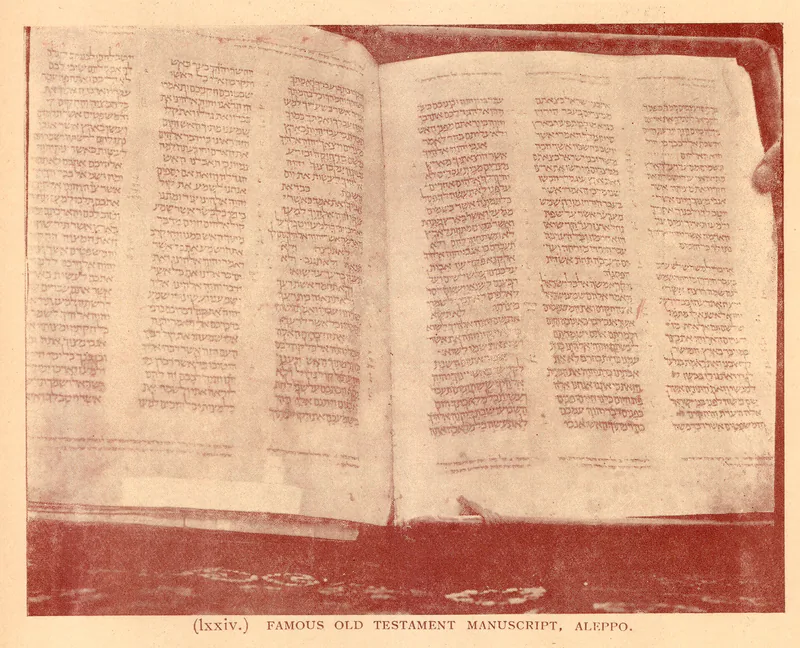
The most famous Masoretic manuscripts are the Aleppo Codex, written in the early tenth century and associated with the scholar Aaron ben Asher, much of which was lost in the twentieth century, and the Leningrad Codex, dated 1008 or 1009 CE, the oldest complete manuscript of the Hebrew Bible and the basis of most modern scholarly editions.
The discovery of the Dead Sea Scrolls in caves near Qumran between 1947 and 1956 transformed the study of the text. Among roughly nine hundred manuscripts were fragments of every book of the Tanakh except Esther, including the Great Isaiah Scroll, usually dated to the second century BCE. Many agree closely with the later Masoretic Text; others are closer to the Greek Septuagint or to the Samaritan Pentateuch, showing that several forms of the biblical text circulated before one became standard. The Septuagint itself, the Greek translation begun in Alexandria in the third century BCE, became the Bible of Greek-speaking Jews and later of the early Church.
Who Wrote the Hebrew Bible? Tradition and Scholarship§
Rabbinic tradition holds that Moses wrote the Torah at God's dictation; a passage of the Babylonian Talmud (Bava Batra 14b–15a) also assigns Joshua, Samuel, David, Jeremiah and others as authors of the later books, and suggests that Joshua wrote the last verses of Deuteronomy describing Moses' death. Medieval commentators such as Abraham ibn Ezra hinted cautiously at a few verses that seemed to come from a later time.
Modern historical criticism developed this observation into theories of composite authorship. The most influential was the Documentary Hypothesis, given classic form by Julius Wellhausen in 1878, which identified four sources in the Torah: J (using the divine name YHWH), E (using Elohim), D (Deuteronomy) and P (the Priestly source), combined by later editors. Many scholars link the core of Deuteronomy to the religious reform of King Josiah in 622 BCE, when a "book of the law" was found in the Temple (2 Kings 22). Since the 1970s many scholars, especially in Europe, have questioned the existence of continuous J and E documents and prefer models of fragments and successive supplements; there is still no consensus. Most agree that much of the Hebrew Bible reached its present form during and after the Babylonian exile, in the sixth to fourth centuries BCE, though it incorporates older poetry, laws and traditions. The historical background is discussed in our article on ancient Israel and the Temple.
Orthodox Judaism maintains the traditional view of the Torah's divine and Mosaic origin, while Conservative, Reform and other movements accept historical scholarship to varying degrees, holding that the text is sacred as the record of Israel's encounter with God.
The Formation of the Jewish Canon§
How and when the list of sacred books was closed is debated. The Torah was regarded as authoritative by the Persian period, and the Prophets probably by the second century BCE; the prologue to the Wisdom of Ben Sira (about 130 BCE) already refers to the Law, the Prophets and the other books of the ancestors as a recognised body of writings. Around 90 CE the historian Josephus counted twenty-two sacred books. The Mishnah records rabbinic debates about whether the Song of Songs and Ecclesiastes "defile the hands", a technical term for sacred status. An older theory that a "Council of Jamnia" (Yavneh) formally closed the canon around 90 CE is now widely doubted; most scholars see a gradual consensus reached during the first centuries CE.
Books that circulated in Greek-speaking Judaism but were not included in the rabbinic canon — such as Tobit, Judith, 1 and 2 Maccabees, Ben Sira and the Wisdom of Solomon — were preserved by the Church and appear in Catholic and Orthodox Bibles as the Deuterocanonical books (the "Apocrypha" of Protestant usage). Works such as 1 Enoch and Jubilees survived mainly in the Ethiopian church.
The Bible in Jewish Worship and Study§
In the synagogue the Torah is read from a handwritten parchment scroll, the Sefer Torah, prepared by a trained scribe (sofer) according to strict rules. The Torah is divided into fifty-four weekly portions (parashot), completing the cycle each year on the festival of Simchat Torah; in ancient Palestine a longer, roughly triennial cycle was also used. Each Torah reading on Sabbaths and festivals is followed by a haftarah, a related passage from the Prophets. The chanting follows the Masoretic accents, and how this ritual unfolds is described in our article on Jewish prayer and the synagogue.
Jews have rarely read the Bible apart from its interpreters. The rabbis' creative exegesis, midrash, is preserved in collections such as Genesis Rabbah, and the Talmud constantly derives law from scripture (see rabbinic Judaism and the Talmud). Medieval commentators — Rashi (1040–1105), Abraham ibn Ezra, David Kimhi and Nachmanides — sought the plain sense (peshat) as well as homiletic meaning. Printed "Rabbinic Bibles" (Mikraot Gedolot), first issued in Venice by Daniel Bomberg in 1516–17, set the text beside the Aramaic Targum and the classic commentaries on each page. Later Jewish interpreters described four levels of meaning — plain, allusive, homiletic and secret, remembered by the acronym PaRDeS — the last of which led into the mystical readings of the Zohar and into number interpretation such as gematria.
Jewish and Christian Bibles Compared§
The Jewish Tanakh and the Christian Old Testament share their text but differ in order, numbering and interpretation. Christian Bibles, following the Septuagint, place the prophets last, so that the Old Testament ends with Malachi's promise of Elijah's return and points toward the New Testament; the Jewish Bible ends with Chronicles and the return to Zion. Christian tradition reads many passages as prophecies of Christ, while Jewish tradition reads them through the rabbinic Oral Torah. Many scholars therefore prefer the neutral term "Hebrew Bible". Readers on this site can consult the text in the public-domain King James translation, beginning with Genesis 1; Jewish translations, such as the Jewish Publication Society's Tanakh (1985), follow the Jewish order and the Masoretic Text.
Frequently asked questions§
What is the difference between the Torah and the Tanakh?§
The Torah is the first part of the Tanakh: the Five Books of Moses from Genesis to Deuteronomy. The Tanakh is the whole Hebrew Bible, including the Prophets and the Writings. In a wider sense "Torah" can also mean all Jewish religious teaching.
Is the Hebrew Bible the same as the Old Testament?§
The Protestant Old Testament contains the same books, but in a different order and numbered as thirty-nine rather than twenty-four. Catholic and Orthodox Old Testaments also include additional books preserved in Greek, which are not part of the Jewish canon.
What is the oldest manuscript of the Hebrew Bible?§
The oldest biblical texts are among the Dead Sea Scrolls, dating from about the third century BCE to the first century CE, though most are fragmentary. The oldest complete manuscript is the Leningrad Codex of 1008 or 1009 CE.
Did Moses write the Torah?§
Jewish tradition holds that he did, and Orthodox Judaism maintains this belief. Most modern biblical scholars regard the Torah as a composite work drawing on several sources and edited over centuries, though they disagree on the details.
Sources and further reading§
- The Jewish Study Bible — Adele Berlin & Marc Zvi Brettler (eds.), 2004
- Tanakh: The Holy Scriptures — Jewish Publication Society, 1985
- Who Wrote the Bible? — Richard Elliott Friedman, 1987
- How to Read the Bible: A Guide to Scripture, Then and Now — James L. Kugel, 2007
- Introduction to the Hebrew Bible — John J. Collins, 2004
- The Art of Biblical Narrative — Robert Alter, 1981