Liber XXXII · Thelema · Chapter II: Holy Books
Thelema and The Book of the Law: Beliefs, Origins and Practice
Thelema and The Book of the Law explained: the 1904 Cairo reception, Nuit, Hadit and Ra-Hoor-Khuit, True Will, the Aeon of Horus and Thelemic organisations.

Thelema is a religious and philosophical movement founded by the English occultist Aleister Crowley, based on The Book of the Law (Liber AL vel Legis), a short text in three chapters that Crowley wrote down in Cairo on 8–10 April 1904 and attributed to a preternatural being called Aiwass. Its central teaching is that each person has a True Will, a unique purpose that it is their highest duty to discover and fulfil. Thelemites hold that 1904 opened a new spiritual era, the Aeon of Horus, and today the religion is practised by individuals and by organisations such as the Ordo Templi Orientis and the A∴A∴.
The Meaning of Thelema and Rabelais' Abbey§
The Greek word thelēma means "will" or "wish." It occurs in the Greek New Testament, including in the Lord's Prayer ("thy will be done"), where it denotes the divine will. Crowley gave it a new sense centred on the will of the individual as an expression of the divine.
The name also had a literary ancestor. In Gargantua (1534), the French Renaissance writer François Rabelais imagined the Abbey of Thélème, an anti-monastery built by the giant Gargantua for the monk Friar John. Unlike real monasteries, it had no walls and no clocks, admitted only the beautiful, well-born and virtuous, and permitted marriage and wealth. Its single rule, in Rabelais's French, was Fay ce que vouldras, "Do what you will." Rabelais explained that free, well-educated people have a natural instinct toward virtue that compulsion only corrupts.
The motto was taken up in eighteenth-century England by Sir Francis Dashwood's "Monks of Medmenham," often called the Hellfire Club. Crowley knew both precedents, and when he founded his commune in Sicily in 1920 he named it the Abbey of Thelema in conscious tribute to Rabelais.
The Reception of Liber AL in Cairo, April 1904§
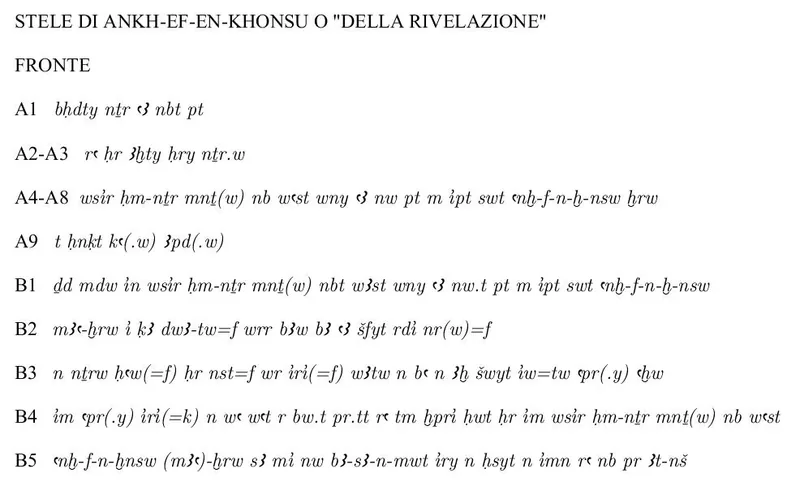
In early 1904 Crowley was travelling in Egypt with his wife Rose. His later account, published in The Equinox of the Gods (1936), describes how Rose, in an apparently altered state, insisted that he was being addressed by the god Horus. She identified the god among the exhibits of the Bulaq Museum on a painted wooden funerary stele of a Theban priest, Ankh-ef-en-Khonsu, catalogued as number 666. The object, now in the Egyptian Museum in Cairo, is known among Thelemites as the Stele of Revealing.
Following Rose's instructions, Crowley entered a room of their apartment at noon on three successive days, 8, 9 and 10 April 1904, and for one hour each day wrote down the words he heard spoken by a voice from behind him. He described the speaker as Aiwass, a being of great intelligence and power, and later identified him with his own Holy Guardian Angel. The result was sixty-five pages of manuscript, later published in facsimile and in typescript. Crowley insisted that he was a scribe and not the author, and that not a letter of the text should be changed.
Historians cannot verify the circumstances of the reception, which are known almost entirely from Crowley's own later writings. Some readers interpret the text as a product of Crowley's unconscious; others accept it as revelation. Most scholarly accounts, including those of Lawrence Sutin and Henrik Bogdan, describe it neutrally as the foundational scripture of a new religious movement. The fuller story of Crowley's life before and after Cairo is told in our article on Aleister Crowley.
The Three Speakers: Nuit, Hadit and Ra-Hoor-Khuit§
Each chapter of The Book of the Law is presented as the speech of a different divine figure, drawing on the imagery of the Stele of Revealing, which shows the sky-goddess Nut arched over a winged solar disk and the falcon-headed god Ra-Horakhty receiving offerings.
Nuit§
The first chapter is spoken by Nuit, a form of the Egyptian sky goddess Nut. In Thelemic thought she represents infinite space and the totality of all possibilities, the boundless circumference of existence. She speaks in terms of love, ecstasy and union, and declares that every man and every woman is a star, a phrase that expresses the Thelemic belief in the uniqueness and divinity of each individual.
Hadit§
The second chapter is spoken by Hadit, a name Crowley derived from Behdet, a form of Horus represented by the winged disk. Hadit is the complement of Nuit: the infinitely small point at the centre, the core of every being, the principle of motion and experience. Thelemic commentators describe the relation of Nuit and Hadit as that of circumference and centre, or of all possibility and the particular perspective that experiences it. Their union is said to bring forth the manifest universe.
Ra-Hoor-Khuit§
The third chapter is spoken by Ra-Hoor-Khuit, a form of Horus as the active, martial lord of the new age. This chapter is the most forceful and confrontational in tone, with violent imagery and denunciations of older religions that have troubled many readers. Crowley associated Ra-Hoor-Khuit with Heru-ra-ha, a combined form of Horus that also includes the passive, silent aspect Hoor-paar-kraat (Harpocrates).
True Will and the Law of Thelema§
The ethical core of Thelema is often summarised in two short formulas from The Book of the Law: a statement that doing one's will is the whole of the law, and a companion statement that love is the law, love under will. Thelemites customarily open letters with the first and close with the second.
Crowley and later Thelemic writers insisted that "will" here does not mean mere whim or appetite. The True Will is understood as the course of action that is in harmony with a person's deepest nature and with the universe as a whole, comparable to a star following its own orbit. Discovering it is a lifelong spiritual task. Because every person has a unique True Will, Thelemic ethics holds that one must not interfere with the will of others, and that conflict arises from the failure to discover one's real purpose. Crowley's essay Duty and his short declaration Liber OZ (1941), a list of human rights, express this principle of individual sovereignty.
In practice, the pursuit of True Will is closely linked to the magical goal Crowley called "Knowledge and Conversation of the Holy Guardian Angel," a phrase taken from the medieval Book of Abramelin. The term is understood variously as contact with a higher self or with an independent divine being. Thelemic training uses yoga, meditation, ceremonial ritual, devotional practice and the keeping of a magical diary.
The Aeon of Horus§
Thelema teaches a scheme of spiritual history divided into aeons, each associated with an Egyptian deity. The Aeon of Isis, a remote age, was characterised by the worship of the mother and of nature. The Aeon of Osiris, embracing the historic religions including Judaism, Christianity and Islam, emphasised the father, sacrifice, death and resurrection. The Aeon of Horus, beginning in 1904, is the age of the crowned and conquering child, in which humanity is to grow beyond obedience to external authority toward self-realisation. Crowley called the event of 1904 the Equinox of the Gods, and Thelemites date their calendar from it.
Some later Thelemic writers, including Charles Stansfeld Jones (Frater Achad) and Kenneth Grant, proposed further aeons, such as an Aeon of Maat. These views are not universally accepted.
Thelemic Organisations§
The A∴A∴§
Founded by Crowley and George Cecil Jones in 1907, the A∴A∴ is a mystical and magical order based on a reworked version of the Golden Dawn grade structure. It works through individual teacher–student relationships rather than group meetings. Several independent lineages now claim descent from Crowley's original body.
Ordo Templi Orientis§
The Ordo Templi Orientis (OTO), which Crowley led from the 1920s, is the largest Thelemic organisation. It confers a series of initiatory degrees in lodge settings and operates a church, the Ecclesia Gnostica Catholica, whose central rite is Crowley's Gnostic Mass (1913). After Crowley's death the order declined until it was revived in California under Grady McMurtry from the late 1960s. Other groups, including the Typhonian Order founded by Kenneth Grant, also claim the OTO name or heritage.
Other movements and influence§
Many Thelemites work independently. Thelemic ideas influenced Gerald Gardner, whose early rituals for Wicca borrowed from Crowley, and the later currents of the occult revival. The magical techniques underpinning Thelemic practice, including the reworked angelic system described in our article on Enochian magic, remain widely studied.
Frequently asked questions§
What does "Thelema" mean?§
Thelema is a Greek word meaning "will." Crowley used it to name the religion based on The Book of the Law, whose central teaching is the discovery and fulfilment of each individual's True Will.
Does "do what thou wilt" mean doing whatever you like?§
Thelemites say it does not. The phrase refers to the True Will, a person's deepest purpose in harmony with their nature, which may require discipline and self-knowledge to discover. Thelemic ethics also forbids interfering with the True Will of others.
Who are Nuit, Hadit and Ra-Hoor-Khuit?§
They are the three divine speakers of The Book of the Law. Nuit represents infinite space and possibility, Hadit the point of individual consciousness at the centre of every being, and Ra-Hoor-Khuit the active, martial form of Horus who rules the new aeon.
Is Thelema a religion?§
Many Thelemites consider it a religion, with a scripture, a mass, clergy and a calendar, while others regard it as a philosophy or magical system. Scholars of religion generally classify it as a new religious movement arising from the Western esoteric tradition.
What is the Aeon of Horus?§
It is the spiritual era that Thelemites believe began with the reception of The Book of the Law in 1904. It follows the Aeons of Isis and Osiris and is associated with the growth of individual freedom and self-realisation.
Sources and further reading§
- The Equinox of the Gods — Aleister Crowley, 1936
- The Law Is for All — Aleister Crowley, ed. Louis Wilkinson and Hymenaeus Beta, 1996
- Gargantua — François Rabelais, 1534
- Do What Thou Wilt: A Life of Aleister Crowley — Lawrence Sutin, 2000
- Aleister Crowley and Western Esotericism — Henrik Bogdan and Martin P. Starr (eds.), 2012
- Perdurabo: The Life of Aleister Crowley — Richard Kaczynski, revised edition 2010
- Magick: Liber ABA, Book Four — Aleister Crowley, ed. Hymenaeus Beta, 1994