Liber XII · High Magick · Chapter III: Enochian Magic
Enochian Magic: John Dee, Edward Kelley and the Angelic Language
Enochian magic explained: John Dee and Edward Kelley's 1580s angel conversations, the angelic language, the 48 Calls, the Great Table and later adaptations.
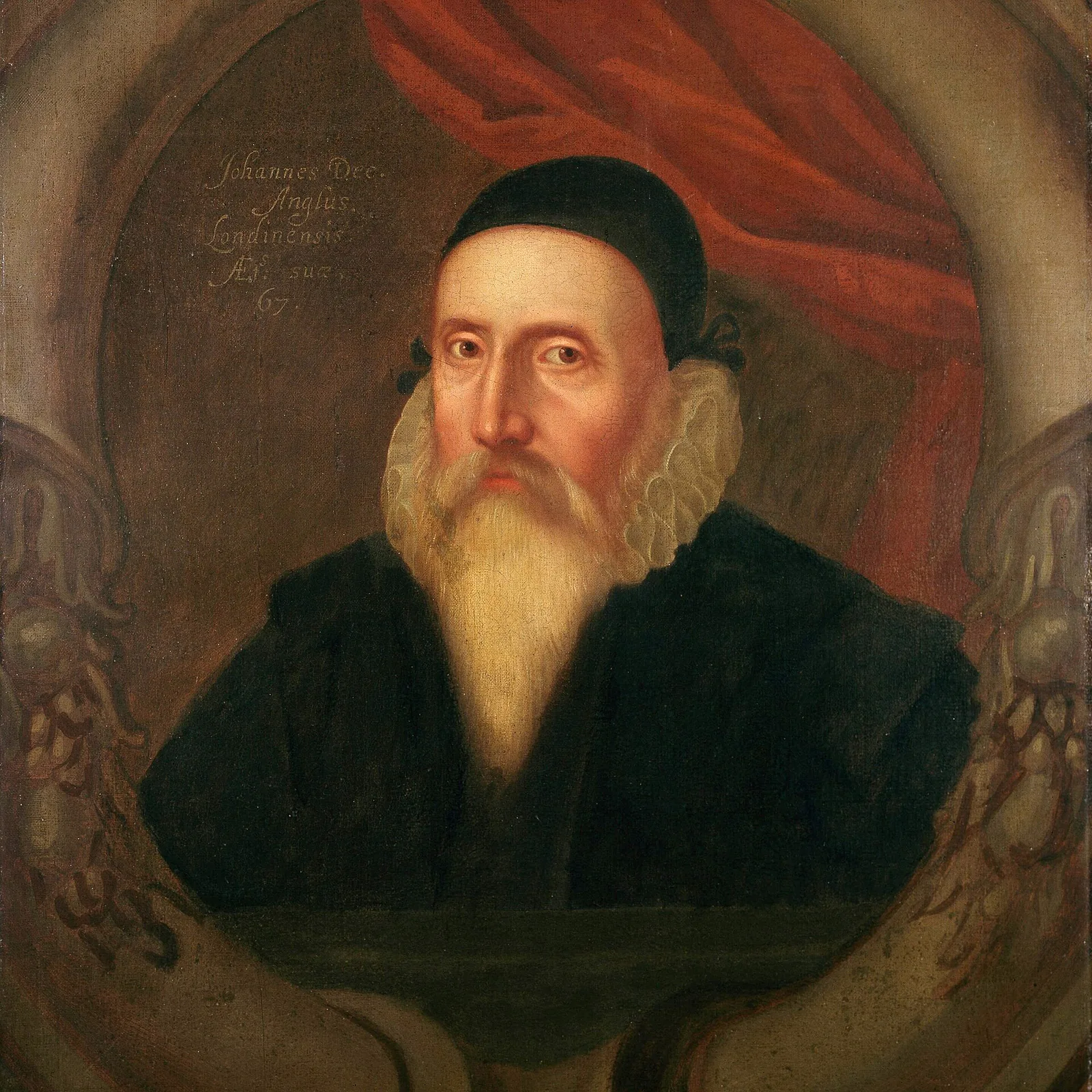
Enochian magic is a system of angel invocation derived from the records of the Elizabethan scholar John Dee and the scryer Edward Kelley, who between 1582 and the late 1580s held hundreds of sessions in which angels were said to appear in a crystal or "shew-stone" and dictate letters, tables and prayers. The material includes a distinctive alphabet and language, a set of invocations called the Calls or Keys, and a "Great Table" of letters assigned to the four quarters of the world. Largely unused by Dee himself, the system was reworked by the Hermetic Order of the Golden Dawn and by Aleister Crowley into a central pillar of modern ceremonial magic.
John Dee: Scholar, Astrologer and Seeker§
John Dee was one of the most learned men of sixteenth-century England. Educated at St John's College, Cambridge, he studied at Louvain and lectured on Euclid in Paris to large audiences. He wrote a celebrated mathematical preface to the first English translation of Euclid (1570), advised navigators on voyages of exploration, and coined or popularised the phrase "British Empire." His library at Mortlake, near London, was among the largest private collections in England. He was consulted by Queen Elizabeth I on astrological matters, including the choice of a date for her coronation.
Dee's interests extended to the occult sciences. His Monas Hieroglyphica (1564) presented a single composite symbol combining the signs of the planets and elements as a key to a universal philosophy. He owned and annotated works on Kabbalah, alchemy and magic, including Agrippa's Three Books of Occult Philosophy and medieval texts of ritual magic such as the Ars Notoria and the Liber Iuratus Honorii. By the late 1570s, convinced that human learning had reached its limits, he sought knowledge directly from angels.
Edward Kelley and the Shew-Stone Sessions§
Dee could not see visions himself and relied on a scryer. After experiments with others, in March 1582 he met Edward Kelley, who at first used the name Edward Talbot. Kelley was a young man of uncertain background, later notorious as an alchemist; he is reported to have lost his ears in the pillory for forgery, though this story is not securely documented. Whatever his past, he proved an extraordinarily productive medium.
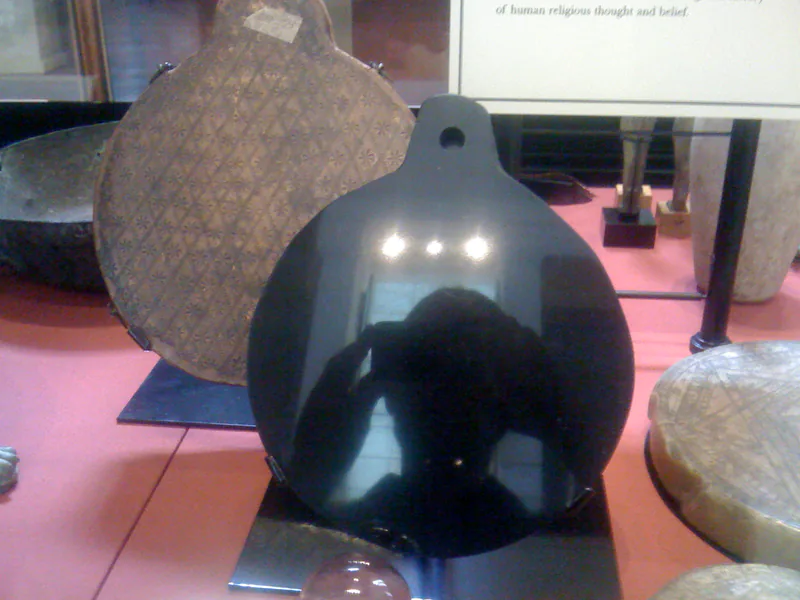
The procedure recorded in Dee's diaries was consistent. After prayer, Kelley gazed into a crystal or polished stone set on a specially prepared table, while Dee sat at a desk and wrote down everything Kelley reported. The table stood on wax seals engraved with a complex figure called the Sigillum Dei Aemeth (Seal of God's Truth), and its legs on smaller seals. The angels who appeared, including Uriel, Michael, Raphael and a childlike spirit called Madimi, gave instructions, delivered prophecies, and dictated letters one at a time, sometimes by pointing to squares on large tables.
The journey to Central Europe§
In 1583 Dee and Kelley, with their families, left England in the company of the Polish nobleman Albert Łaski and travelled to Poland and Bohemia. They sought patronage from King Stephen Báthory of Poland and from the Emperor Rudolf II in Prague, whose court was famously receptive to alchemy and the occult. The angels' messages increasingly turned to apocalyptic warnings and religious reform. In 1587, at Třeboň in Bohemia, the angels instructed the two men to share everything in common, including their wives. The two households signed a covenant to obey, and the episode marked the beginning of the end of the partnership. Dee returned to England in 1589; Kelley remained in Bohemia, where he won and then lost the favour of Rudolf II and died in imprisonment in the late 1590s.
The Angelic Language§
The most remarkable product of the sessions is a language with its own script of twenty-one letters, written from right to left. Dee referred to it as the angelic tongue or the language of Adam, the original speech of humanity before Babel. The name "Enochian" comes from the angels' statements that this knowledge had been granted to the patriarch Enoch and then lost; it became the usual name in later occultism.
Scholars have debated whether this is a genuine language or an invented one. The linguist Donald Laycock, who compiled The Complete Enochian Dictionary (1978), observed that it has a consistent if limited grammar and phonology that closely resembles English, and that its vocabulary shows no systematic relation to Hebrew or other languages. Some words recur with stable meanings; others appear only once. Whether the language originated in Kelley's imagination, in a genuine visionary experience, or in some combination, it has a coherence that has fascinated readers.
Liber Loagaeth and the 48 Calls§
Liber Loagaeth§
In 1583 the angels dictated Liber Loagaeth, "the Book of the Speech from God," also called the Book of Enoch. It consists of forty-nine large tables, each of forty-nine by forty-nine cells, filled with letters, together with passages of text in the angelic language. Only some of the tables were fully completed. The angels described it as a sacred book that would be opened at the time of a future restoration of true religion, and they gave no translation. It remains largely unintelligible.
The Calls or Keys§
In April to July 1584, while the two men were in Kraków, the angels dictated a series of invocations known as the Calls or Keys. These are the only substantial passages in the angelic language that came with English translations, which makes them the foundation of all study of the language. Remarkably, Kelley reported the letters of the Calls in reverse order, from last to first, and the English was provided afterwards, a detail Dee recorded carefully.
Eighteen Calls are distinct texts. The nineteenth, the Call of the Aethyrs, is a single invocation that is repeated thirty times, changing only the name of the Aethyr addressed. Counting each repetition separately produces forty-eight, which is why the set is often called the 48 Calls; the angels also spoke of a first Call that was not to be uttered, making forty-nine in their scheme. The language of the Calls is grand and apocalyptic, describing the divine ordering of the creation and the governors who rule its regions.
The Great Table and the Four Watchtowers§
Also in 1584, the angels revealed a large table of letters divided into four quarters, each associated with a direction of the world. Within each quarter the letters yield names of God and of hierarchies of angels: kings, seniors, and lesser angels set over particular regions and functions. A cross of letters separates the quarters, and a further "Tablet of Union" joins them. Together these were linked with the Thirty Aethyrs and with ninety-one governors of the parts of the earth. The relation between the Great Table, the Calls and the Aethyrs was not fully explained in Dee's records, which leaves much room for later interpretation.
It is important to note that Dee never assembled these materials into a practical system of magic. The surviving diaries show him receiving instructions and recording them, but there is little evidence that he performed the operations they described. The historian Deborah Harkness argues that Dee understood the sessions primarily as a form of natural philosophy and religious inquiry, a means of recovering the divine order of creation, rather than as ritual magic in the manner of the medieval grimoires such as the Key of Solomon.
Publication: Meric Casaubon's True and Faithful Relation§
After Dee's death his papers were scattered. Some were found in a hidden compartment of a chest; others were acquired by the antiquary Robert Cotton and by Elias Ashmole and are now in the British Library and the Bodleian Library. In 1659 Meric Casaubon, son of the scholar Isaac Casaubon, published a large portion of the diaries as A True and Faithful Relation of What Passed for Many Yeers Between Dr. John Dee ... and Some Spirits. Casaubon intended the book as a warning: he believed Dee had been sincere but deceived by evil spirits. The publication nevertheless preserved the material and shaped Dee's reputation for centuries as a deluded conjuror rather than a serious scholar.
Golden Dawn and Crowley Adaptations§
In the 1880s and 1890s the Hermetic Order of the Golden Dawn took up Dee's materials, which its leaders studied in manuscript in the British Museum. Mathers and Westcott integrated the Great Table, which the order called the four Watchtowers or Elemental Tablets, into the Second Order curriculum. They assigned each tablet to an element, developed colour schemes and three-dimensional "truncated pyramid" diagrams for each square, linked the letters to Hebrew, astrological and tarot correspondences, and created a form of Enochian chess. The Enochian names also appear in the order's ritual for opening a temple by the elemental watchtowers. This was a creative synthesis rather than a reconstruction of Dee's own practice.
Aleister Crowley learned the system in the Golden Dawn and extended it. In 1900 in Mexico he explored the two outermost Aethyrs, numbered thirty and twenty-nine; in 1909, travelling in the Algerian desert with Victor Neuburg, he worked through the remaining Aethyrs, reciting the nineteenth Call and recording the visions that followed. The record was published as The Vision and the Voice, which Crowley regarded as a confirmation of the new religious dispensation of Thelema. Later authors, including Israel Regardie and the scholar-practitioners who returned to Dee's manuscripts in the late twentieth century, have debated how far the Golden Dawn system departs from the original material. Some contemporary practitioners prefer to work from Dee's diaries directly, a distinction now commonly marked by speaking of "Dee's angelic magic" as against "Golden Dawn Enochian."
Frequently asked questions§
Is the Enochian language real?§
It is a real written and spoken system with an alphabet, vocabulary and some grammatical structure, recorded by John Dee from Edward Kelley's dictation. Linguists such as Donald Laycock found that its sounds and grammar closely resemble English and that it shows no clear relationship to other languages. Whether it is an invented language or a revealed one is a matter of belief.
Did John Dee practise Enochian magic?§
Dee received and recorded the angelic material but there is little evidence that he worked the system as a practical magic. He seems to have regarded the conversations as a means of recovering sacred knowledge. The ritual system known today as Enochian magic was largely developed by the Golden Dawn and its successors.
Why are there 48 Calls if only 19 were dictated?§
Eighteen Calls are unique texts, and the nineteenth is repeated for each of the thirty Aethyrs, giving forty-eight in total. The angels also referred to an unspoken first Call, so their own count reached forty-nine.
Where are John Dee's original manuscripts?§
Most of the surviving records of the angel conversations are held in the British Library, especially in the Cotton and Sloane collections, with further material in the Bodleian Library at Oxford. Meric Casaubon's 1659 edition reproduces a large part of them.
Sources and further reading§
- A True and Faithful Relation of What Passed for Many Yeers Between Dr. John Dee and Some Spirits — Meric Casaubon (ed.), 1659
- John Dee's Conversations with Angels: Cabala, Alchemy, and the End of Nature — Deborah E. Harkness, 1999
- John Dee: The World of an Elizabethan Magus — Peter J. French, 1972
- The Complete Enochian Dictionary — Donald C. Laycock, 1978
- John Dee's Five Books of Mystery — Joseph H. Peterson (ed.), 2003
- The Vision and the Voice — Aleister Crowley, first published in The Equinox, 1911
- The Queen's Conjurer: The Science and Magic of Dr. John Dee — Benjamin Woolley, 2001