Liber XXVIII · Solomonic Magic · Chapter IV: Key of Solomon
Key of Solomon: History of the Clavicula Salomonis Grimoire
The Key of Solomon (Clavicula Salomonis) explained: Renaissance manuscripts, Mathers' 1889 edition, pentacles, planetary hours, tools and purity rules.

The Key of Solomon, or Clavicula Salomonis, is a Renaissance grimoire attributed to King Solomon that describes how a magician should purify himself, prepare consecrated tools, observe planetary days and hours, and use inscribed talismans called pentacles to invoke and command spirits. It survives in many Latin, Italian, French and other manuscripts from the fifteenth century onward, and became widely known in English through S. L. MacGregor Mathers' edition of 1889, often called the Greater Key of Solomon.
What the Key of Solomon Is§
Despite its attribution, the Key of Solomon has nothing to do with the historical king of Israel. It belongs to the genre that historians call learned or ritual magic: a structured, text-based practice combining Christian prayer, Hebrew divine names, astrology and ceremonial procedure, aimed at gaining the cooperation of spirits for knowledge, protection, love, treasure-finding and similar ends. The attribution to Solomon placed the work within a tradition stretching back to the Seal of Solomon legends and the late antique Testament of Solomon, lending it prestige and an aura of ancient authority.
The Key differs from demon catalogues such as the Goetia in that it is primarily a manual of method. It describes the moral and physical preparations of the operator and his assistants, the construction of the circle and tools, the correct times for each work, and the prayers and conjurations to be recited. It does not contain a list of named demons with ranks and legions.
Origins and Manuscript History§
The book's prehistory lies in the Greek Solomonic literature of Byzantium. The Hygromanteia, or Magical Treatise of Solomon addressed to his son Rehoboam, survives in Greek manuscripts from the fifteenth century onward and contains planetary hours, angelic and demonic names, instructions for tools, and conjurations. Scholars such as Ioannis Marathakis, who translated it, and Pablo Torijano have shown that it shares material with the Latin Key, suggesting that Greek texts were one source when the Clavicula crystallized in Italy.
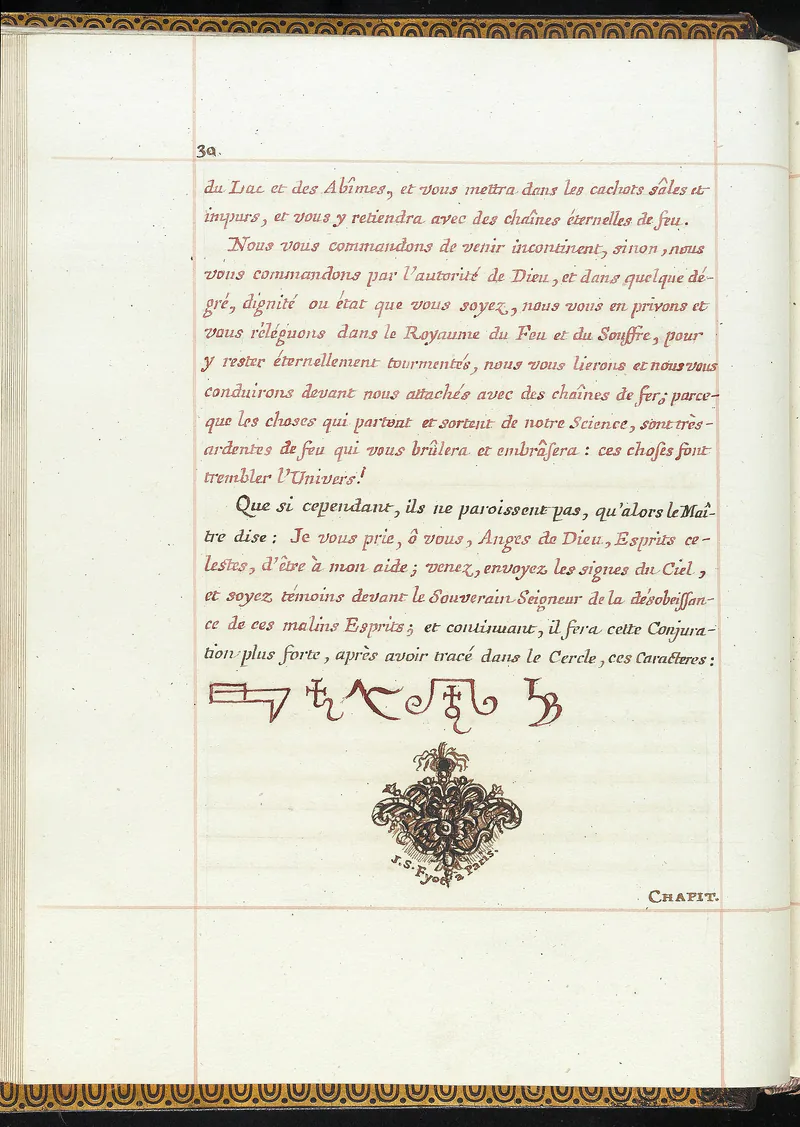
References to a Clavicula Salomonis appear in Italy by the fifteenth and sixteenth centuries, and the work was soon a target of ecclesiastical censorship. The Venetian Inquisition confiscated copies in investigations of magical practice, and the book appeared on lists of prohibited works, including the index associated with the papacy in the mid-sixteenth century. Prohibition did not stop circulation: manuscript copies multiplied in Italian, Latin and later French, each copyist adding, omitting or rearranging material.
By the seventeenth and eighteenth centuries, French versions were especially numerous, many held today in the Bibliothèque de l'Arsenal in Paris. Some carried titles like Les Véritables Clavicules de Salomon. The diversity is so great that historians speak of a "Clavicula family" rather than a single book. Owen Davies' Grimoires and Jean-Patrice Boudet's work on medieval learned magic place the Key within this wider history of manuscript transmission.
Mathers' 1889 Edition§
Samuel Liddell MacGregor Mathers, later a founding chief of the Hermetic Order of the Golden Dawn, published The Key of Solomon the King (Clavicula Salomonis) in London in 1889. He worked from several manuscripts in the British Museum (now the British Library), including Sloane and Harley manuscripts and others in Latin, French and Italian, combining them into a single English text divided into two books.
Mathers made editorial choices that modern scholars note carefully. He omitted material he considered to belong to black magic, standardized the arrangement, corrected Hebrew where he judged it faulty, and redrew the pentacles. His introduction asserted the book's ancient Hebrew origin, a claim not supported by the manuscript evidence. Nevertheless, his edition became the version most English-speaking readers know, and it was influential on the ceremonial magic of the Golden Dawn and its successors. A later edition by Joseph Peterson, published online and drawing on additional manuscripts, gives a fuller picture of the textual variety.
Structure: The Two Books§
In Mathers' arrangement, Book One concerns the operations themselves. It opens with Solomon's account of how he received wisdom and instructs that the book be guarded and transmitted only to the worthy. It then sets out the planetary hours, the conjurations and prayers, the experiments for particular ends, such as finding stolen goods, obtaining favor or invisibility, and the pentacles.
Book Two concerns preparations. It covers the purification of the master and his disciples, the days of fasting and abstinence, the garments, the consecration of the knife, sword, lancet, staff and wand, the preparation of parchment, ink and pens, the incense and perfumes, the water and the hyssop sprinkler, and the construction of the magic circle. Here the Key shows itself to be, above all, a manual of ritual purity and consecration.
Planetary Days and Hours§
Timing is fundamental to the Key. Following medieval astrology, each day of the week is ruled by one of the seven classical planets: Saturn, Jupiter, Mars, the Sun, Venus, Mercury and the Moon. Each day and night is further divided into twelve unequal planetary hours, and the ruling planet of each hour cycles through the so-called Chaldean order. The Key assigns different operations to different planetary influences: Saturn for matters of destruction or the dead, Jupiter for honor and wealth, Mars for war, the Sun for favor and authority, Venus for love and friendship, Mercury for eloquence and knowledge, and the Moon for journeys, messages and water.
This scheme was not unique to the Key. It appears throughout medieval and Renaissance astrological magic, including in Picatrix and in Agrippa's Three Books of Occult Philosophy. The Key's contribution lies in integrating it with Solomonic prayer and the consecration of objects.
The Pentacles of Solomon§
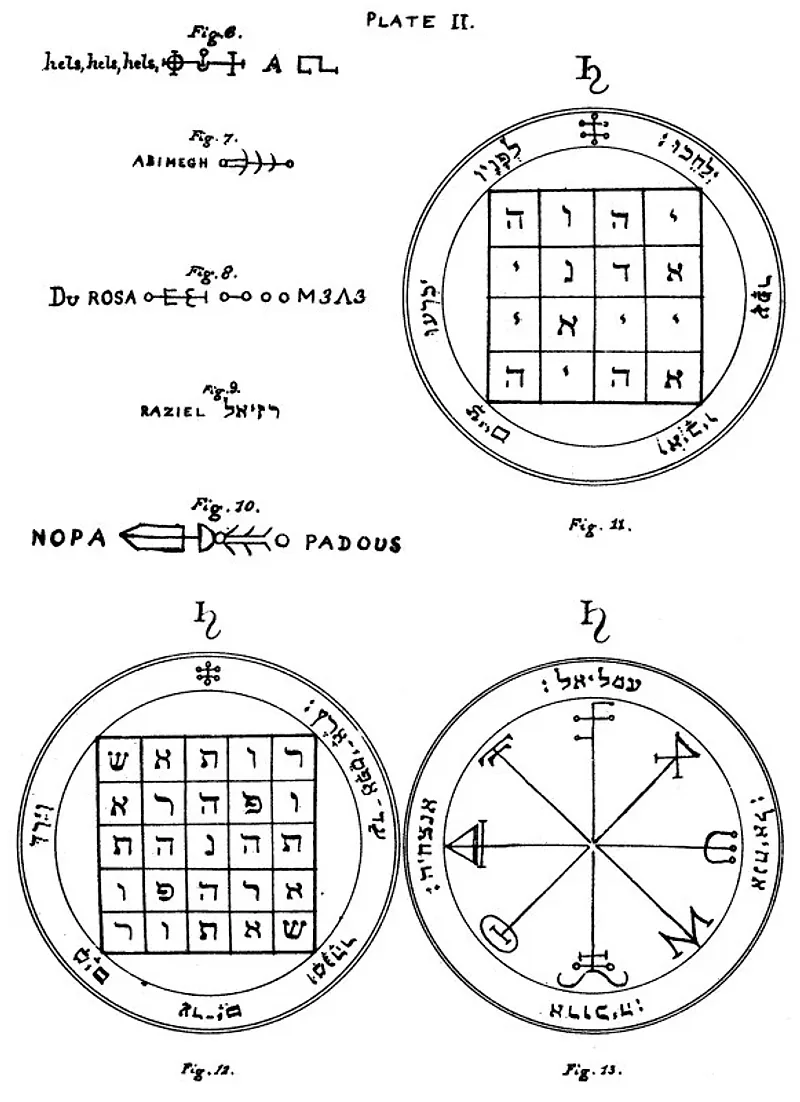
The most recognizable feature of the Key is its set of pentacles. In this context the word does not mean a five-pointed star but a consecrated talisman, usually circular, drawn on parchment or engraved on metal. Mathers' edition contains forty-four, distributed among the seven planets: seven for Saturn, seven for Jupiter, seven for Mars, seven for the Sun, five for Venus, five for Mercury and six for the Moon.
Each pentacle contains a central figure, such as a geometric design, magical characters or a sigil, surrounded by Hebrew letters, divine names and a verse from the Psalms or another biblical book. The text attributes to each a specific virtue: protection from danger, the gaining of riches, the overcoming of enemies, the winning of love, the opening of locks and so on. The pentacles were to be made in the day and hour of the corresponding planet, consecrated with prayer and incense, and kept wrapped in silk. Historically they are one of the clearest examples of how Christian Europe absorbed Hebrew names into its magical practice; whether the Hebrew is meaningful or garbled varies by manuscript.
Purity, Prayer and the Magician's Tools§
The Key insists that the magician's success depends on moral and ritual purity. The operator must confess his sins, fast, abstain from sexual relations for a set period, bathe in consecrated water, and wear clean linen garments. His disciples must be similarly prepared. Prayers drawn from the Psalms and composed in a liturgical style accompany every step.
The tools are equally regulated. Knives with white and black handles serve different purposes; the sword, staff and wand are made on particular days and inscribed with divine names; parchment must be virgin, ink freshly made, and quills consecrated. The magic circle, drawn with the consecrated knife and inscribed with names, protects the operator during the conjuration. Historians often note that this emphasis on purity mirrors Catholic sacramental practice: the magician behaves in many respects like a priest, which helps explain why church authorities found the genre so troubling.
A Note on Sacrifice and Harm§
Some manuscripts include instructions involving animals, such as blood for ink or the use of particular animal parts. These reflect early modern practice and are recorded here only as historical fact. Modern editors and practitioners commonly omit or substitute such material.
Influence and Legacy§
The Key of Solomon became the model for many later grimoires. The Lesser Key of Solomon, compiled in the seventeenth century, borrows its name and some of its ritual apparatus, though its contents are quite different. Popular French grimoires of the eighteenth and nineteenth centuries, such as the Grand Grimoire, draw on the Clavicula's tools and conjurations. Through Mathers, its pentacles and tools entered the curriculum of the Golden Dawn, and through that order the wider Western ceremonial tradition. Nineteenth-century writers such as Éliphas Lévi discussed it as a key text of what he called the high magic of the past.
Frequently asked questions§
Who wrote the Key of Solomon?§
Its authorship is anonymous. Although attributed to King Solomon, it was compiled in Renaissance Italy from earlier Greek and Latin magical traditions, and different copyists shaped the many surviving manuscripts.
What is the difference between the Key of Solomon and the Lesser Key of Solomon?§
The Key of Solomon (Clavicula) is a manual of ritual preparation, timing, tools and pentacles. The Lesser Key (Lemegeton) is a seventeenth-century English compilation of five separate texts, best known for its catalogue of 72 spirits in the Goetia.
What are the pentacles of Solomon?§
They are planetary talismans described in the Key, each combining a central design with Hebrew divine names and a biblical verse. Mathers' edition includes forty-four, assigned to the seven classical planets.
Is Mathers' Key of Solomon an accurate text?§
It is a composite edition made from several British Museum manuscripts, with material Mathers judged harmful omitted and Hebrew sometimes corrected. Scholars value it historically but treat it as one reconstruction among many.
Sources and further reading§
- The Key of Solomon the King (Clavicula Salomonis) — trans. and ed. S. L. MacGregor Mathers, 1889
- The Magical Treatise of Solomon, or Hygromanteia — trans. Ioannis Marathakis, 2011
- Grimoires: A History of Magic Books — Owen Davies, 2009
- Forbidden Rites: A Necromancer's Manual of the Fifteenth Century — Richard Kieckhefer, 1997
- Entre science et nigromance: astrologie, divination et magie dans l'Occident médiéval — Jean-Patrice Boudet, 2006
- Magic in the Middle Ages — Richard Kieckhefer, 1989
- Solomon the Esoteric King: From King to Magus, Development of a Tradition — Pablo A. Torijano, 2002