Liber XIII · High Magick · Chapter IV: Founders & Magi
Éliphas Lévi: Life, Dogme et Rituel and the Occult Revival
Éliphas Lévi (Alphonse-Louis Constant) explained: Dogme et Rituel de la Haute Magie, the astral light, tarot and Hebrew letters, and his Baphomet.

Éliphas Lévi was the pen name of Alphonse-Louis Constant (1810–1875), a French former seminarian and radical writer whose book Dogme et Rituel de la Haute Magie (1854–1856) effectively founded the modern occult revival. Lévi presented magic as a coherent science grounded in Kabbalah, a universal "astral light," and the correspondence between the tarot trumps and the Hebrew alphabet. His drawing of Baphomet became one of the most recognisable occult images in the world, and his ideas shaped the Hermetic Order of the Golden Dawn, Aleister Crowley and almost every later system of Western ceremonial magic.
Alphonse-Louis Constant: Early Life and Radical Years§
Alphonse-Louis Constant was born in Paris on 8 February 1810, the son of a shoemaker. His intelligence won him a place in the seminary system of the Catholic Church, where he studied for the priesthood at Saint-Sulpice. He was ordained a deacon, but in 1836, shortly before he was due to take priestly orders, he left the seminary. His own accounts link the decision to his falling in love with a young woman he had been asked to prepare for her first communion; whatever the precise cause, the break with the Church shaped the rest of his life, and he remained attached to Catholicism in his own unconventional way.
During the 1840s Constant moved in socialist and romantic circles. He was associated with the feminist socialist Flora Tristan and with Alphonse Esquiros, a writer interested in mysticism. His pamphlet La Bible de la liberté (1841), which interpreted the Gospel as a charter of radical social equality, earned him a prison sentence for subversion. Further writings brought further trouble with the authorities. In 1846 he married the young Noémie Cadiot, who later became known as a sculptor under the name Claude Vignon; the marriage broke down in the early 1850s and was later annulled.
The failure of the 1848 revolution and the coup of Louis-Napoléon in 1851 ended Constant's political hopes. Around this time he encountered the eccentric Polish mathematician and mystic Józef Hoene-Wroński, whose grand philosophical synthesis encouraged him to seek in occult tradition the unity of religion and science. In the early 1850s he adopted the name Éliphas Lévi Zahed, a Hebraised form of his given names, and turned to writing on magic.
Dogme et Rituel de la Haute Magie (1854–1856)§
Lévi's major work was published in two volumes: Dogme de la haute magie in 1854 and Rituel de la haute magie in 1856. The book was arranged in twenty-two chapters for each volume, matching the number of Hebrew letters and tarot trumps, so that its very structure embodied the correspondences it described. A. E. Waite translated it into English in 1896 as Transcendental Magic: Its Doctrine and Ritual.
The Dogme sets out a philosophy of magic. Lévi argued that the great religions and esoteric traditions all preserved fragments of a single primordial doctrine, transmitted through Hermes, the Kabbalah, the Gnostics and the Templars. Magic in his sense was not superstition but the knowledge of the hidden laws of nature and the training of the human will to act in accordance with them. Throughout he stressed balance, the reconciliation of opposites, and the need for the magician to master himself before attempting to act on the world.
The Rituel turns to practice, describing the consecration of instruments, the use of the pentagram, the evocation of spirits and the preparation of the magician. Lévi drew freely on earlier grimoires such as the Key of Solomon and on Renaissance writers including Agrippa and Paracelsus, but he reframed their material within his own philosophical system.
The evocation of Apollonius§
The Rituel includes an account of Lévi's attempted evocation of the shade of Apollonius of Tyana in London in 1854, after twenty-one days of preparation and fasting. He described a figure appearing in the smoke, his arm going numb, and his own sense of exhaustion. Lévi was careful to say that he did not claim to know whether the apparition was objectively real or the product of his own heightened imagination, and he warned readers of the dangers of such experiments to mental and physical health. The episode was much cited by later occultists.
The Astral Light§
At the centre of Lévi's theory stands what he called the astral light (lumière astrale). He described it as a universal, subtle agent that fills all space, a kind of living fluid that both records every image and impression and transmits the influence of a trained will. He identified it with the serpent of Genesis, with the "great magical agent" of the alchemists, and with the "animal magnetism" of the mesmerists who had fascinated Europe since Franz Anton Mesmer in the late eighteenth century.

For Lévi the astral light was morally neutral. It could serve wisdom or folly, illumination or delusion; the magician's task was to direct it through disciplined will and imagination. This idea gave occultists a quasi-scientific vocabulary that suited the nineteenth century's fascination with electricity, magnetism and invisible forces. Helena Blavatsky adopted the term in Isis Unveiled (1877), and the concept of an "astral plane" that pervades modern esoteric writing descends partly from Lévi.
Tarot and the Hebrew Alphabet§
The idea that the tarot carried ancient esoteric wisdom had been proposed in the 1780s by Antoine Court de Gébelin, who believed the cards were an Egyptian book, and by the cartomancer Etteilla. Lévi gave this idea a new form by linking the twenty-two major trumps systematically with the twenty-two letters of the Hebrew alphabet and through them with the paths of the Kabbalistic tradition explained in our introduction to what Kabbalah is.
In Lévi's scheme the Magician (trump I) was assigned to Aleph, the first letter, and so on through the sequence, with the unnumbered Fool placed near the end at Shin. The Hermetic Order of the Golden Dawn later adopted a different order, placing the Fool at Aleph, and this became the standard in the English-speaking world, while Lévi's attribution remained influential in France through writers such as Papus and Oswald Wirth. The longer story of how a Renaissance card game became an occult instrument is told in our history of tarot.
Baphomet: The Sabbatic Goat§
The frontispiece of the Rituel (1856) is Lévi's drawing of Baphomet, a winged, goat-headed figure seated on a globe, with a pentagram on its forehead, a torch between its horns, female breasts, and a caduceus rising from its lap. One arm points upward and the other downward, bearing the Latin words solve and coagula, "dissolve" and "coagulate," an alchemical formula. One crescent moon is light and the other dark.
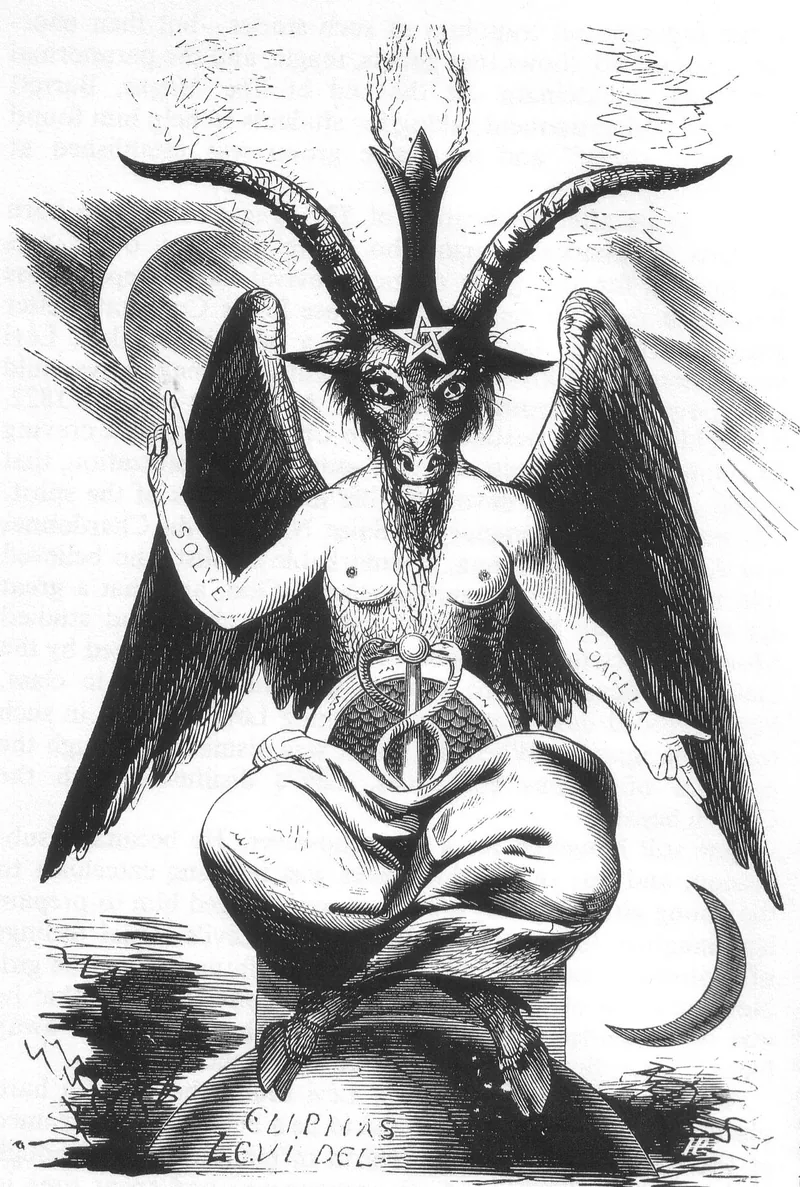
The name Baphomet came from the trials of the Knights Templar in the early fourteenth century, when some Templars were accused of worshipping an idol so named; the word is usually explained by historians as an Old French corruption of "Mahomet." Lévi, however, intended his figure not as a devil but as a symbol of the balance of opposites: male and female, light and darkness, human and animal, spirit and matter. He called it a hieroglyph of the astral light and of the absolute.
Despite this intention, the image was soon read as a picture of Satan. In the 1890s the hoaxer Léo Taxil used it in his fabricated exposés of Satanic Freemasonry, and in the twentieth century it influenced the popular image of the Devil on tarot cards and became a symbol of modern Satanist groups. Its complex history is part of the larger story told in our article on the history of Satan and the Devil.
Later Works, Students and Influence§
Lévi followed Dogme et Rituel with Histoire de la magie (1860), a sweeping narrative of magic from antiquity onward, and La Clef des grands mystères (1861), as well as later works including La Science des esprits. In his later years he lived modestly in Paris, earning his living by giving lessons to private students. The most important of these was Baron Spedalieri of Marseille, with whom he conducted an extensive correspondence. The English novelist Edward Bulwer-Lytton, whose occult novel Zanoni (1842) Lévi admired, was among his acquaintances.
Lévi's influence after his death in Paris on 31 May 1875 was enormous. In France he inspired the occultists of the fin de siècle, including Papus (Gérard Encausse), Stanislas de Guaita and Joséphin Péladan. In Britain his works were read by the founders of the Golden Dawn, and Waite's translations spread them to a wider public. Aleister Crowley believed himself to be Lévi's reincarnation, noting that he had been born a few months after Lévi's death, and translated La Clef des grands mystères into English. Many of the ideas that now seem basic to Western occultism, including the use of the pentagram as a symbol of the human microcosm, the "inverted" pentagram as a sign of evil, and the fusion of Kabbalah and tarot, either originate with Lévi or were popularised by him.
Lévi's relationship to Christianity remained ambivalent to the end. He continued to profess a form of Catholic faith, interpreted symbolically, and he regarded the Church as the guardian of truths it no longer understood. Historians of esotericism, including Christopher McIntosh, have shown how his synthesis of romantic socialism, religious reform and occult science reflected the hopes and disappointments of his generation.
Frequently asked questions§
What was Éliphas Lévi's real name?§
His real name was Alphonse-Louis Constant. He adopted "Éliphas Lévi Zahed" around 1853, a Hebraised version of his first names, and published his occult works under it.
What is Dogme et Rituel de la Haute Magie?§
It is Lévi's principal work, published in two volumes in 1854 and 1856. The first part sets out a philosophy of magic and the second describes ritual practice. Waite's 1896 English translation is known as Transcendental Magic.
Did Éliphas Lévi worship Baphomet or Satan?§
No. Lévi drew Baphomet as a symbol of the union of opposites and of the astral light, not as an object of worship. He considered himself a Christian, albeit an unorthodox one, and the association of his image with Satanism developed after his lifetime.
What is the astral light?§
The astral light was Lévi's term for a universal subtle medium that stores images and transmits the force of the will. He identified it with the magnetic fluid of the mesmerists and saw it as the instrument of all magical operations.
How did Éliphas Lévi influence the Golden Dawn?§
The Golden Dawn founders adopted his model of magic as a disciplined science of the will, his use of the pentagram, and his idea that the tarot trumps correspond to the Hebrew letters. They changed his specific letter assignments, however, creating the system that became standard in English-speaking occultism.
Sources and further reading§
- Dogme et Rituel de la Haute Magie — Éliphas Lévi, 1854–1856
- Transcendental Magic: Its Doctrine and Ritual — Éliphas Lévi, trans. A. E. Waite, 1896
- The History of Magic — Éliphas Lévi, trans. A. E. Waite, 1913
- Eliphas Lévi and the French Occult Revival — Christopher McIntosh, 1972
- A Wicked Pack of Cards: The Origins of the Occult Tarot — Ronald Decker, Thierry Depaulis and Michael Dummett, 1996
- Sozialismus, Katholizismus und Okkultismus im Frankreich des 19. Jahrhunderts: Die Genealogie der Schriften von Eliphas Lévi — Julian Strube, 2016