Liber XXIII · Satanism · Chapter II: The Devil in History
History of Satan and the Devil: From Adversary to Rebel Angel
History of Satan and the Devil: the Hebrew satan in Job, the Watchers of Enoch, the New Testament, Lucifer in Isaiah 14, Milton and the Romantic rebel.
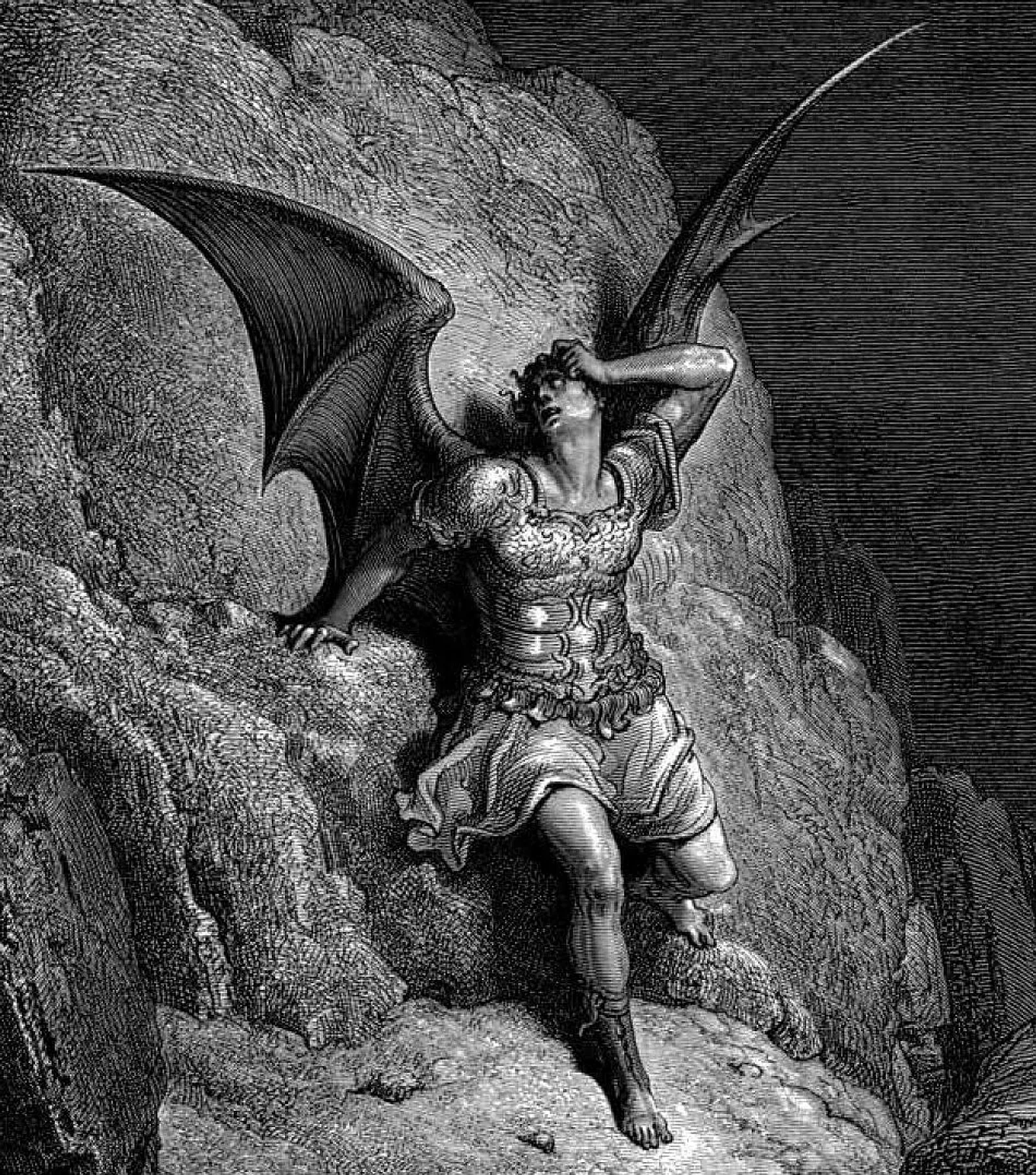
Satan began in the Hebrew Bible not as a prince of evil but as a satan, an "adversary" or "accuser", a role that could be filled by humans or by an angel serving God. Over roughly a thousand years, through Second Temple Jewish literature, the New Testament, the Church Fathers and medieval theology, this figure grew into the Devil: a fallen angel, ruler of demons and cosmic enemy of God. Later, poets such as John Milton and the Romantics reimagined him as a tragic rebel, preparing the ground for modern Satanism.
The Hebrew Satan: Adversary and Accuser§
In biblical Hebrew, satan is a common noun meaning "adversary" or "one who obstructs". It is used of human opponents: David is called a potential satan by the Philistines in 1 Samuel 29, and Solomon thanks God that he has no satan in 1 Kings 5. In Numbers 22 the angel of the Lord stands in the road "as a satan" to block Balaam's donkey, which shows that the role could be performed by a divine messenger acting on God's behalf.
The Satan in the Book of Job§
The most famous early appearance is in the prologue to the Book of Job. Here ha-satan, "the satan" with the definite article, appears among the "sons of God" who present themselves before the Lord. He questions whether Job's piety is disinterested and receives God's permission to test him by destroying his property, his children and his health. Most scholars read this figure as a member of the divine council, a kind of prosecuting attorney or roving inspector, not as God's independent enemy. He acts only by permission and disappears from the book after the prologue.
Zechariah and Chronicles§
In Zechariah 3, usually dated to the late sixth century BCE, the satan stands at the right hand of the high priest Joshua to accuse him, and is rebuked by the Lord. In 1 Chronicles 21:1, the satan (possibly here without the article, as a name) incites David to take a census. The earlier parallel in 2 Samuel 24 attributes the same incitement to God's anger, which suggests that later writers were becoming uncomfortable attributing harmful actions directly to God and assigned them to an intermediary. Many scholars see this as an early step toward a more independent evil figure.
The serpent of Genesis 3 is not identified with Satan in the Hebrew Bible itself. That identification appears later, in texts such as the Wisdom of Solomon (2:24, which speaks of death entering the world through the envy of the devil) and especially in Christian interpretation.
Second Temple Judaism: Watchers, Mastema and Belial§
Between the Babylonian exile and the end of the first century CE, Jewish literature developed a much richer world of angels and demons. Scholars often link this to contact with Persian Zoroastrianism, whose cosmic dualism set the good Ahura Mazda against the destructive spirit Angra Mainyu, though the extent of direct influence is debated.
The most important text is 1 Enoch, a composite work whose earliest sections, including the Book of the Watchers (chapters 1–36), are generally dated to the third century BCE. Expanding on the brief and enigmatic account of the "sons of God" and "daughters of men" in Genesis 6, it tells how two hundred angels called Watchers, led by figures named Shemihazah and Asael (or Azazel), descended to earth, took human wives, fathered giants and taught humanity forbidden arts, including metallurgy, weapons, cosmetics, sorcery and astrology. The flood was sent to cleanse the earth of the resulting violence, and the spirits of the dead giants became evil spirits that continue to afflict humanity.
Other texts gave the chief evil power different names. The Book of Jubilees (second century BCE) has Mastema, the leader of evil spirits who is allowed a tenth of them to test humanity. The Dead Sea Scrolls, especially the War Scroll and the Community Rule, describe Belial as the leader of the "sons of darkness" opposed to the "sons of light". The Life of Adam and Eve, preserved in Greek and Latin versions, includes the story that Satan fell because he refused God's command to bow before the newly created Adam, a motif later found in the Qur'an's account of Iblis. Related traditions of demons commanded by Solomon appear in the Testament of Solomon.
Satan in the New Testament§
By the first century CE, Satan had become, for many Jews and early Christians, the leader of a hostile spiritual kingdom. The New Testament uses several names: Satan, the devil (Greek diabolos, "slanderer", which translates the Hebrew satan in the Greek Septuagint), Beelzebul, the tempter, the evil one, and "the ruler of this world" in John's Gospel.
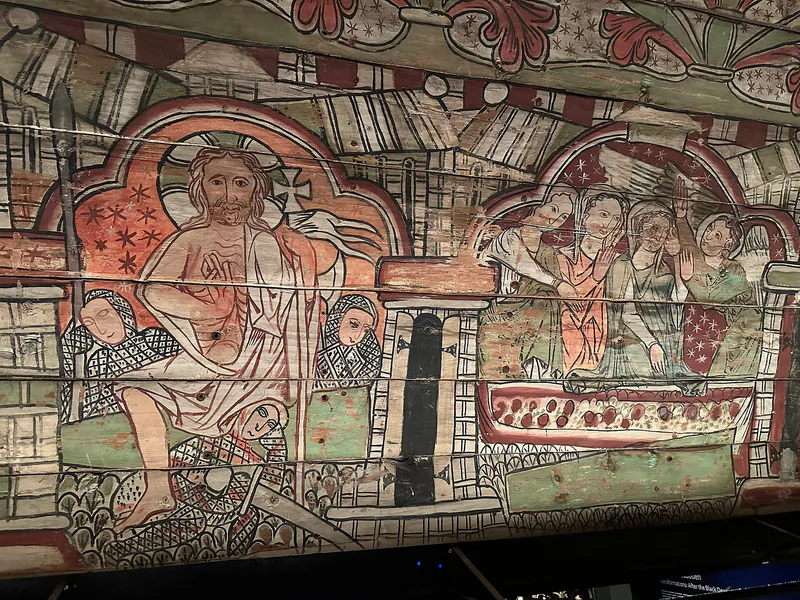
In the Synoptic Gospels Satan tempts Jesus in the wilderness and his kingdom is attacked through Jesus's exorcisms. Elaine Pagels's The Origin of Satan (1995) argued that the Gospel writers increasingly associated Satan with their human opponents, a reading that has been influential though also contested. Paul calls Satan the god of this age (2 Corinthians 4:4) and as able to disguise himself as an angel of light.
The Book of Revelation provides the most dramatic imagery. In Revelation 12, a great red dragon, explicitly identified with the ancient serpent, the Devil and Satan, is cast out of heaven by Michael and his angels. In Revelation 20 he is bound for a thousand years, released, and finally thrown into the lake of fire. These passages, with their merging of the serpent, the dragon and Satan, became foundational for later Christian imagery. Gnostic writers developed a related but distinct figure in the Demiurge, the flawed creator of the material world, who is sometimes confused with the Devil but has a different role.
Lucifer and Isaiah 14: The Morning Star§
The name Lucifer comes from Isaiah 14:12, which in the King James Version reads: "How art thou fallen from heaven, O Lucifer, son of the morning!" The Hebrew text has Helel ben Shachar, "shining one, son of the dawn", a reference to the morning star, the planet Venus. In context the chapter is a taunt song against the king of Babylon, whose arrogant ambition to ascend above the stars of God ends in his downfall. Scholars note possible parallels with Canaanite myths of a minor deity who tried to seize a higher throne.
The Latin Vulgate translated Helel as lucifer, "light-bearer", the ordinary Latin word for the morning star. Early Christian writers, notably Origen in the third century and later others, read the passage alongside Luke 10:18, where Jesus says he saw Satan fall from heaven like lightning, and Ezekiel 28, a lament over the king of Tyre who was once in Eden as a covering cherub. From this combination came the classic Christian story of Lucifer as a glorious archangel who fell through pride. Lucifer thus became a proper name for Satan before his fall, a usage that persists in literature and in modern Luciferian movements.
The Devil in Early Christian and Medieval Thought§
The Church Fathers systematised these sources. Augustine of Hippo argued that the Devil fell through pride, that evil has no independent substance but is a privation of good, and that God permits the Devil's activity for his own purposes. This rejected the radical dualism of Manichaeism, which posited two equal and opposing principles. Later dualist movements, discussed in Cathars and Bogomils, revived the idea that the material world was the Devil's creation, and were condemned as heresies.
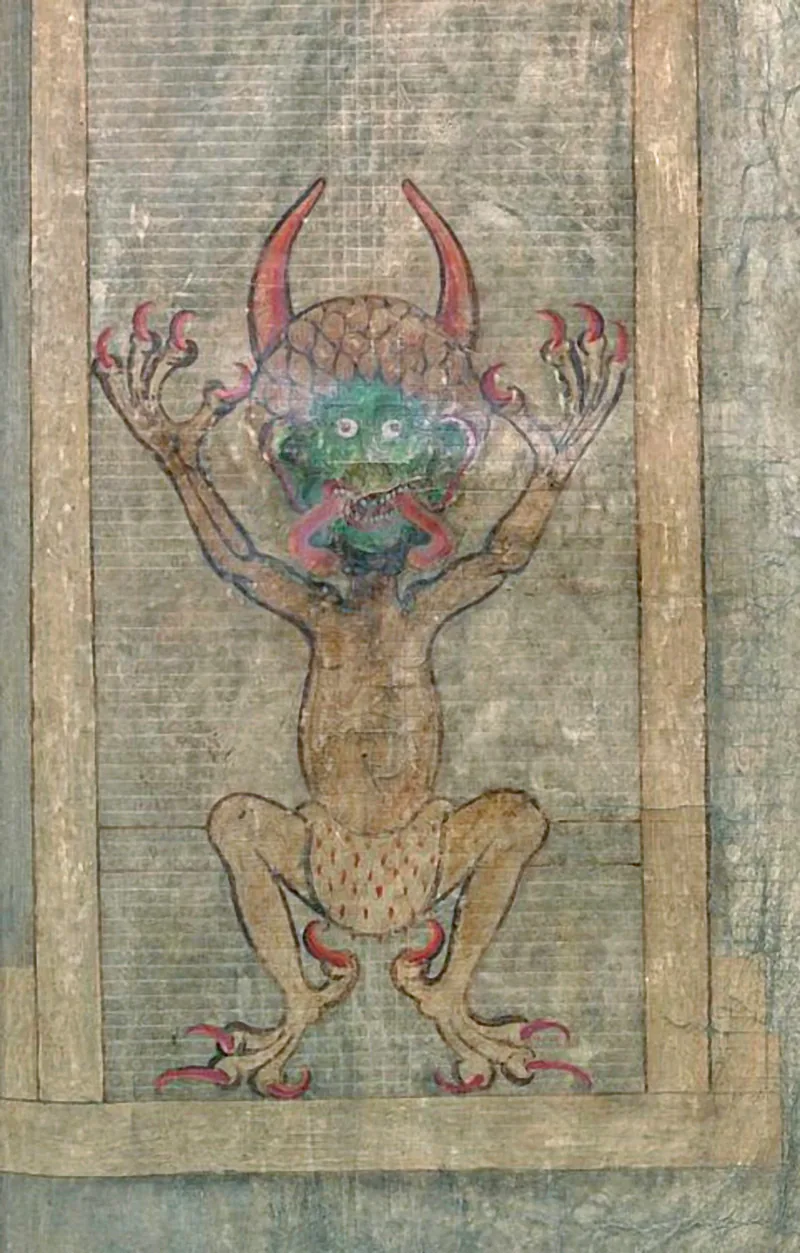
Medieval theologians debated the Devil's nature, the timing and cause of his fall, and his role in redemption. Early "ransom" theories of atonement held that Christ's death paid a price owed to the Devil, a view criticised by Anselm of Canterbury in Cur Deus Homo (1098). The Fourth Lateran Council (1215) affirmed that the Devil and other demons were created good by God but became evil by their own choice.
The Devil in Medieval Art and Culture§
Visual depictions changed over time. Early Christian art rarely showed the Devil at all. From the Romanesque period onward he appeared increasingly monstrous: dark, hairy, horned, with bat wings, claws and sometimes a face on his belly or buttocks. Some of these features likely drew on images of pagan deities such as Pan, though art historians caution against assuming direct continuity. Dante's Inferno (early fourteenth century) placed a three-faced, gigantic Satan frozen in ice at the centre of hell, chewing the traitors Judas, Brutus and Cassius.
In the late Middle Ages the Devil became central to the new idea of diabolical witchcraft. Demonologists argued that witches made explicit pacts with Satan and worshipped him at sabbats, a belief that underpinned the European witch trials.
Milton's Satan and the Romantic Rebel§
The most influential literary portrait is in John Milton's Paradise Lost (1667, revised 1674). Milton's Satan is eloquent, proud and magnetic, especially in the early books, where he rallies the fallen angels in hell and declares that it is "better to reign in Hell, than serve in Heaven." Milton intended a theological epic that would vindicate God's providence, and over the poem Satan degenerates, ending as a serpent. But his early grandeur proved fascinating.
William Blake remarked in The Marriage of Heaven and Hell (c.1790–93) that Milton, as a true poet, had unknowingly sided with the Devil. Percy Bysshe Shelley, in his Defence of Poetry, judged Milton's Satan morally superior to Milton's God, and Lord Byron's Cain (1821) presented a Lucifer who encourages human questioning. The French poet Charles Baudelaire's "Litanies of Satan" in Les Fleurs du mal (1857) addressed Satan as a consoler of the oppressed, and in Italy Giosuè Carducci's "Inno a Satana" (1863) hailed Satan as a symbol of reason and progress against clerical power. Scholars such as Peter Schock and, more recently, Per Faxneld have described this "Romantic Satanism" as a literary and political use of Satan as an emblem of rebellion, liberty, science, and sometimes sexual or feminist emancipation, rather than as an object of worship.
From Literary Satanism to Modern Satanism§
The nineteenth century also produced lurid rumours of Satanic cults. The most notorious was the Taxil hoax of the 1890s, in which the French writer Léo Taxil fabricated stories of a Satanic Masonic order, the "Palladists", before publicly confessing the fraud in 1897. Historians generally find no evidence of organised religious Satanism before the twentieth century.
Organised Satanic religion appeared in 1966 with Anton LaVey's Church of Satan, which drew heavily on the Romantic image of Satan as rebel and symbol of human nature, discussed in LaVeyan Satanism and the Church of Satan. Later initiatory groups such as the Temple of Set reinterpreted the figure further, as covered in the Temple of Set and the left-hand path. For most modern Satanists, as for the Romantic poets, Satan is primarily a symbol rather than a literal being.
Frequently asked questions§
Is Satan the serpent in the Garden of Eden?§
The text of Genesis 3 describes a talking serpent and does not identify it with Satan. The identification developed later, in Jewish texts such as the Wisdom of Solomon and in Christian interpretation, and is made explicit in Revelation 12, which equates the dragon with the ancient serpent. It became standard Christian doctrine.
Are Lucifer and Satan the same?§
In mainstream Christian tradition, Lucifer is the name of Satan before his fall, derived from the Latin translation of Isaiah 14:12. In its original context, however, the passage concerns a king of Babylon described as the morning star. Some modern esoteric movements distinguish Lucifer, as a bringer of light and knowledge, from Satan.
Where did the image of the horned Devil come from?§
Horns, hooves and animal features developed gradually in medieval Christian art, especially from about the eleventh century. Art historians suggest a mix of influences, including biblical imagery of beasts and possibly classical images of satyrs and Pan. The New Testament itself does not describe the Devil's appearance in such terms.
Does Judaism believe in the Devil?§
Mainstream rabbinic Judaism does not have a Devil comparable to Christian theology's cosmic enemy of God. The satan appears in rabbinic literature as an accuser, a tempter and sometimes the angel of death, and the "evil inclination" (yetzer ha-ra) within humans is emphasised. Some Jewish mystical texts give demonic powers greater prominence.
Sources and further reading§
- The Holy Bible, King James Version — 1611
- Paradise Lost — John Milton, 1667/1674
- The Marriage of Heaven and Hell — William Blake, c.1790–93
- The Devil: Perceptions of Evil from Antiquity to Primitive Christianity — Jeffrey Burton Russell, 1977
- Lucifer: The Devil in the Middle Ages — Jeffrey Burton Russell, 1984
- The Origin of Satan — Elaine Pagels, 1995
- The Old Enemy: Satan and the Combat Myth — Neil Forsyth, 1987
- 1 Enoch: A New Translation — George W. E. Nickelsburg and James C. VanderKam, 2004
- Satanic Feminism: Lucifer as the Liberator of Woman in Nineteenth-Century Culture — Per Faxneld, 2017
- The Invention of Satanism — Asbjørn Dyrendal, James R. Lewis and Jesper Aa. Petersen, 2016