Liber IX · Gnosticism · Chapter VII: Manichaeism & Mandaeism
Manichaeism and Mandaeism: Mani, the Light and the Last Gnostics
Manichaeism and Mandaeism explained: Mani and his religion of light, its myth and spread from Rome to China, and the Mandaeans of Iraq and Iran, the last living Gnostics.

Manichaeism and Mandaeism are the two great Gnostic religions that grew beyond the Christian sects of the second century. Manichaeism, founded by the prophet Mani (216–c. 276) in Persian Mesopotamia, taught a cosmic struggle between Light and Darkness and spread from the Roman Empire to China before dying out; Mandaeism, a baptismal religion that honours John the Baptist, survives today among small communities from Iraq and Iran and in a worldwide diaspora.
Mani and the Founding of Manichaeism§
Mani was born in 216 CE near Ctesiphon in Mesopotamia, then part of the Parthian and soon the Sasanian Persian empire. The Cologne Mani Codex, a tiny Greek parchment book published in the 1970s, confirms that he grew up in a Jewish-Christian baptist community linked to the Elchasaites. At the ages of twelve and twenty-four, according to his followers, he received revelations from a heavenly "twin" (syzygos), who disclosed the secrets of the universe and commissioned him as an apostle.
Mani broke with the baptists, travelled to India, and won the favour of the Sasanian king Shapur I, for whom he wrote the Shabuhragan, a summary of his teaching in Middle Persian. He claimed to be the last in a line of messengers that included Zoroaster, the Buddha and Jesus, and, unlike them, to have written his own scriptures: the Living Gospel, the Treasure of Life, the Pragmateia, the Book of Mysteries, the Book of Giants, his letters and psalms, together with a book of pictures. Under Bahram I, influenced by the Zoroastrian priesthood, Mani was imprisoned and died around 274–277; his followers commemorated his death as a crucifixion-like "passion" at the annual Bema festival.
The Manichaean Myth: Light, Darkness and the Three Times§
Manichaean teaching is set out as a myth in "three times." In the beginning, two principles existed separately: the Kingdom of Light, ruled by the Father of Greatness, and the Kingdom of Darkness, a realm of chaotic, devouring matter. In the middle time, Darkness attacked the Light. The Father sent forth the Primal Man, who was defeated and whose light was swallowed by the powers of darkness. Further divine emanations, the Living Spirit and the Third Messenger, rescued him and built the cosmos as a vast machine for recovering the captured light: the sun and moon are ships that carry purified light back to its source.

Humanity was created by the demonic powers to imprison light in flesh through procreation. Salvation is the awakening of the light within, brought by Jesus the Splendour, by Mani as Paraclete and by the "Light-Mind." In the final time, the last light will be gathered and Darkness sealed away forever. The demiurge of other Gnostic systems has no place here: matter is not the work of a foolish creator but an eternal, independent evil, a more radical dualism shaped partly by Iranian ideas.
The Manichaean Church: Elect and Hearers§
The community was divided into a small class of Elect, men and women bound by strict vows of celibacy, poverty, vegetarianism and harmlessness, and a larger body of Hearers, lay followers who supported them. Because light was believed to be trapped in plants, the Elect's ritual meal, prepared and offered by Hearers, was understood to release light particles through the Elect's purified bodies. A hierarchy of a leader, twelve teachers, seventy-two bishops and presbyters organised the church. Manichaeans were famous for beautiful books, calligraphy and painting, which they used in mission.
From Rome to China: The Spread and Persecution of Manichaeism§
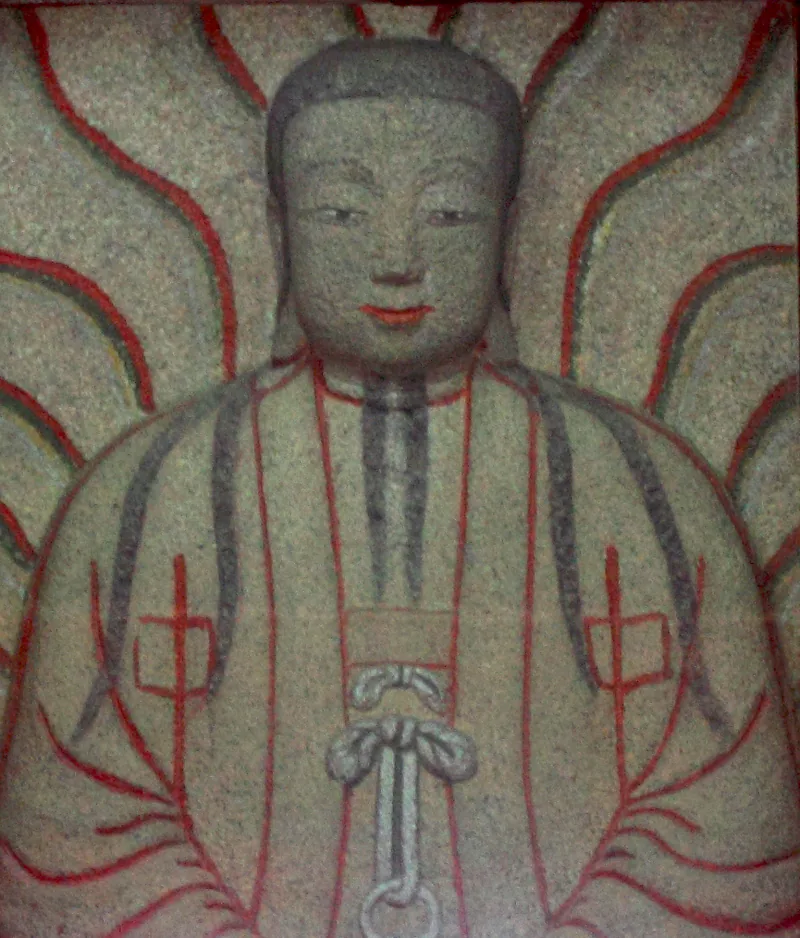
Manichaeism spread rapidly west and east. In the Roman Empire Diocletian ordered its suppression around 302, and Christian emperors later outlawed it. Augustine of Hippo was a Hearer for about nine years before becoming its fiercest critic. Eastward, Sogdian merchants carried it along the Silk Road; in 762 or 763 the ruler of the Uyghur Khaganate adopted it as a state religion. In China, where it was known as the "religion of light" (Mingjiao), it survived persecution in 843 by blending with popular Buddhism and Daoism; a fourteenth-century shrine at Cao'an in Fujian still contains a statue of Mani as the "Buddha of Light."
For centuries Manichaeism was known almost only from its enemies. That changed in the twentieth century with the discovery of manuscripts at Turfan in Chinese Central Asia (from 1902), Coptic codices from Medinet Madi in Egypt (around 1929–1930), and the Cologne codex. In medieval Europe, "Manichaean" became a standard label for dualist heretics, including the Paulicians, Bogomils and Cathars; whether there was any real historical connection is doubtful, as the article on the Cathars and Bogomils explains.
The Mandaeans: The Last Living Gnostics§
The Mandaeans, whose name comes from manda, "knowledge," are a small ethno-religious community traditionally living along the rivers of southern Iraq and in Khuzestan in Iran. Their scriptures, written in Mandaic, a dialect of Aramaic with its own script, include the Ginza Rabba ("Great Treasure"), the Book of John (Drashe d-Yahya) and the liturgical Qolasta. They teach that a supreme, transcendent Life (Hayyi) dwells in the World of Light, attended by light beings (uthras), while the material world was fashioned by the lesser being Ptahil, with the involvement of the dark spirit Ruha.
Mandaeans revere John the Baptist (Yahya Yuhana) as a great prophet and teacher but are not Christians; they regard Jesus as a false messiah and Abraham, Moses and Muhammad as false prophets. Their origins are debated. One Mandaean text, the Haran Gawaita, recounts a migration from the region of the Jordan to Mesopotamia in the Parthian period, and scholars such as Kurt Rudolph and Jorunn Buckley have taken a western, Palestinian origin seriously, while others emphasise Mesopotamian roots. Their mythology shares much with the systems described in What Is Gnosticism? and Sethian Gnosticism.
Mandaean Ritual and Survival Today§
The central Mandaean rite is masbuta, baptism by triple immersion in flowing "living water," always called yardena (Jordan), performed by priests dressed in white. Unlike Christian baptism, it is repeated often, on Sundays, at festivals, at marriage and after impurity. The masiqta, an elaborate "ascent" ritual for the dead, helps the soul rise through the watch-houses of the planets to the World of Light. Many scholars identify the Mandaeans with the "Sabians" whom the Qur'an names as a protected "people of the book," a status they have long claimed.
The twentieth-century British scholar E. S. Drower lived among the Mandaeans and published their texts and rites. Since the Iraq war of 2003, violence and persecution have driven most Mandaeans from Iraq; communities now live in Sweden, Australia, the United States and elsewhere, with a worldwide population usually estimated in the tens of thousands. The diaspora faces the challenge of training priests and preserving a religion that does not accept converts.
Frequently asked questions§
What did Manichaeans believe?§
They believed in two eternal principles, Light and Darkness, whose mixing produced the present world. Human souls are particles of light trapped in matter, and salvation comes through knowledge brought by a series of messengers culminating in Mani, together with an ascetic life that releases light.
Is Manichaeism still practised?§
No organised Manichaean community has survived into modern times; the last traces disappeared in southern China, probably by the sixteenth or seventeenth century. Some modern groups have tried to revive it, but without historical continuity.
Are the Mandaeans Christians?§
No. Mandaeans honour John the Baptist but reject Jesus as a messiah. They have their own scriptures, priesthood and rituals and are usually classed by scholars as the only surviving religion with clearly Gnostic features.
Why is "Manichaean" used to mean black-and-white thinking?§
Because Mani taught a sharp opposition between Light and Darkness, the word became a byword for any rigid division of the world into absolute good and absolute evil. This metaphorical use says little about the actual sophistication of Manichaean thought.
Sources and further reading§
- Manichaeism in the Later Roman Empire and Medieval China — Samuel N. C. Lieu, 1985
- Manichaeism — Michel Tardieu, 2008
- The Manichaean Body: In Discipline and Ritual — Jason David BeDuhn, 2000
- The Gnostic Religion — Hans Jonas, 1958
- Gnosis: The Nature and History of Gnosticism — Kurt Rudolph, 1983
- The Mandaeans of Iraq and Iran — E. S. Drower, 1937
- The Mandaeans: Ancient Texts and Modern People — Jorunn Jacobsen Buckley, 2002
- Confessions — Augustine of Hippo, c. 400