Liber IX · Gnosticism · Chapter VI: Gnostic Schools
Sethian Gnosticism: Barbelo, Yaldabaoth and the Seed of Seth
Sethian Gnosticism explained: the myth of Barbelo, the Autogenes and Yaldabaoth, the seed of Seth, its key Nag Hammadi texts and its links to Platonism.

Sethian Gnosticism is the modern name for a group of second- to fourth-century texts and communities that saw themselves as the spiritual descendants of Seth, the third son of Adam and Eve. Their myth describes a transcendent Invisible Spirit, his first thought Barbelo, a heavenly triad that includes the self-generated Autogenes, and the fall of Sophia, which produces the ignorant creator Yaldabaoth. The Sethian corpus, mostly preserved in the Nag Hammadi library, ranges from biblical retellings such as the Apocryphon of John to philosophical treatises closely tied to Platonism.
Who Were the Sethians? Defining a Scholarly Category§
Ancient heresiologists mention a group called "Sethians". Pseudo-Tertullian, Hippolytus and Epiphanius all describe people who honoured Seth, though their reports differ and are not always reliable. Irenaeus, writing around 180 CE, describes a group he simply calls the "Gnostics", whose myth of Barbelo and the ignorant creator matches the first part of the later-discovered Apocryphon of John.
After the Nag Hammadi discovery, the German Coptologist Hans-Martin Schenke noticed that a set of texts shared a recognisable mythology: the same divine names, the same heavenly luminaries, the same self-understanding as the "seed of Seth". In a paper published in 1981 he defined this as "Sethian" Gnosticism. Bentley Layton, in The Gnostic Scriptures (1987), preferred to call it "classic Gnostic" literature, and David Brakke (2010) argues that these are the people the ancient sources actually called gnōstikoi. John D. Turner's Sethian Gnosticism and the Platonic Tradition (2001) is the most detailed reconstruction of the group's development.
Whether the texts reflect a single organised movement is uncertain. In line with wider debates over the category described in our overview of Gnosticism, many scholars now speak of a Sethian literary and mythic tradition rather than a church with fixed boundaries.
The Sethian Divine World: The Invisible Spirit, Barbelo and the Autogenes§
The Sethian myth begins above the cosmos with a God described almost entirely through negations. In the Apocryphon of John the supreme being is the Invisible Spirit, the Monad, who is not one of the things that exist but beyond them; he is neither corporeal nor incorporeal, neither large nor small, and cannot be named. This language closely resembles the "negative theology" of contemporary Platonism and anticipates later Christian apophatic mysticism.
Barbelo, the First Thought§
The Invisible Spirit contemplates his own image in the luminous water that surrounds him, and this act of self-reflection becomes a second being: Barbelo, his Ennoia or first Thought. Barbelo is described as the "womb of everything", the "mother-father", the first human and the thrice-powered, thrice-male, thrice-named. The origin of her name is unknown; proposals include Hebrew and Coptic etymologies, none conclusive. Barbelo becomes the first of a series of emanations that complete the divine realm.
The Triad and the Autogenes§
From the Father and Barbelo comes a son, the self-generated (Autogenes), identified in Christian versions with Christ. Father, Mother and Son form the supreme Sethian triad. The Autogenes in turn is attended by four great luminaries, Harmozel, Oroiael, Daveithai and Eleleth, each accompanied by three further aeons, making twelve. In these luminaries are placed the heavenly prototypes of salvation history: the perfect human, Adamas (or Geradamas), in the first; Seth in the second; the seed of Seth in the third; and the souls of those who will repent in the fourth.
Sophia and Yaldabaoth: The Fall and the Creation of the World§
The last of the twelve aeons is Sophia, Wisdom. She desires to bring forth a being from herself without the consent of the Spirit and without her consort. Her product is misshapen: a lion-faced serpent with flashing eyes. Ashamed, she casts it away from the divine realm, hides it in a luminous cloud, and names it Yaldabaoth. Other texts give alternative names, Saklas ("fool") and Samael ("blind god"), which reflect Jewish traditions about the angel of death and the adversary.

Yaldabaoth has taken a portion of his mother's power. With it he generates archons and angels, often twelve rulers and seven planetary powers, and organises the material cosmos as a counterfeit of the higher aeons he dimly perceives. Then he proclaims, echoing Isaiah 45 and Exodus 20, that he is a jealous God and there is no other beside him. The texts treat this boast as proof of his ignorance: if there were no other God, of whom would he be jealous? The figure of this ignorant creator and his relation to Plato's craftsman is examined in our article on the demiurge.
The Seed of Seth and the Drama of Salvation§
The Sethian account of human origins is a bold rereading of Genesis 1–6. When the image of the perfect human is reflected in the waters below, Yaldabaoth and his archons attempt to copy it. They create Adam's soul-body, assigning parts to hundreds of angelic powers, but the figure cannot move. At the prompting of the higher world, Yaldabaoth breathes his mother's power into Adam, transferring the divine spark out of himself. Adam becomes luminous and wiser than his creators, who in jealousy imprison him in a material body.
The rest of the myth turns on the struggle for this spark. The archons place Adam in paradise, where the trees of life symbolise their deception. A spiritual feminine figure, Epinoia or the luminous Eve, awakens Adam, and the act of eating from the tree of knowledge becomes an act of enlightenment rather than disobedience. Cain and Abel are the offspring of Yaldabaoth's assault on Eve; Seth, by contrast, is born "in the likeness of the Son of Man" and carries the true seed.
The rulers then try to destroy this race through the flood, through their angels' union with human women (Genesis 6), and through a "counterfeit spirit" that leads souls astray. Each time, the higher world intervenes. The Apocalypse of Adam and the Holy Book of the Great Invisible Spirit (also called the Gospel of the Egyptians) describe three descents of a saviour, often identified with Seth himself, in the flood, the fire and the end of time. In Christianised texts the final descent is Jesus, whom Seth "puts on".
Sethian Ritual: Baptism and the Five Seals§
Sethian texts are not only speculative myth. Several refer to a ritual called the Five Seals, apparently a baptism or series of immersions through which the initiate was stripped of ignorance and clothed in light. The Trimorphic Protennoia and the Gospel of the Egyptians name heavenly beings who preside over baptism, including Micheus, Michar and Mnesinous, and the "living water" Yesseus Mazareus Yessedekeus. Some scholars, notably Jean-Marie Sevrin and John Turner, think Sethian groups began as baptismal sects, possibly in contact with other Jewish and Christian baptist movements, before developing more contemplative practices. The exact form of the ritual cannot be reconstructed with confidence.
Key Sethian Texts in the Nag Hammadi Library§
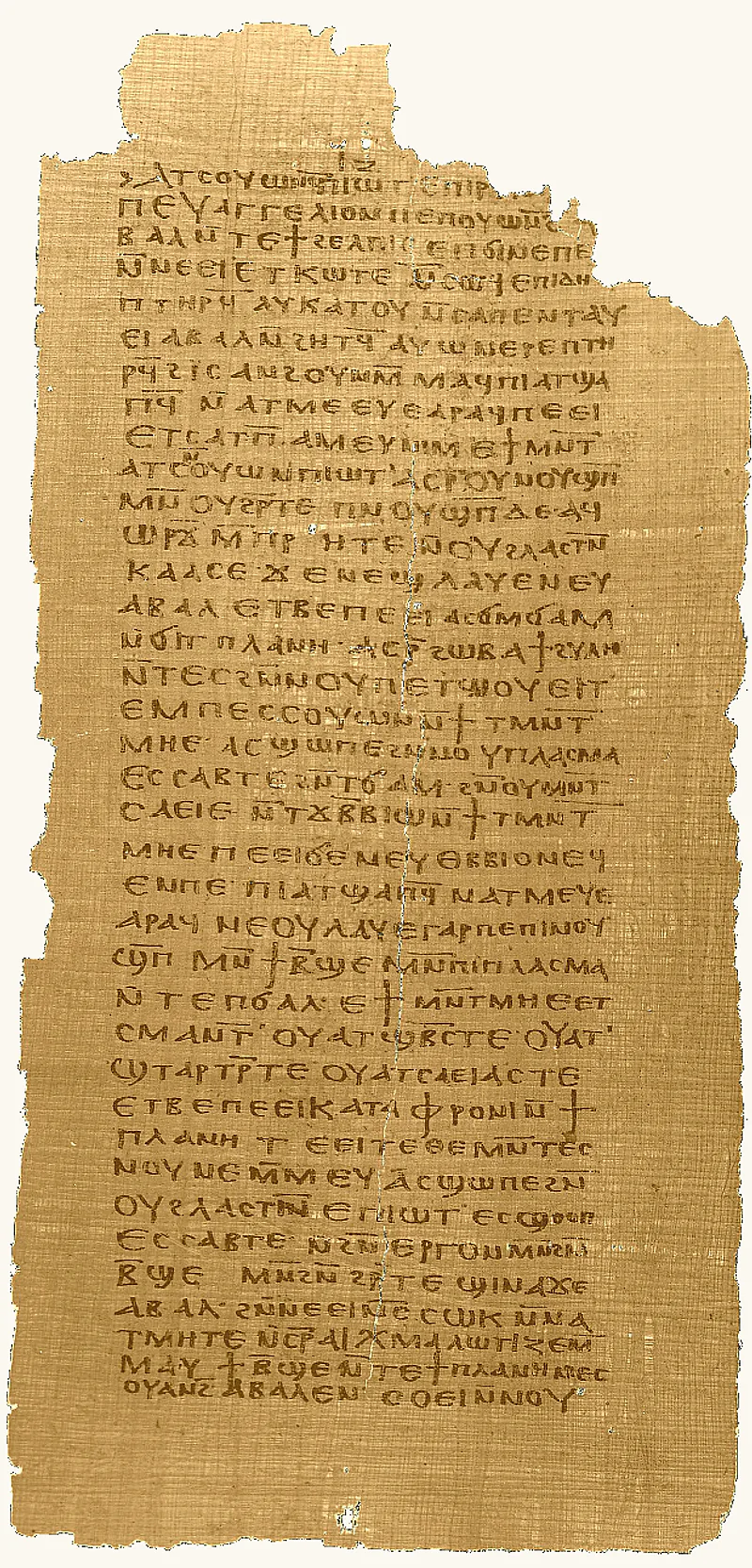
Most Sethian writings survive in Coptic in the Nag Hammadi library. Scholars commonly assign the following works to the tradition:
- The Apocryphon (Secret Book) of John (NHC II, III, IV and the Berlin Codex): the fullest form of the myth, framed as a revelation from the risen Christ to John.
- The Hypostasis of the Archons (NHC II): a commentary on Genesis focusing on the rulers' attempts to seize Eve and her daughter Norea, and the revelation given to Norea by the luminary Eleleth.
- The Holy Book of the Great Invisible Spirit (NHC III and IV): an elaborate account of the heavenly world and of Seth as saviour, with baptismal hymns.
- The Apocalypse of Adam (NHC V): Adam's revelation to Seth about the coming saviour, notable for its relative lack of Christian content.
- The Trimorphic Protennoia (NHC XIII): three discourses spoken by the First Thought in her descents as voice, speech and word.
- Melchizedek and The Thought of Norea (NHC IX).
- Zostrianos (NHC VIII), Allogenes (NHC XI), Marsanes (NHC X) and The Three Steles of Seth (NHC VII): the so-called Platonizing treatises.
The Gospel of Judas, published from Codex Tchacos in 2006, also uses Sethian names and cosmology.
Zostrianos, the Three Steles of Seth and the Platonist Connection§
The four Platonizing treatises differ in tone from the Apocryphon of John. They contain little or no Christian material and present salvation as a contemplative ascent through levels of being. In Zostrianos, the seer withdraws from the body, is baptised repeatedly as he ascends, and learns the structure of the Barbelo aeon, which is divided into three levels: Kalyptos ("hidden"), Protophanes ("first-appearing") and Autogenes. Allogenes describes a vision of the Triple-Powered One and a "learned ignorance" before the unknowable God. The Three Steles of Seth consists of three hymns of praise ascending in turn to Autogenes, Barbelo and the pre-existent One, and may have been used in communal worship.
These texts use the technical vocabulary of contemporary Middle Platonism and early Neoplatonism: the triad of Existence, Life and Mind, and the language of the One beyond being. Michel Tardieu showed that a passage of Zostrianos runs closely parallel to a section of the fourth-century Christian Platonist Marius Victorinus, suggesting that both drew on a common Greek source, and scholars have also compared Allogenes with the anonymous Commentary on the Parmenides. This matters because Porphyry, in his Life of Plotinus, reports that Christian Gnostics attended Plotinus's seminars in Rome and circulated revelations under the names of Zoroaster, Zostrianos, Nicotheus, Allogenes and Messos. Plotinus wrote a treatise against them (Enneads II.9), and his students Amelius and Porphyry wrote refutations of the books of Zostrianos and Zoroaster. Many scholars therefore believe that Greek versions of the Nag Hammadi Zostrianos and Allogenes, or close relatives, were read in Plotinus's school in the 260s.
The Sethian ascent also invites comparison with Jewish visionary literature, such as the heavenly journeys described in our article on Merkavah and Hekhalot mysticism, though direct dependence in either direction is unproven.
Origins and Development of Sethian Gnosticism§
Where did the Sethian myth come from? Several strands are visible. The heavy use of Genesis, Jewish angel names and wisdom speculation points to an origin in or near Hellenistic Judaism, possibly among Jews disillusioned with traditional interpretations. The Christian frame of the Apocryphon of John seems in several places to be a secondary layer added to an earlier myth. The philosophical treatises show a later stage of engagement with Platonism in the third century.
John Turner proposed a developmental sequence: a non-Christian baptismal group revering Seth, its encounter with Christianity in the second century, estrangement from emerging orthodox churches, and then a turn toward Platonist contemplative practice before the tradition faded in the fourth century. This reconstruction is influential but not universally accepted, and others warn against building detailed histories from a small and fragmentary set of texts. What is clear is that Sethian themes also influenced Valentinian Gnosticism, which shares the figure of Sophia but tells the story very differently.
Frequently asked questions§
Why are they called Sethians?§
The texts describe their readers as the "seed of Seth", the "immovable race" descended spiritually from Adam's third son. Ancient heresiologists already mentioned a group called Sethians, and the modern scholar Hans-Martin Schenke adopted the term for the shared mythology he identified in the Nag Hammadi texts.
Who is Barbelo in Sethian Gnosticism?§
Barbelo is the first emanation of the Invisible Spirit, his first thought or self-reflection, and functions as the divine Mother in the supreme triad of Father, Mother and Son. She is described as androgynous and as the womb of all that follows. Her name has no agreed etymology.
Is Yaldabaoth the same as the God of the Old Testament?§
The Sethian texts deliberately identify Yaldabaoth with the creator who speaks in Genesis and declares himself a jealous God, and they reinterpret those biblical passages critically. Jewish and Christian traditions, of course, reject this identification. Historians see it as a radical form of biblical interpretation rather than a separate deity.
Did Plotinus know the Sethians?§
Porphyry says Gnostics attended Plotinus's lectures in Rome and used books titled Zostrianos and Allogenes, names that match Nag Hammadi treatises. Plotinus wrote Against the Gnostics (Enneads II.9) in response. Most scholars accept that the Sethian Platonizing texts or close relatives were known in his circle.
Sources and further reading§
- Against Heresies, Book I.29 — Irenaeus of Lyon, c. 180 CE
- Life of Plotinus — Porphyry, c. 301 CE
- "The Phenomenon and Significance of Gnostic Sethianism" — Hans-Martin Schenke, in The Rediscovery of Gnosticism, vol. 2, ed. Bentley Layton, 1981
- The Gnostic Scriptures — Bentley Layton, 1987
- Sethian Gnosticism and the Platonic Tradition — John D. Turner, 2001
- The Secret Revelation of John — Karen L. King, 2006
- The Gnostics: Myth, Ritual, and Diversity in Early Christianity — David Brakke, 2010
- The Nag Hammadi Scriptures — Marvin Meyer (ed.), 2007