Liber IX · Gnosticism · Chapter VIII: Nag Hammadi Texts
The Nag Hammadi Library: Discovery, Codices and Key Texts
The Nag Hammadi library: how 13 Coptic codices were found in Egypt in 1945, what texts they contain, and how scholars published and interpret them.

The Nag Hammadi library is a collection of thirteen papyrus codices, bound in leather, discovered in December 1945 near the town of Nag Hammadi in Upper Egypt. Copied in Coptic in the fourth century, the codices contain fifty-two tractates, most of them translations of lost Greek originals, including the Gospel of Thomas, the Gospel of Philip, the Apocryphon of John and the Gospel of Truth. The find gave historians direct access to the writings of groups previously known almost only through their opponents.
The Discovery at Nag Hammadi in 1945§
The usual account of the discovery comes largely from interviews the American scholar James M. Robinson conducted with the finder in the 1970s, and some details are uncertain. In December 1945 a local farmer, Muhammad Ali al-Samman, was digging for sabakh, a nitrate-rich soil used as fertiliser, near a cliff called the Jabal al-Tarif on the east bank of the Nile. He uncovered a large sealed earthenware jar. Fearing it might contain a jinn but hoping for gold, he broke it open and found a set of leather-bound books.
According to the story told to Robinson, some loose leaves and perhaps part of a codex were burned in the family's oven, and the books passed through several hands. A blood feud in which the family was involved made them wary of the authorities. The codices eventually reached dealers in Cairo. The Coptic Museum acquired Codex III in 1946, and the Egyptian state later secured most of the rest; the French scholar Jean Doresse, who saw the material in 1947–1948, was among the first to recognise its importance.
One codex took a different route. Codex I was smuggled out of Egypt and offered for sale abroad; in 1952 it was bought for the C. G. Jung Institute in Zurich and presented to Jung, hence its name, the "Jung Codex". Its leaves were returned to Cairo in stages over the following two decades. Today all the codices are held by the Coptic Museum in Cairo.
The Thirteen Codices and Their Physical Form§
The Nag Hammadi books are codices rather than scrolls: sheets of papyrus folded and bound between leather covers, like a modern book. They are among the oldest surviving bound books. Scholars number them I to XIII. Codex XIII is not really a separate book but eight leaves that had been removed from another codex and tucked inside the cover of Codex VI.
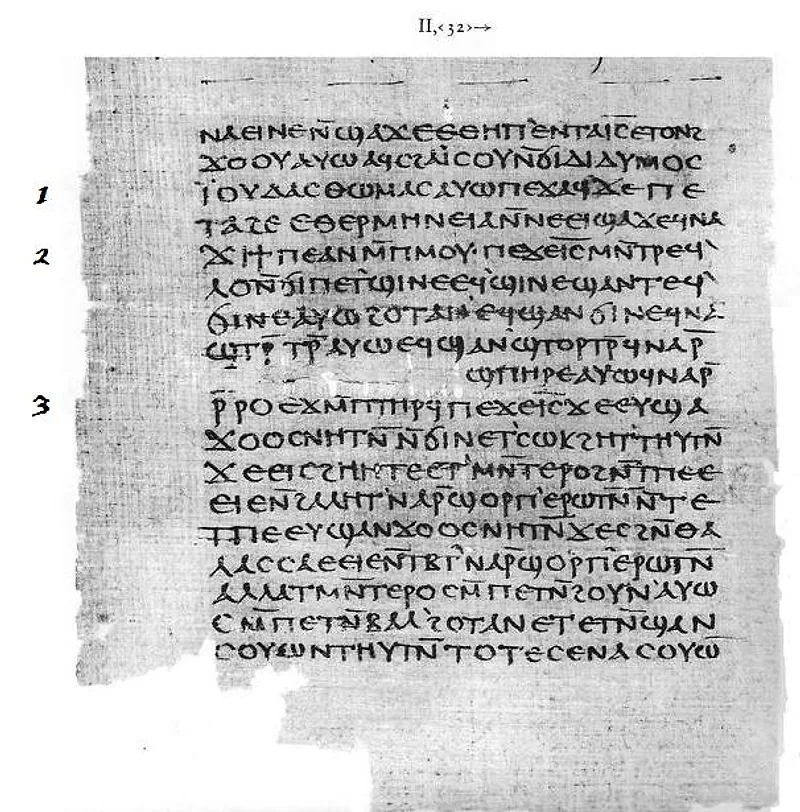
The covers were stiffened with cartonnage, layers of discarded papyrus pasted together. These waste papers include letters, receipts and contracts, some with dates in the 340s CE. This gives a rough terminus after which the codices were bound and supports a dating of the copies to the middle or second half of the fourth century.
The texts are in Coptic, the last stage of the Egyptian language, written in an alphabet derived from Greek. Most are in Sahidic, the main literary dialect of Upper Egypt, with some in Lycopolitan (formerly called Subakhmimic). Analysis of the vocabulary and style shows that almost all the works were translated from Greek. The Greek originals were composed much earlier, mostly in the second and third centuries, so the codices are copies at several removes from their authors.
Key Texts in the Nag Hammadi Library§
The fifty-two tractates are remarkably varied. They include gospels, apocalypses, revelation dialogues, myths of creation, sermons, prayers, wisdom sayings and philosophical treatises. Some appear in more than one copy; the Apocryphon of John survives in three. Several tractates are badly damaged. The following are among the most widely studied.

The Gospel of Thomas§
The Gospel of Thomas (Codex II) is a collection of 114 sayings attributed to Jesus, with almost no narrative. About half have parallels in the canonical gospels; others are unknown elsewhere. Greek fragments of the same work had already been found at Oxyrhynchus and published by Bernard Grenfell and Arthur Hunt in 1897 and 1904, though they were not identified as Thomas until the Coptic version appeared. Its date is one of the most debated questions in New Testament scholarship: some place an early core in the first century, others date it to the second century and argue that it depends on the canonical gospels. Whether it should be called Gnostic at all is also disputed, since it lacks the demiurge myth.
The Gospel of Philip§
The Gospel of Philip (Codex II) is not a narrative gospel but an anthology of theological reflections, many concerned with sacraments: baptism, chrism, eucharist, redemption and the "bridal chamber". It is generally regarded as Valentinian and is a major source for the ritual life discussed in our article on Valentinian Gnosticism. A frequently cited passage mentions Mary Magdalene as Jesus's companion, though the manuscript is damaged at key points.
The Apocryphon of John§
The Apocryphon (Secret Book) of John is the classic statement of the Sethian myth. The risen Christ appears to the apostle John and reveals the nature of the invisible Spirit, the emanation of Barbelo, the fall of Sophia, the birth of Yaldabaoth and the creation and salvation of humanity. It survives in a shorter version (Codex III and the Berlin Codex) and a longer one (Codices II and IV). A version of its myth was already summarised by Irenaeus around 180 CE. See our article on Sethian Gnosticism for its content.
The Gospel of Truth§
The Gospel of Truth (Codices I and XII) is a meditative homily on the Father's revelation through Jesus, the overcoming of "error" and the return of all things to their source. Its language is allusive rather than mythological. Many scholars connect it with Valentinus himself, because Irenaeus mentions a Valentinian "Gospel of Truth", although authorship cannot be proven.
Other Notable Tractates§
- The Hypostasis of the Archons and On the Origin of the World (Codex II): retellings of Genesis that describe the rulers of the world and their defeat.
- The Tripartite Tractate (Codex I): a systematic Valentinian theology.
- The Thunder, Perfect Mind (Codex VI): a striking poem of paradoxical self-proclamations by a female divine voice.
- Zostrianos, Allogenes, Marsanes and The Three Steles of Seth: philosophical Sethian texts on visionary ascent.
- The Apocalypse of Adam (Codex V) and The Second Treatise of the Great Seth (Codex VII).
- The Teachings of Silvanus (Codex VII): a Christian wisdom text with no Gnostic myth.
Not Only Gnostic: Hermetic, Platonic and Monastic Texts§
The library is not a single sect's scripture. Codex VI contains three Hermetic texts: a Coptic version of part of the Latin Asclepius, a Prayer of Thanksgiving, and a previously unknown dialogue usually called the Discourse on the Eighth and Ninth, which describes the initiation of a disciple by Hermes into visionary experience. These connect the collection with the wider world described in our article on the Corpus Hermeticum. The same codex includes a loose Coptic rendering of a passage from Plato's Republic (588a–589b), on the many-headed beast within the soul. Codex XII contains the Sentences of Sextus, a collection of moral maxims popular among Christian ascetics.
This mixture has fuelled debate about who owned and buried the books. The site lies close to Pbow and Chenoboskion, centres of the monastic federation founded by Pachomius in the fourth century. One influential hypothesis connects the burial with the Festal Letter of Athanasius of Alexandria in 367, which listed the canonical books and condemned "apocrypha", suggesting that monks hid books they could no longer use openly. Hugo Lundhaug and Lance Jenott, in The Monastic Origins of the Nag Hammadi Codices (2015), argue at length that the codices were produced and read in a Pachomian monastic setting. Others are sceptical: Nicola Denzey Lewis and Justine Ariel Blount have questioned the received story of the jar and suggested the books could have been deposited in a burial as a private collection. The question remains open.
Publication History of the Nag Hammadi Codices§
Publication was slow and contentious. The death of the Coptic Museum's director Togo Mina in 1949, political upheavals in Egypt including the Suez Crisis of 1956, and rivalries among scholars all delayed access. The Jung Codex texts appeared first, beginning with the Gospel of Truth in 1956. The Gospel of Thomas was published in 1959 by an international team and immediately attracted wide attention.
In the 1960s UNESCO and the Egyptian government set up an International Committee for the Nag Hammadi Codices, with James M. Robinson as its permanent secretary. Its Facsimile Edition, photographs of every page, appeared between 1972 and 1977, with an introductory volume in 1984. This made the whole library available to scholars for the first time. In 1977 Robinson's team published The Nag Hammadi Library in English, the first complete translation, which went through revised editions in 1984 and 1988. The critical editions with Coptic text, translation and notes appeared in the Coptic Gnostic Library series (part of the Nag Hammadi Studies monographs), completed in the 1990s. A French project at Université Laval in Québec produced its own critical series, the Bibliothèque copte de Nag Hammadi, and a further one-volume English translation, The Nag Hammadi Scriptures, edited by Marvin Meyer, appeared in 2007.
The Berlin Codex and Other Related Manuscripts§
The Nag Hammadi library has close relatives. The most important is the Berlin Codex, Papyrus Berolinensis 8502, purchased in Cairo in 1896 by the German scholar Carl Reinhardt for the Egyptian Museum in Berlin. It is a fifth-century Coptic codex containing four works: the Gospel of Mary, the Apocryphon of John, the Sophia of Jesus Christ, and an Act of Peter. The Gospel of Mary, of which no copy was found at Nag Hammadi, is the main source for this text, which presents Mary Magdalene as a recipient of special teaching; see Karen King's study of it. The Berlin Codex was prepared for publication by Carl Schmidt, but a series of misfortunes, including a burst water pipe that destroyed the printed sheets and two world wars, meant that Walter Till's edition appeared only in 1955, when it could finally be compared with the Nag Hammadi copies.
Other Coptic codices known before 1945 include the Askew Codex, acquired by the British Museum in 1785 and containing the Pistis Sophia, and the Bruce Codex, brought from Egypt by the Scottish traveller James Bruce in 1769 and now in Oxford, which contains the Books of Jeu. More recently, the Codex Tchacos, which surfaced on the antiquities market and was published in 2006, contains the Gospel of Judas along with versions of texts also known from Nag Hammadi.
Why the Nag Hammadi Library Matters§
Before 1945 the movements discussed in our overview of Gnosticism were seen mostly through the eyes of their critics. The Nag Hammadi texts allowed scholars to read the myths, prayers and arguments of these groups in their own terms. They revealed that the heresiologists had sometimes reported accurately (Irenaeus's summary of the Apocryphon of John is recognisable) and sometimes distorted their opponents.
The discovery also changed the study of early Christianity more broadly. It showed how diverse Christian writing was in the second and third centuries, raised new questions about the formation of the canon, and provided evidence for Platonist and Hermetic currents in late antique Egypt. At the same time, the very diversity of the library has fed the scholarly debate over whether "Gnosticism" names a single religion, since the codices themselves group together texts that modern scholars would assign to quite different traditions.
Frequently asked questions§
Where are the Nag Hammadi codices kept today?§
All thirteen codices are held in the Coptic Museum in Cairo. Codex I, the Jung Codex, was in Switzerland for some years after 1952 but was returned to Egypt in stages. High-quality photographs are available in the published Facsimile Edition.
How old are the Nag Hammadi texts?§
The surviving manuscripts were copied in the fourth century CE, as indicated by dated documents in the cartonnage of the covers. The works themselves were mostly composed in Greek in the second and third centuries, and some scholars argue that parts of the Gospel of Thomas are earlier still.
Are the Nag Hammadi texts all Gnostic?§
No. Alongside Sethian and Valentinian works, the library includes Hermetic treatises, a passage of Plato's Republic, the Sentences of Sextus and Christian wisdom literature. Some texts, such as the Gospel of Thomas, are of disputed classification.
What is the difference between the Nag Hammadi library and the Dead Sea Scrolls?§
They are entirely separate discoveries. The Dead Sea Scrolls were found from 1947 onward near Qumran in the Judaean desert and are mainly Jewish texts in Hebrew, Aramaic and Greek from roughly the third century BCE to the first century CE. The Nag Hammadi codices are later Coptic Christian-era books found in Egypt.
Sources and further reading§
- The Facsimile Edition of the Nag Hammadi Codices — International Committee for the Nag Hammadi Codices, 1972–1984
- The Nag Hammadi Library in English — James M. Robinson (ed.), 1977; 3rd ed. 1988
- The Nag Hammadi Scriptures — Marvin Meyer (ed.), 2007
- The Gnostic Scriptures — Bentley Layton, 1987
- The Monastic Origins of the Nag Hammadi Codices — Hugo Lundhaug and Lance Jenott, 2015
- The Gospel of Mary of Magdala: Jesus and the First Woman Apostle — Karen L. King, 2003
- The Secret Revelation of John — Karen L. King, 2006
- Die gnostischen Schriften des koptischen Papyrus Berolinensis 8502 — Walter C. Till, 1955