Liber IX · Gnosticism · Chapter VIII: Nag Hammadi Texts
Gospel of Thomas: The 114 Hidden Sayings of Jesus Explained
The Gospel of Thomas explained: its 114 sayings of Jesus, the Nag Hammadi and Oxyrhynchus manuscripts, debates over its date, and whether it is Gnostic.

The Gospel of Thomas is an early Christian collection of 114 sayings attributed to Jesus, with almost no narrative, introduced as the secret words of "the living Jesus" written down by Didymos Judas Thomas. Its complete text survives only in a fourth-century Coptic copy found at Nag Hammadi in Egypt in 1945, while three Greek fragments from Oxyrhynchus show that it circulated in Greek by about 200 CE. Scholars still argue over its date, its relationship to the canonical gospels and whether it should be called Gnostic at all.
Discovery: From the Oxyrhynchus Papyri to Nag Hammadi§
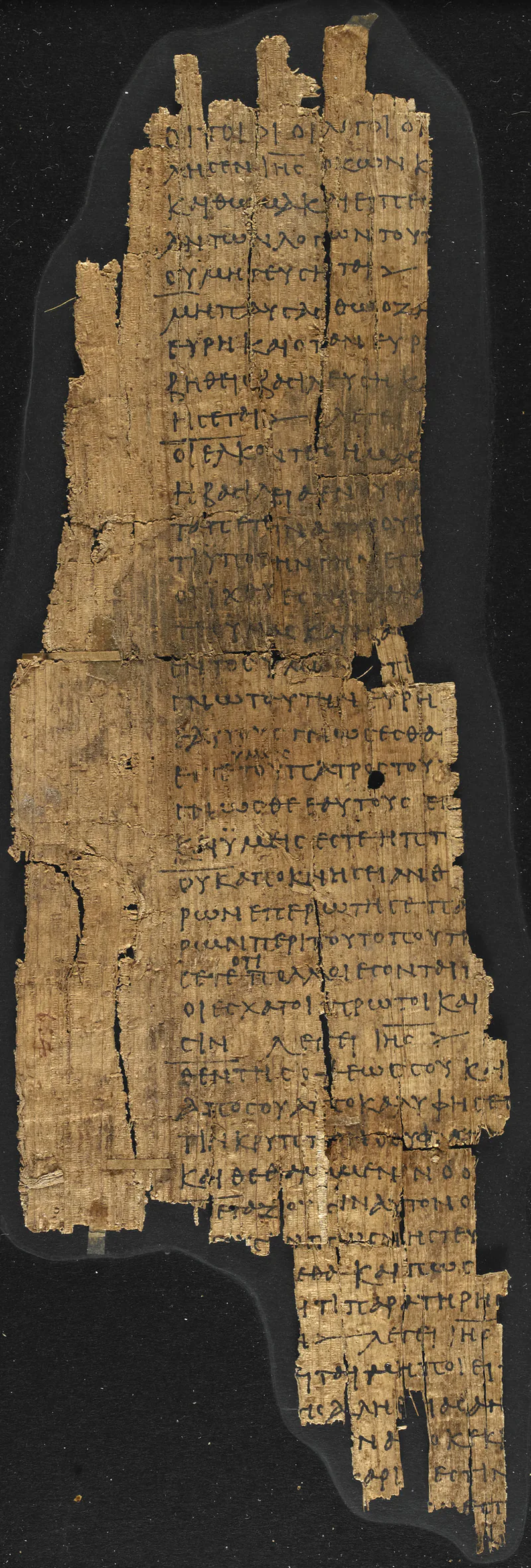
The story of the Gospel of Thomas begins before anyone knew its name. Between 1897 and 1904 the Oxford papyrologists Bernard Grenfell and Arthur Hunt, excavating the rubbish mounds of the Egyptian town of Oxyrhynchus, published three Greek papyrus fragments containing sayings of Jesus. Papyrus Oxyrhynchus 1 was hailed as "Sayings of Our Lord"; P.Oxy. 654 and 655 followed. They were dated palaeographically to the late second or third century, but their source was a mystery.
The mystery was solved after the discovery of the Nag Hammadi library in December 1945. Codex II of that find contains, as its second tractate, a Coptic work whose closing title reads "The Gospel according to Thomas". When the Coptic text became available to scholars in the 1950s, it was quickly recognised that the Oxyrhynchus fragments were pieces of the same work in Greek. A first edition and translation by a team including Antoine Guillaumont, Henri-Charles Puech, Gilles Quispel, Walter Till and Yassah 'Abd al-Masih appeared in 1959.
The Greek and Coptic versions do not match exactly. The order of some sayings differs, and individual wordings vary, which shows that the text was fluid as it was copied and translated. This matters for every argument about the gospel's origins: no one possesses an "original" Thomas, only witnesses to a work that changed over time.
Structure and Contents of the 114 Sayings§
The division into 114 sayings is modern; the manuscript simply runs the sayings together, most beginning with "Jesus said". Some are single aphorisms, some are parables, and some are short exchanges in which disciples, among them Thomas, Peter, Matthew, Mary and Salome, ask questions and receive cryptic answers.
The Prologue and the Promise of Life§
The work opens by presenting itself as hidden sayings, and the first saying promises that whoever finds their interpretation will not taste death. This sets the reader a task. Thomas is not a narrative to be followed but a collection to be interpreted, and the act of interpretation itself is presented as the path to life.
Themes of the Sayings§
Several themes recur. The kingdom is described as already present, within and around the hearer, rather than as a future cosmic event; one saying pointedly says that the kingdom is spread out upon the earth but people do not see it. Self-knowledge is central: those who know themselves will be known and will realise that they are children of the living Father. Disciples are urged to seek and not stop seeking, to become "solitary" or single (Coptic monachos), to be passers-by in the world, and to recover a primordial unity in which "the two become one". Several sayings speak of returning to the beginning, to the light from which humanity came.
Familiar and Unfamiliar Sayings§
Many sayings will be familiar to readers of the synoptic gospels: the parables of the sower, the mustard seed and the lost sheep, the saying about a prophet without honour, the blind leading the blind. Others are found nowhere else, such as the parable of the woman whose jar of meal leaks away unnoticed on the road, or the parable of the man who tests his strength by thrusting a sword into the wall before killing a powerful man. The final saying, in which Peter asks that Mary leave the disciples and Jesus replies that he will make her "male" so that she may become a living spirit, is among the most discussed passages in early Christian literature.
Dating the Gospel of Thomas§
The date of Thomas is the most contested question about it, because the answer affects how historians use it in the study of Jesus.
The physical evidence sets a firm lower limit: the Greek fragments show that the work existed by around 200 CE, and possibly somewhat earlier. Beyond that, scholars rely on internal arguments.
- Early dating (c. 50–100 CE). Scholars such as Helmut Koester and Stephen Patterson argued that Thomas preserves a sayings tradition independent of the canonical gospels, comparable in form to the hypothetical sayings source "Q" used by Matthew and Luke. On this view some Thomas sayings, especially parables without the allegorical interpretations found in the synoptics, may be closer to an early oral form.
- Later dating (c. 120–180 CE). Others, including Nicholas Perrin and Simon Gathercole, argue that Thomas shows knowledge of the synoptic gospels in their edited form, for instance by reproducing wording that originated with Matthew or Luke. Perrin proposed a Syriac origin closely tied to Tatian's gospel harmony, the Diatessaron, of around 170 CE.
- Layered composition. April DeConick has argued that the text grew over time, from an early "kernel" of sayings to which later material reflecting mystical and ascetic concerns was added.
Most scholars agree that the attribution to Thomas, and the strong ascetic flavour, point to Syria, perhaps Edessa, where the apostle Thomas was especially venerated and where the Acts of Thomas, with its famous Hymn of the Pearl, and the Book of Thomas the Contender also belong.
Is the Gospel of Thomas Gnostic?§
Early commentators, reading Thomas alongside the other Nag Hammadi books, often described it as a Gnostic gospel. The emphasis on saving knowledge, the contempt for the body and the world in some sayings, and the idea that the disciples come from the light all seemed to fit.

Yet Thomas lacks most of what defines the classic Gnostic systems described in our overview of Gnosticism. There is no pleroma of aeons, no fall of Sophia, no ignorant demiurge who made the world, and no archons. The world is criticised, but it is not described as the creation of an inferior god. For this reason many scholars now describe Thomas as an early Christian wisdom text with mystical and ascetic tendencies, which Gnostic readers could later appropriate but which was not composed within a Gnostic system. Some have compared its interest in the image of God and the primordial human with Jewish interpretation of Genesis, and with Hellenistic Jewish writers such as Philo of Alexandria.
Its later readers were certainly varied. The heresiologist Hippolytus, writing in the early third century, quotes a saying that resembles Thomas as used by the Naassenes, a group he considered Gnostic. In the fourth century Cyril of Jerusalem warned that a gospel of Thomas was read by the Manichaeans, who honoured Thomas as a missionary apostle. The text was evidently at home in more than one community.
The Gospel of Thomas and the Canon§
Thomas never entered any church's New Testament. Lists of accepted and rejected books from the third and fourth centuries, such as Origen's remark about a gospel of Thomas among the works used by heretics, and Eusebius's list of disputed and spurious writings, show that it was known and excluded. Its omission was not the result of a single decree but of the gradual process described in our article on the Christian Bible and its canon, in which churches favoured texts believed to be apostolic, widely used and consistent with the emerging rule of faith.
In the late twentieth century Thomas became a centre of popular interest. The Jesus Seminar printed it alongside the four canonical gospels in The Five Gospels (1993), and Elaine Pagels's Beyond Belief (2003) contrasted its call to inner discovery with the Gospel of John's emphasis on belief in Jesus. These works brought the text to a broad audience, while specialists continued to debate how far it can be used as evidence for the historical Jesus.
Reading Thomas Today: Interpretation and Influence§
Because the sayings are short and enigmatic, Thomas invites many readings. Christian contemplatives have read it alongside the Christian mystics as a call to interior transformation. Comparative writers have noted resemblances to Buddhist and Daoist sayings literature, although there is no evidence of direct contact. Feminist scholars have debated the final saying about Mary, which some read as a symbolic statement about overcoming gender distinctions and others as evidence of an ascetic ideal that devalued women; it can usefully be compared with the treatment of Mary Magdalene in the Gospel of Mary.
For historians, the most lasting effect of Thomas has been to show that early Christian memory of Jesus was not confined to narrative gospels. Collections of sayings were a recognised form, and communities shaped and reinterpreted those sayings to fit their own spiritual concerns.
Frequently asked questions§
Why is the Gospel of Thomas not in the Bible?§
It was not widely read in the churches that shaped the canon, its apostolic origin was doubted, and some of its sayings were associated with groups considered heretical. Writers such as Origen and Eusebius list it among works that were not accepted.
How many sayings are in the Gospel of Thomas?§
Modern editions divide it into 114 sayings, a numbering introduced by scholars rather than found in the manuscript. Some editions subdivide individual sayings further.
Is the Gospel of Thomas older than the canonical gospels?§
A minority of scholars think its core may be as early as the canonical gospels or earlier; many others date it to the second century and see it as dependent on them. The evidence allows both views, and the matter is still debated.
Who was Thomas?§
The text names Didymos Judas Thomas. "Didymos" (Greek) and "Thomas" (Aramaic) both mean "twin", and in Syrian Christian tradition Judas Thomas was regarded as an apostle and even as Jesus's twin brother, and was credited with the mission to India.
Sources and further reading§
- The Nag Hammadi Library in English — James M. Robinson (ed.), 1977
- The Gospel of Thomas: The Hidden Sayings of Jesus — Marvin Meyer, 1992
- The Gospel of Thomas: Introduction and Commentary — Simon Gathercole, 2014
- Recovering the Original Gospel of Thomas: A History of the Gospel and Its Growth — April D. DeConick, 2005
- Thomas and Tatian: The Relationship between the Gospel of Thomas and the Diatessaron — Nicholas Perrin, 2002
- Beyond Belief: The Secret Gospel of Thomas — Elaine Pagels, 2003
- The Five Gospels: The Search for the Authentic Words of Jesus — Robert W. Funk, Roy W. Hoover and the Jesus Seminar, 1993