Liber VI · Christianity · Chapter VII: Jesus & the Apostles
Jesus and the Apostles: The Historical Jesus and Early Church
Jesus and the apostles in history and tradition: the life of Jesus, the Twelve, Paul's mission, Mary Magdalene and how the first Christian churches spread.

Jesus of Nazareth was a Jewish preacher and healer from Galilee who proclaimed the coming kingdom of God and was crucified in Jerusalem under the Roman prefect Pontius Pilate, probably around 30 or 33 CE. His followers, led by the twelve disciples known as the apostles and soon joined by Paul of Tarsus, proclaimed that God had raised him from the dead, and their mission across the Roman world created the first Christian churches.
Historical Sources for the Life of Jesus§
Everything known about Jesus comes from texts written after his death. The most important are the four Gospels of the New Testament, composed in Greek roughly between 65 and 110 CE, and the letters of Paul, written in the 50s. Matthew, Mark and Luke — the "Synoptic" Gospels — share much material and a similar outline; John presents a distinct portrait with long discourses and a ministry spanning several Passover festivals. How these books were written and collected is discussed in The Christian Bible and Its Canon.
A few non-Christian authors refer to Jesus. The Jewish historian Josephus, writing in the 90s, mentions "James, the brother of Jesus who was called Christ," and contains a longer passage on Jesus that most scholars believe was expanded by later Christian copyists, though they think an authentic core lies beneath it. The Roman historian Tacitus, around 116, records that "Christus" was executed by Pontius Pilate in the reign of Tiberius. The governor Pliny the Younger, around 112, describes Christians singing hymns "to Christ as to a god."
Since the eighteenth century scholars have pursued "the historical Jesus," trying to distinguish what can be known by historical methods from the faith of the Gospel writers. Albert Schweitzer's Quest of the Historical Jesus (1906) showed how often earlier lives of Jesus mirrored their authors' ideals. More recent work, by scholars such as E. P. Sanders, John P. Meier and Paula Fredriksen, places Jesus firmly within the Judaism of his time.
The Life and Teaching of Jesus§
Birth and early life§
Jesus was probably born shortly before the death of Herod the Great in 4 BCE; the familiar calendar, devised by the monk Dionysius Exiguus in the sixth century, is slightly off. Matthew and Luke place his birth in Bethlehem and give differing accounts of his infancy. He grew up in Nazareth, a village in Galilee, and his family is named in the Gospels: his mother Mary, Joseph, and brothers including James.
Ministry in Galilee§
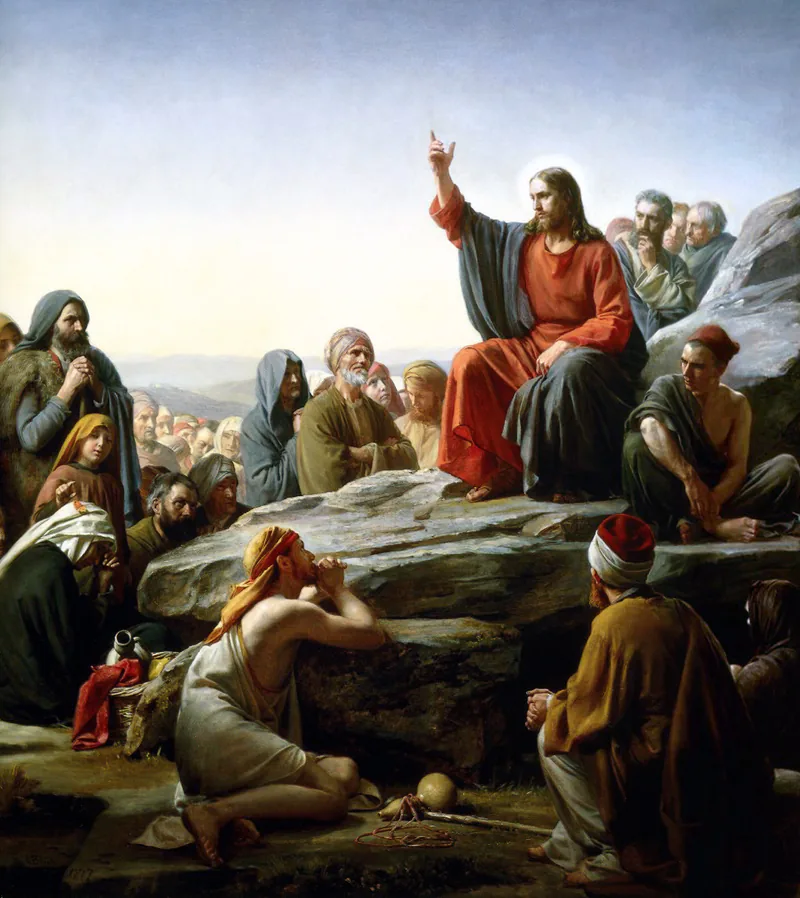
Around the age of thirty Jesus was baptised by John the Baptist, an ascetic prophet who called Israel to repentance before an imminent judgement. After John's arrest Jesus began his own ministry in the towns around the Sea of Galilee. He proclaimed the "kingdom of God," God's reign breaking into the world, taught in parables drawn from village life, ate with people regarded as sinners, and was known as a healer and exorcist. The Sermon on the Mount in Matthew 5–7, with the Beatitudes and the Lord's Prayer, collects much of his ethical teaching.
The final week in Jerusalem§
Jesus went to Jerusalem for Passover, where an action against the traders in the Temple courts seems to have provoked the priestly authorities. After a final meal with his disciples, remembered in the Eucharist, he was arrested, handed over to Pilate and crucified as a would-be "King of the Jews." The Gospels then report that women disciples found his tomb empty and that he appeared to Mary Magdalene, Peter and others. Historians cannot verify the resurrection as such, but they agree that his followers sincerely believed they had seen him alive, and that this belief launched the movement. 1 Corinthians 15 preserves an early list of these appearances.
The Twelve Apostles§
Jesus chose an inner group of twelve men, a number that echoes the twelve tribes and signalled the restoration of Israel. The lists in Mark 3, Matthew 10, Luke 6 and Acts 1 vary slightly but usually name:
- Simon, called Peter ("rock"), and his brother Andrew, fishermen of Galilee;
- James and John, the sons of Zebedee;
- Philip, Bartholomew, Thomas and Matthew;
- James the son of Alphaeus, Thaddaeus (or Judas son of James), and Simon the Zealot;
- Judas Iscariot, who betrayed Jesus and was replaced after his death by Matthias.
Peter, James and John form an inner circle in the Gospels. In Matthew 16 Jesus calls Peter the rock on which he will build his church, a passage later central to Catholic claims for the papacy. The Gospels also describe women who followed and supported Jesus, among them Mary Magdalene, Joanna and Susanna. Mary Magdalene's role as first witness to the resurrection led later writers to call her the "apostle to the apostles"; the medieval image of her as a repentant prostitute rests on a conflation of different Gospel women and has been abandoned by modern scholarship.
Paul and the Mission to the Gentiles§
Paul (Saul) of Tarsus was a Greek-speaking Jew and Pharisee who at first persecuted the followers of Jesus. A few years after the crucifixion he experienced what he describes as a revelation of the risen Christ and became the most influential missionary of the first generation. Travelling through Syria, Asia Minor, Macedonia and Greece, he founded communities in cities such as Philippi, Thessalonica, Corinth and Ephesus.

Paul taught that Gentiles could belong to God's people through faith in Christ without becoming Jews through circumcision and observance of the law. This was contested. Around 48–50 CE leaders met in Jerusalem to discuss the question, an episode described from different angles in Acts 15 and Galatians 2. Paul's letters, written to deal with practical problems in his churches, became the foundation of Christian theology, especially his teaching on grace, faith, the body of Christ and the resurrection. Scholars influenced by E. P. Sanders have emphasised that Paul remained a Jewish thinker and that older readings opposing him to "legalistic" Judaism are misleading.
The Jerusalem Church and the Spread of Christianity§
The first community in Jerusalem was led by Peter and then by James, "the brother of the Lord," who was killed in 62 CE according to Josephus. Acts portrays the gift of the Spirit at Pentecost (Acts 2) as the birth of the Church and follows the mission outward to Samaria, Antioch — where the disciples were first called "Christians" — and eventually Rome.
Christian tradition holds that both Peter and Paul were executed in Rome under Nero in the 60s, Peter by crucifixion and Paul by the sword; the evidence is late but early enough that most historians think the tradition about their deaths in Rome is plausible. Later legends sent the other apostles to the ends of the known world: Thomas to India, where the Saint Thomas Christians of Kerala trace their origin to him; Mark to Alexandria; Andrew to Greece; James the son of Zebedee, after his martyrdom in Jerusalem, to a shrine at Santiago de Compostela in Spain. Such traditions are hard to test, but they shaped the identity of churches that still claim apostolic foundation. The cult of the apostles' tombs and relics is explored in Saints, Relics and the Virgin Mary.
Jesus Beyond the New Testament§
The early centuries produced many other writings about Jesus and the apostles: infancy gospels, sayings collections such as the Gospel of Thomas, apocryphal acts of Peter, Paul, John and Thomas, and the revelation dialogues favoured by groups that scholars call Gnostic, discussed in What Is Gnosticism?. In magical papyri of late antiquity, the name of Jesus appears in protective spells and exorcisms, as it does in later Christian charms. Judaism and Islam have their own perspectives: the Qur'an honours Jesus ('Isa) as a prophet and Messiah born of the Virgin Mary, while denying that he was divine. Debates over who Jesus was — prophet, Messiah, Son of God, or God incarnate — led directly to the councils described in Christian Creeds and Councils.
Frequently asked questions§
Is there historical evidence that Jesus existed?§
Yes. Nearly all historians of antiquity, whatever their religious views, accept that Jesus was a real Jewish teacher crucified under Pontius Pilate. The evidence includes Paul's letters, written within about twenty-five years of his death, the Gospels, and references by Josephus and Tacitus.
Who were the twelve apostles?§
They were Peter, Andrew, James and John the sons of Zebedee, Philip, Bartholomew, Thomas, Matthew, James son of Alphaeus, Thaddaeus (or Judas son of James), Simon the Zealot and Judas Iscariot, who was later replaced by Matthias. Paul is also called an apostle, though he was not one of the Twelve.
When did Jesus die?§
Most scholars place the crucifixion in 30 or 33 CE, during Pilate's term as prefect of Judaea (26–36 CE). Both dates fit the Gospel indications that he died at Passover on a Friday.
Why is Paul so important in Christianity?§
Paul's letters are the oldest Christian writings and make up nearly a quarter of the New Testament. His mission opened the movement to non-Jews, and his theology of grace and faith shaped Augustine, Luther and much of later Christian thought.
Sources and further reading§
- The Historical Figure of Jesus — E. P. Sanders, 1993
- A Marginal Jew: Rethinking the Historical Jesus — John P. Meier, 1991
- Jesus of Nazareth, King of the Jews — Paula Fredriksen, 1999
- The Quest of the Historical Jesus — Albert Schweitzer, 1906
- Paul and Palestinian Judaism — E. P. Sanders, 1977
- The New Testament: A Historical Introduction to the Early Christian Writings — Bart D. Ehrman, 1997