Liber VI · Christianity · Chapter IV: Creeds, Councils & Doctrine
Christian Creeds and Councils: Nicaea, Chalcedon and Doctrine
A history of Christian creeds and councils: the Apostles' and Nicene Creeds, the seven ecumenical councils, the Trinity, Christology and later confessions.

Christian creeds are short, formal statements of faith, and the ecumenical councils were assemblies of bishops that defined disputed doctrines for the whole Church. The most important are the Nicene Creed, drafted at the Council of Nicaea in 325 and expanded at Constantinople in 381, and the seven ecumenical councils from Nicaea (325) to Nicaea II (787), which shaped Christian teaching on the Trinity, the person of Christ and the veneration of icons.
The Origins of Christian Creeds§
The earliest Christians already used short confessions such as "Jesus is Lord" and the summary of the gospel that Paul says he had received (1 Corinthians 15). At baptism candidates were asked whether they believed in the Father, the Son and the Holy Spirit, following the threefold formula of Matthew 28. In the second century writers such as Irenaeus and Tertullian spoke of a "rule of faith," a flexible outline of belief used to distinguish the churches' teaching from that of rival groups such as the Gnostics, described in What Is Gnosticism?.
The Apostles' Creed grew from a baptismal creed used in Rome, known to scholars as the Old Roman Creed, which is attested in the fourth century and probably earlier. A medieval legend claimed that each of the twelve apostles contributed one article; in fact the text reached its present form in Gaul around the seventh or eighth century. It remains the basic creed of the Western churches, Catholic and Protestant, but is not used in Orthodox worship.
Nicaea and the Arian Controversy§
The first great doctrinal crisis concerned the relationship between Christ and God. Around 318 Arius, a priest of Alexandria, taught that the Son, though the first and greatest of creatures, had a beginning: "there was when he was not." His bishop Alexander condemned him, and the dispute spread across the eastern empire.
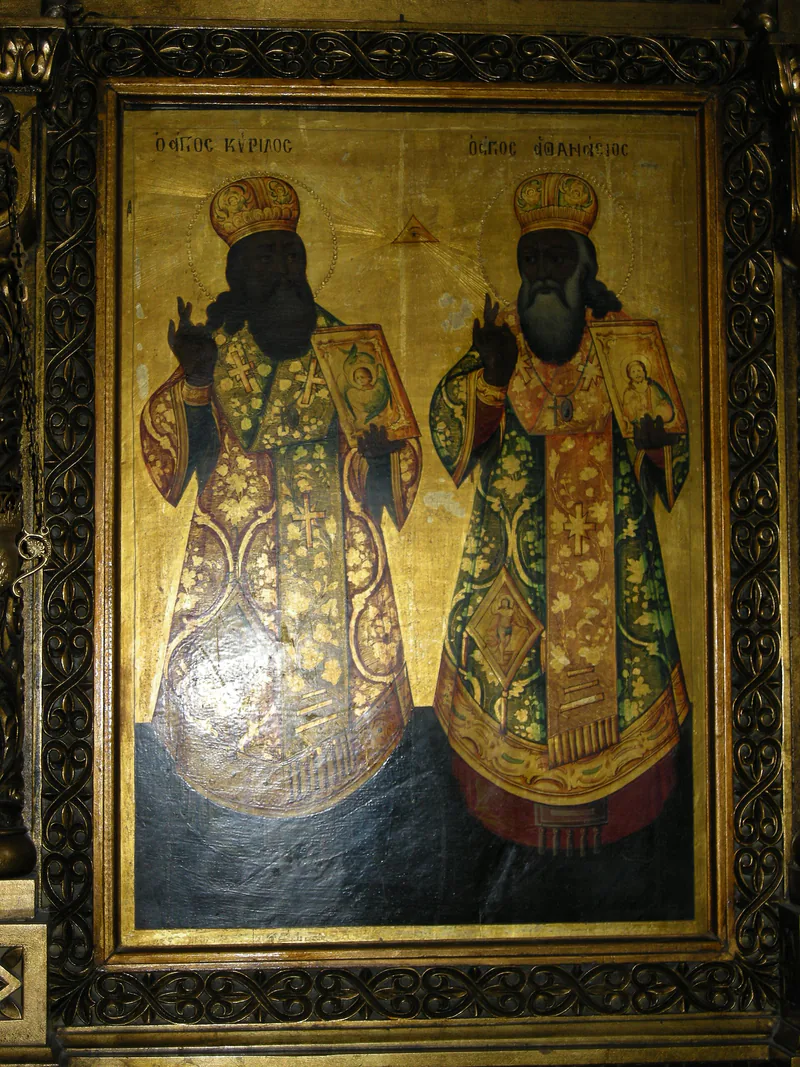
The emperor Constantine, newly committed to Christianity and concerned for unity, summoned a council to Nicaea in Asia Minor in 325. Tradition counts 318 bishops; the real number was probably around 250 to 300. The council adopted a creed declaring the Son "of one substance" (homoousios) with the Father, true God from true God, begotten not made, and also settled questions such as the date of Easter. The word homoousios was controversial because it was not biblical, and for half a century emperors and bishops favoured compromise formulas. Athanasius of Alexandria (bishop 328–373) defended Nicaea through five exiles.
The Cappadocian Fathers — Basil of Caesarea, Gregory of Nazianzus and Gregory of Nyssa — provided the vocabulary that resolved the debate: one divine ousia (being) in three hypostases (persons). The Council of Constantinople in 381 reaffirmed Nicaea and affirmed the full divinity of the Holy Spirit. The creed associated with it, technically the Niceno-Constantinopolitan Creed, is what most churches today simply call the Nicene Creed.
Ephesus, Chalcedon and the Person of Christ§
Once Christ's divinity was settled, the question became how divinity and humanity were united in him. Nestorius, patriarch of Constantinople, objected to calling Mary Theotokos, "God-bearer," preferring "Christ-bearer," and was accused of dividing Christ into two persons. Cyril of Alexandria led the opposition, and the Council of Ephesus in 431 condemned Nestorius and approved the title Theotokos, which became central to devotion to the Virgin Mary.
The pendulum then swung the other way. The monk Eutyches taught that Christ's humanity was absorbed into his divinity. The Council of Chalcedon in 451, drawing on a letter of Pope Leo I known as the Tome, defined Christ as one person "in two natures," divine and human, "without confusion, without change, without division, without separation."
Chalcedon caused a lasting division. Many Christians in Egypt, Syria and Armenia held to Cyril's formula of "one incarnate nature of God the Word" and rejected the council. Their heirs, the Oriental Orthodox churches (Coptic, Ethiopian, Eritrean, Syriac, Armenian and Malankara), are sometimes called "Monophysite," a label they reject in favour of "Miaphysite." Modern dialogues have concluded that much of the dispute was terminological. The Church of the East, which accepted neither Ephesus nor Chalcedon, developed separately in Persia and Asia.
The Seven Ecumenical Councils§
Orthodox and Catholic Christians recognise seven councils of the first millennium as ecumenical:
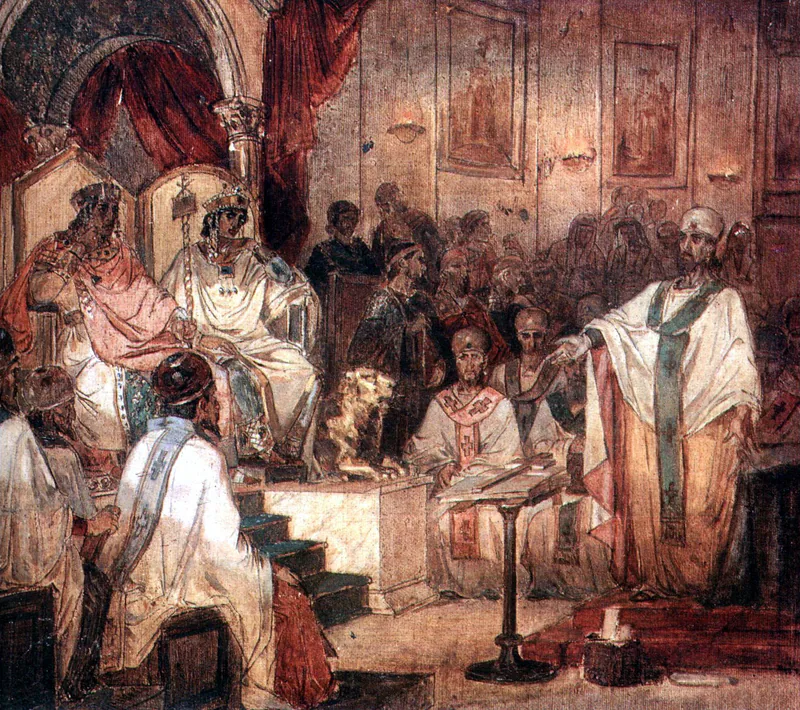
- Nicaea I (325) — condemned Arius; the Son is homoousios with the Father.
- Constantinople I (381) — affirmed the divinity of the Holy Spirit; completed the Nicene Creed.
- Ephesus (431) — condemned Nestorius; Mary is Theotokos.
- Chalcedon (451) — Christ is one person in two natures.
- Constantinople II (553) — condemned writings known as the Three Chapters and clarified Chalcedon in Cyril's terms.
- Constantinople III (680–681) — taught that Christ has two wills, divine and human, against Monothelitism.
- Nicaea II (787) — ended the first phase of Byzantine iconoclasm and approved the veneration of icons, distinguishing honour paid to images from worship due to God alone.
The Orthodox regard these seven as the definitive councils of the undivided Church, as explained in Eastern Orthodox Christianity. The Latin West continued to hold general councils after the separation from the East, and the Catholic Church counts twenty-one in all, from Lateran I (1123) and Trent (1545–1563) to Vatican I (1869–1870) and Vatican II (1962–1965); these are discussed in Roman Catholicism.
The Filioque and Other Western Developments§
One phrase became a symbol of East–West division. The original creed says the Holy Spirit "proceeds from the Father." In Spain, probably at the Third Council of Toledo in 589, the Latin creed added filioque, "and the Son." The addition spread through the Frankish churches and was finally adopted in the liturgy at Rome in the early eleventh century. Eastern theologians objected both to the theology and to the unilateral change of an ecumenical creed, and the filioque remains a point of dialogue.
The Western churches also used the Athanasian Creed, or Quicumque vult, a Latin statement of Trinitarian and Christological doctrine composed in southern Gaul in the fifth or sixth century and attributed to Athanasius only by later tradition. Augustine's writings on grace, against the British monk Pelagius, shaped Western teaching on sin and salvation, and Anselm of Canterbury's Why God Became Man (Cur Deus Homo, c. 1098) gave classic form to the theology of atonement.
Reformation Confessions and Modern Doctrine§
The Protestant Reformers kept the ancient creeds but produced new confessions to set out their positions: the Lutheran Augsburg Confession (1530), the Reformed Heidelberg Catechism (1563), the Anglican Thirty-Nine Articles (1563, finalised 1571) and the Presbyterian Westminster Confession (1646). The Catholic Council of Trent replied with decrees on scripture, justification and the sacraments, a story told in Protestantism and the Reformation. Some Protestant groups, including many Baptists and the Restorationist movements, describe themselves as "non-creedal," appealing to the Bible alone. Others, such as Unitarians and the Latter-day Saints, reject the Nicene doctrine of the Trinity altogether.
In 2025, the seventeen-hundredth anniversary of Nicaea, churches of many traditions marked the council as a shared inheritance, a sign that the creeds still function as a common language among divided Christians.
Frequently asked questions§
What is the difference between the Apostles' Creed and the Nicene Creed?§
The Apostles' Creed is a shorter Western baptismal creed that developed from the Old Roman Creed. The Nicene Creed, completed at Constantinople in 381, is longer and states the divinity of the Son and the Holy Spirit in precise terms; it is used by Orthodox, Catholic and many Protestant churches.
What happened at the Council of Nicaea?§
The council, called by Constantine in 325, condemned the teaching of Arius that the Son of God was a created being and declared the Son to be "of one substance" with the Father. It also issued rules on church discipline and the date of Easter. Despite a popular myth, it did not decide which books belong in the Bible.
How many ecumenical councils are there?§
The Orthodox and Catholic churches agree on seven councils held between 325 and 787. The Catholic Church recognises fourteen further councils in the West, for a total of twenty-one, while the Oriental Orthodox accept only the first three.
What is the Filioque controversy?§
It concerns the Latin addition "and the Son" to the creed's statement that the Holy Spirit proceeds from the Father. Eastern churches objected to the addition and its theology, and it became one of the main doctrinal issues in the separation of East and West.
Sources and further reading§
- Early Christian Creeds — J. N. D. Kelly, 1950
- Early Christian Doctrines — J. N. D. Kelly, 1958
- The First Seven Ecumenical Councils (325–787): Their History and Theology — Leo Donald Davis, 1983
- The Search for the Christian Doctrine of God: The Arian Controversy 318–381 — R. P. C. Hanson, 1988
- The Emergence of the Catholic Tradition (100–600) — Jaroslav Pelikan, 1971