Liber VI · Christianity · Chapter III: Catholicism
Thomas Aquinas: Life, the Summa Theologiae and Catholic Thought
Thomas Aquinas explained: the Dominican friar's life, the Summa Theologiae, the Five Ways, natural law, his views on angels and magic, and Thomism's legacy.

Thomas Aquinas (c. 1225–1274) was an Italian Dominican friar, priest and theologian whose Summa Theologiae became the most influential synthesis of Christian doctrine and Aristotelian philosophy ever written. Canonised in 1323 and named a Doctor of the Church in 1567, he is known as the "Angelic Doctor," and his thought, called Thomism, has shaped Catholic theology, philosophy and moral teaching to the present day.
The Life of Thomas Aquinas§
Thomas was born around 1225 at Roccasecca, the castle of his family, the counts of Aquino, between Rome and Naples. At about five he was given as an oblate to the great Benedictine abbey of Monte Cassino, and his family probably hoped he would one day become its abbot. Around 1239 he went to study at the new university of Naples, where he met both the philosophy of Aristotle and the Order of Preachers, the Dominicans, founded only a generation earlier. In 1244 he took the Dominican habit. His family, opposed to his joining a mendicant order of begging friars, had his brothers seize him on the road and kept him confined at Roccasecca for about a year before letting him go.
Thomas then studied under Albert the Great, the most learned scholar of his order, in Paris and Cologne. Fellow students reportedly called the large, quiet young man "the dumb ox"; a well-known later story has Albert reply that this ox would one day bellow so loudly that his lowing would fill the world. Thomas became a master of theology at the University of Paris in 1256, taught there until 1259, spent most of the 1260s in Italy, including Orvieto and Rome, returned to Paris from 1268 to 1272, and then founded a Dominican house of studies in Naples.
On or around 6 December 1273, while celebrating Mass, Thomas had an experience that made him stop writing. According to his companion Reginald of Piperno, he said that everything he had written seemed to him like straw compared with what he had seen. He died on 7 March 1274 at the Cistercian abbey of Fossanova, on his way to the Second Council of Lyon. He was not yet fifty.
Faith, Reason and the Recovery of Aristotle§
The thirteenth century was the age of the new universities and of the full recovery of Aristotle's works in Latin, often accompanied by the commentaries of the Muslim philosopher Averroes (Ibn Rushd). Many churchmen saw Aristotle as a danger: he taught that the world was eternal, and some readers took him to deny personal immortality. At Paris a group of arts masters, the so-called Latin Averroists led by Siger of Brabant, seemed to hold that philosophy might reach conclusions contrary to faith.
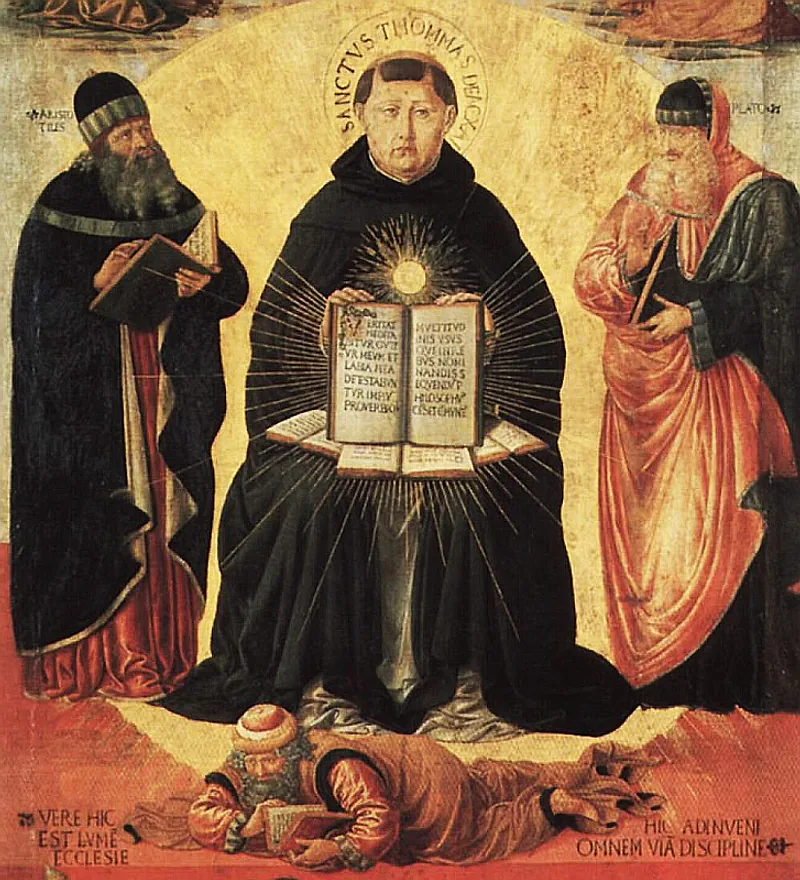
Thomas took a different path. He argued that reason and revelation come from the same God and therefore cannot truly contradict each other. Some truths, such as God's existence, can be known by reason; others, such as the Trinity and the Incarnation, exceed reason and are known only by revelation, but are never against reason. Philosophy is the servant of theology, but a real servant with its own competence. He wrote line-by-line commentaries on many of Aristotle's works, and in the Summa contra Gentiles (c. 1259–1265) he set out the Christian faith in a form intended to persuade readers who did not accept the Bible as authority. He also drew heavily on Augustine, on Pseudo-Dionysius and on Jewish and Islamic philosophers, especially Maimonides and Avicenna, whom he cited with respect.
The Summa Theologiae: Structure, Method and the Five Ways§
Thomas began the Summa Theologiae around 1265 as a textbook for beginners in theology. It has three parts: the first on God and creation; the second, itself in two halves, on human action, virtue and the moral life; and the third on Christ and the sacraments. He stopped work during the treatise on penance, and his followers completed it with a supplement drawn from his earlier writings.
Every article follows the method of the medieval disputation. Thomas poses a question, lists objections against the answer he will give, cites an authority on the other side ("on the contrary"), gives his own answer ("I answer that"), and finally replies to each objection. The method gives the work its clarity and fairness: opposing views are stated at full strength before they are answered.
The most famous passage is the "Five Ways" (Part I, question 2, article 3), five short arguments that God exists: from motion to a first unmoved mover; from efficient causes to a first cause; from contingent things to a necessary being; from degrees of perfection to a supreme perfection; and from the ordered activity of natural things to an intelligence directing them. Thomas did not think these arguments proved the God of Christian faith in full. They established, he believed, that there is a first cause, and the rest of the Summa explains what can be said about it. His teaching that God is "being itself" (ipsum esse subsistens) and that we speak of God only by analogy was influential on later apophatic theology as well as on scholastic philosophy.
Ethics, Natural Law and the Eucharist§
The second part of the Summa is a vast treatise on the moral life. Drawing on Aristotle's ethics, Thomas describes human beings as directed toward happiness, which is finally found only in the vision of God. He analyses the passions, habits, the cardinal virtues of prudence, justice, fortitude and temperance, and the theological virtues of faith, hope and charity. His account of natural law, the moral order that human reason can know because it shares in God's eternal law, became the foundation of Catholic moral teaching and influenced later Western thinking about rights and justice. He also discussed just war, property, usury and the duties of rulers.
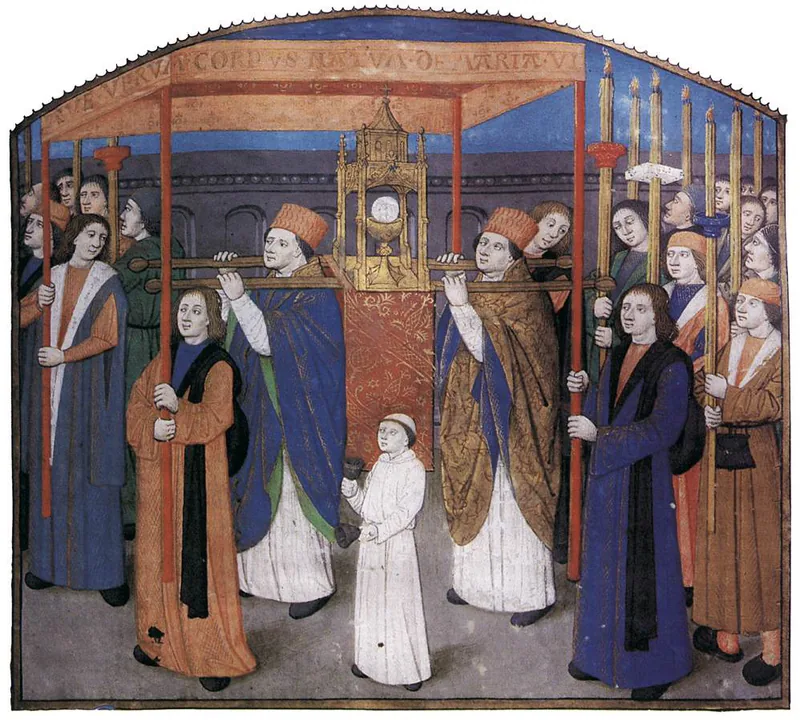
On the sacraments, discussed in Christian Sacraments and Liturgy, Thomas gave the classic philosophical explanation of transubstantiation, the doctrine that in the Eucharist the substance of bread and wine becomes the body and blood of Christ while their appearances remain. Pope Urban IV asked him to compose the liturgy for the new feast of Corpus Christi (1264), and the hymns Pange lingua, with its final verses Tantum ergo, and Lauda Sion are traditionally ascribed to him; the prayer Adoro te devote is also attributed to him, though some scholars question it.
Angels, Demons and Magic in Aquinas§
Thomas earned the title "Angelic Doctor" partly through his angelology. He taught that angels are pure intellects without bodies, that each angel is a species of its own, and that angels know by ideas infused by God rather than by learning from the senses. His treatment of guardian angels in Part I, question 113, became the standard Catholic account.
His views on demons and magic had far-reaching consequences. Following Augustine, whose views are discussed in Augustine's City of God on Magic, Demons and Theurgy, Thomas argued that the effects claimed by magicians could not come from words, figures or characters themselves, which have no natural power. If such rites produced results, the work must be done by demons, who respond to signs as to a contract. Every use of magical characters or invocations therefore implied at least a tacit pact with demons, even if the magician did not intend it. This argument, set out in the Summa contra Gentiles (Book III) and in the Summa Theologiae's questions on superstition and divination (II–II, questions 92–96), was later used by inquisitors and demonologists, as explained in How Theologians and Inquisitors Judged Demonic Magic.
Thomas allowed that the stars influence bodies and may incline the passions, but denied that they govern the free will, so astrological prediction of human choices was unlawful. He also wrote a short letter, On the Occult Workings of Nature, explaining the hidden properties of things such as the magnet as natural powers. Later alchemical writings were falsely attributed to him, notably the Aurora consurgens, which modern scholarship regards as a pseudonymous work.
Condemnation, Canonisation and Thomism§
Thomas's thought was not immediately accepted. In 1277 Bishop Stephen Tempier of Paris condemned 219 propositions, some of which touched positions held by Thomas, and the Archbishop of Canterbury issued a similar condemnation at Oxford. Franciscan theologians criticised him, and Dominicans defended him. The tide turned with his canonisation by Pope John XXII in 1323. At the Council of Trent, according to a long-repeated tradition, the Summa lay on the altar beside the Bible, and in 1567 Pius V declared Thomas a Doctor of the Church.
In 1879 Pope Leo XIII's encyclical Aeterni Patris called for the renewal of Christian philosophy on the model of Thomas, launching the neo-Thomist revival. Twentieth-century philosophers such as Jacques Maritain and Étienne Gilson made Thomas a major presence in modern thought, and his influence continues in Catholic social teaching and in analytic philosophy of religion. For the wider history of the Church that adopted him as its master, see Roman Catholicism.
Frequently asked questions§
Why is Thomas Aquinas called the Angelic Doctor?§
The title, used from the fifteenth century, honours both his extensive teaching on angels and the purity and clarity traditionally attributed to his life and thought. He is also called the "Common Doctor" of the Church.
What are the Five Ways?§
They are five brief arguments for the existence of God in the Summa Theologiae, based on motion, causation, contingency, degrees of perfection and the order of nature. Each argues from features of the world to a first cause that people call God.
Did Aquinas believe in magic?§
He believed that magical rites could produce real effects, but only through the action of demons, not through any power in words or symbols. He therefore condemned magic and most forms of divination as superstition involving at least an implicit pact with demons.
Did Aquinas finish the Summa Theologiae?§
No. He stopped writing in December 1273, during the section on penance in the third part, and died a few months later. His followers added a supplement compiled from his earlier commentary on Peter Lombard's Sentences.
Sources and further reading§
- Summa Theologiae — Thomas Aquinas, 1265–1274
- Summa contra Gentiles — Thomas Aquinas, c. 1259–1265
- Saint Thomas Aquinas, Volume 1: The Person and His Work — Jean-Pierre Torrell, 1993
- The Christian Philosophy of St. Thomas Aquinas — Étienne Gilson, 1956
- Aquinas — Anthony Kenny, 1980
- Aquinas: A Beginner's Guide — Edward Feser, 2009
- After Aquinas: Versions of Thomism — Fergus Kerr, 2002