Liber VI · Christianity · Chapter I: Angels, Demons & Exorcism
Guardian Angels in Christianity: Scripture, Saints and Devotion
Guardian angels in Christian belief: biblical roots, the Church Fathers, Aquinas, the feast of 2 October, Orthodox and Protestant views and modern devotion.

In Christian belief a guardian angel is a spirit appointed by God to watch over an individual person, protecting body and soul, encouraging good and presenting that person's prayers before God. The idea rests on a few biblical passages, above all Jesus' saying that the "little ones" have angels who always behold the face of the Father, and was developed by the Church Fathers and medieval theologians. Catholic and Orthodox Christians honour guardian angels in prayer and liturgy; Protestant churches have generally been more reserved about the details.
Biblical Foundations of the Guardian Angel§
The Hebrew Bible speaks often of angels who protect, guide and rescue. God promises to send an angel before Israel "to keep thee in the way" (Exodus 23); the dying Jacob blesses his grandsons in the name of "the Angel which redeemed me from all evil" (Genesis 48); and the psalmist declares that God "shall give his angels charge over thee, to keep thee in all thy ways" (Psalm 91). These passages describe God's protection through angels without yet saying that each individual has a single assigned guardian.
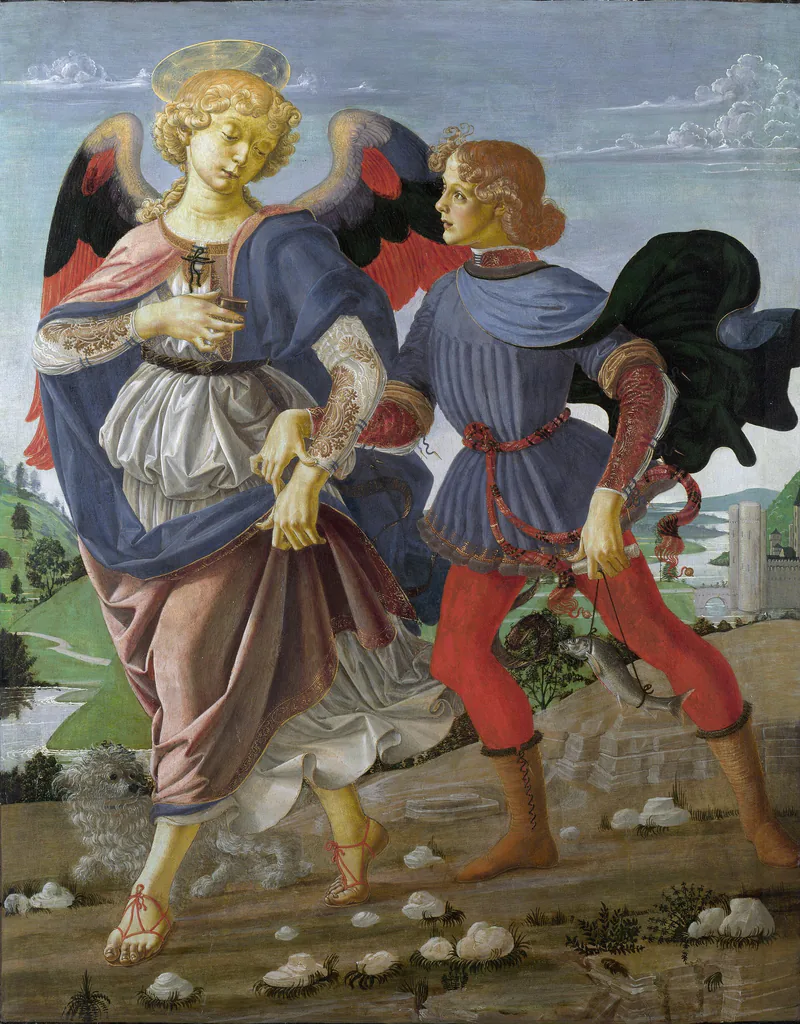
The Book of Tobit, part of the Catholic and Orthodox Old Testament but counted among the Apocrypha by Protestants, gave the idea its most vivid story. The angel Raphael, disguised as a young man named Azarias, accompanies Tobias on a journey, protects him from a demon and brings healing to his father. Painters of the Renaissance turned "Tobias and the Angel" into a favourite subject and a model image of the guardian angel.
In the New Testament, Jesus warns against despising "one of these little ones; for I say unto you, That in heaven their angels do always behold the face of my Father" (Matthew 18). When Peter escapes from prison and knocks at the door, the disciples inside exclaim, "It is his angel" (Acts 12), suggesting a popular belief in a personal angel who could resemble the person it guarded. The Letter to the Hebrews calls angels "ministering spirits, sent forth to minister for them who shall be heirs of salvation" (Hebrews 1). On these verses, together with Jewish ideas about the angels of nations and individuals, the later doctrine was built.
Guardian Angels in the Church Fathers§
The Shepherd of Hermas, a Roman work of the second century that many early Christians read as scripture, teaches that each person is accompanied by two angels, one of righteousness and one of wickedness, and that the believer must learn to recognise and follow the good one. The same two-spirit scheme appears in Jewish writings and in the Dead Sea Scrolls' doctrine of two spirits.
Origen of Alexandria (c. 185–c. 254) discussed guardian angels at length. He taught that every believer has an angel who watches over him and offers his prayers to God, and speculated about whether the angel is assigned at birth or at baptism. Basil of Caesarea in the fourth century affirmed that an angel stands beside every believer as tutor and shepherd, unless driven away by sin. Jerome, commenting on Matthew 18:10, wrote that the dignity of souls is great, since each has from birth an angel delegated to guard it. In the Greek East, Pseudo-Dionysius placed the angels who deal directly with human beings in the lowest of the nine celestial orders, a scheme explained in Pseudo-Dionysius and Christian Mysticism.
The Fathers also debated whether nations, churches and cities had their own angels, drawing on the "angels of the seven churches" in Revelation and the angelic princes of Daniel, and whether the guardian angel would accompany the soul at death. These speculations were never formally defined, and the Church left room for differing opinions.
Aquinas and the Scholastic Theology of Angels§
The medieval schools systematised what the Fathers had said. Honorius Augustodunensis in the twelfth century and Peter Lombard's Sentences discussed angelic guardianship, and in the thirteenth century Thomas Aquinas devoted a question of his Summa Theologiae (Part I, question 113) to the subject. His conclusions became the standard Catholic account.
According to Aquinas, every human being, Christian or not, has a guardian angel from the moment of birth, because human life is a journey on which travellers need protection. Guardians belong to the lowest order of angels, since their office is nearest to human affairs, but the higher angels watch over larger communities. The guardian never abandons its charge completely, even when a person falls into sin, though it may permit evils for the sake of a greater good. Angels act on human beings not by forcing the will but by enlightening the intellect and stirring the imagination. Aquinas also held, following earlier tradition, that demons are permitted to tempt human beings, so that the moral life is a field between good and evil spiritual influences, a theme discussed in Angels, Demons and Exorcism in Christian Tradition.
Franciscan theologians such as Bonaventure taught much the same, and the guardian angel became a staple of medieval preaching, devotional manuals and death-bed literature, where the angel stands beside the dying person to defend the soul against accusing demons.
The Feast and Devotion of the Guardian Angels§
A liturgical feast of the guardian angel appears in Spain and Portugal in the fifteenth and sixteenth centuries; the city of Valencia is often named as an early centre. Pope Paul V permitted a feast in 1608, and Clement X extended it to the universal Church in 1670, fixing it on 2 October. The Catechism of the Catholic Church (1992) states that "from infancy to death human life is surrounded by their watchful care and intercession" (paragraph 336).
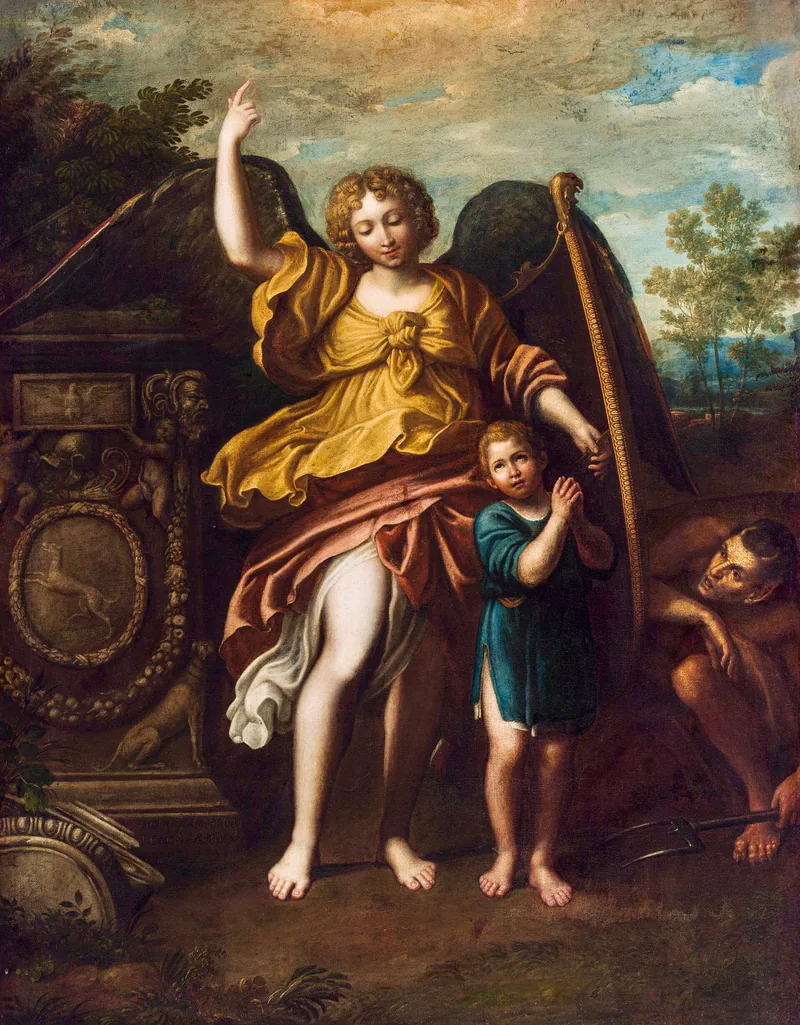
The best-known prayer to the guardian angel is the Latin Angele Dei, attributed in some sources to the eleventh-century monk Reginald of Canterbury, and familiar in English as "Angel of God, my guardian dear." Generations of Catholic children learned it as their first prayer. The Jesuits, beginning with Ignatius of Loyola and Peter Faber, recommended devotion to the guardian angel, and baroque churches filled with altarpieces of an angel leading a child by the hand. In the nineteenth century, printed holy cards showing an angel guarding children on a broken bridge or beside a cliff spread the image into homes across Europe and the Americas.
The Orthodox Church teaches that a guardian angel is given to each Christian at baptism. Prayers to the guardian angel appear in the daily morning and evening prayers of the Orthodox prayer book, and the angels are honoured each Monday in the weekly cycle and at the Synaxis of the Archangels on 8 November, described in Archangel Michael.
Protestant Views of the Guardian Angel§
The Reformers accepted that angels protect believers but were wary of devotion directed to them. Martin Luther wrote warmly of the angels' care and included in his morning and evening prayers the request "let thy holy angel be with me." John Calvin, in his Institutes of the Christian Religion (Book I, chapter 14), judged it uncertain whether each believer has one particular angel and thought it better to say that all the angels together watch over the whole Church. Protestant theology since has tended to follow Calvin's caution, avoiding prayer addressed to angels while affirming their ministry.
Folk belief often went further than any official teaching. In Protestant as well as Catholic regions, people spoke of a child's angel, left room on the bed for it, or saw a narrow escape as the angel's work; and amulets naming protective angels, discussed in Angelic Amulets in Jewish and Christian Folk Practice, circulated for centuries despite clerical disapproval.
Personal Spirits Beyond the Church§
The Christian guardian angel has parallels and possible ancestors in other traditions. Greek philosophy spoke of a personal daimon: Socrates described a divine sign that warned him, and Plato's myth of Er has each soul choose a daimon to accompany it through life. Later Platonists, discussed in Neoplatonism and Theurgy, sought contact with a personal guardian spirit through ritual. Islamic tradition speaks of recording angels assigned to every person, as described in Angels in Islam.
Western ceremonial magic took the idea in a different direction. The Book of Abramelin made "the knowledge and conversation of the holy guardian angel" the goal of a long ascetic operation, and the Golden Dawn and Aleister Crowley reinterpreted that angel as a higher self, as explained in The Holy Guardian Angel. Since the late twentieth century, popular books and the "angel movement" have offered methods for contacting one's guardian angel. Catholic and Orthodox teachers generally caution against such practices, especially attempts to learn an angel's name, and the Vatican's 2001 Directory on Popular Piety and the Liturgy discourages assigning names to angels other than Michael, Gabriel and Raphael.
Frequently asked questions§
Does the Bible say everyone has a guardian angel?§
The Bible does not state the doctrine in so many words. Its strongest support is Matthew 18:10, where Jesus speaks of the angels of "these little ones," together with Acts 12:15 and Psalm 91. The belief that every person has one assigned angel developed from these texts in early Christian tradition.
When is the feast of the Guardian Angels?§
In the Catholic calendar it falls on 2 October; it was extended to the whole Church by Pope Clement X in 1670. Orthodox Christians honour the angels on Mondays and at the Synaxis of the Archangels on 8 November.
Do guardian angels have names?§
Christian tradition names only a few angels, chiefly Michael, Gabriel and Raphael from scripture. The Catholic Church discourages giving names to guardian angels, and Orthodox teachers likewise advise against it.
Do Protestants believe in guardian angels?§
Most Protestant churches affirm that angels protect believers, but many follow Calvin in doubting that each person has a single assigned guardian, and they do not pray to angels. Views vary by denomination and individual.
Sources and further reading§
- Summa Theologiae — Thomas Aquinas, 1265–1274
- Institutes of the Christian Religion — John Calvin, 1559
- Angels: A History — David Albert Jones, 2010
- Angels and Angelology in the Middle Ages — David Keck, 1998
- Angels in the Early Modern World — Peter Marshall & Alexandra Walsham, 2006
- The Angels and Their Mission — Jean Daniélou, 1952