Liber XVII · Islam · Chapter V: Jinn & the Unseen
Angels in Islam: Gabriel, Michael, Israfil and the Angel of Death
Angels in Islam explained: the malaika created from light, Gabriel, Michael, Israfil and the Angel of Death, recording angels, Harut and Marut, and theology.

In Islam, angels (malāʾika, singular malak) are beings created by God from light who worship Him without ceasing and carry out His commands in heaven and on earth. Belief in them is one of the six articles of Islamic faith, alongside belief in God, His scriptures, His messengers, the Last Day and divine decree. The Qur'an names Gabriel and Michael; hadith and later tradition add Israfil, who will sound the trumpet of the Resurrection, the Angel of Death, often called 'Azra'il, the questioning angels of the grave and the guardians who record every deed.
The Nature of Angels in the Qur'an and Hadith§
The Qur'an mentions angels more than eighty times. It describes them as messengers "having wings two, three and four" (Qur'an 35:1), as servants who never tire of glorifying God, and as guardians of the Fire "who resist not Allah in that which He commandeth them" (Qur'an 66:6). In the dominant Sunni view they therefore lack the capacity to disobey: unlike humans and jinn, they are not tested by free choice between good and evil.
A well-known hadith reported by 'Ā'isha in the Ṣaḥīḥ of Muslim says that angels were created from light. They do not eat, drink or marry, and the Qur'an firmly rejects the pre-Islamic Arabian belief that angels were "daughters of God" (Qur'an 53:27). In Islamic teaching they have no gender. They can take on visible forms, often of handsome men, as Gabriel did when he appeared to Mary, or when, in the famous "hadith of Gabriel", he came to the Prophet's companions as a traveller in white and asked about faith, submission and excellence. The broader category of unseen beings, including the jinn, is introduced in Jinn and the Unseen in Islam.
Gabriel, Michael, Israfil and the Angel of Death§
Jibril (Gabriel)§
Gabriel is the greatest of the angels in Islamic tradition, the messenger of revelation who "revealed (this Scripture) to thy heart by Allah's leave" (Qur'an 2:97). He is often identified with the "Holy Spirit" (rūḥ al-qudus) and the "Faithful Spirit" (al-rūḥ al-amīn) of the Qur'an. According to the biography of the Prophet, he first appeared in the cave of Hira with the command "Recite!"; he accompanied the Prophet on the Night Journey and Ascension as far as the lote-tree of the boundary; and he reviewed the Qur'an with him each Ramadan.
Mika'il (Michael)§
Michael is named once in the Qur'an, together with Gabriel (Qur'an 2:98). Tradition charges him with the provision of creation, the sending of rain and the growth of plants, and some reports say he has never laughed since Hell was created.
Israfil§
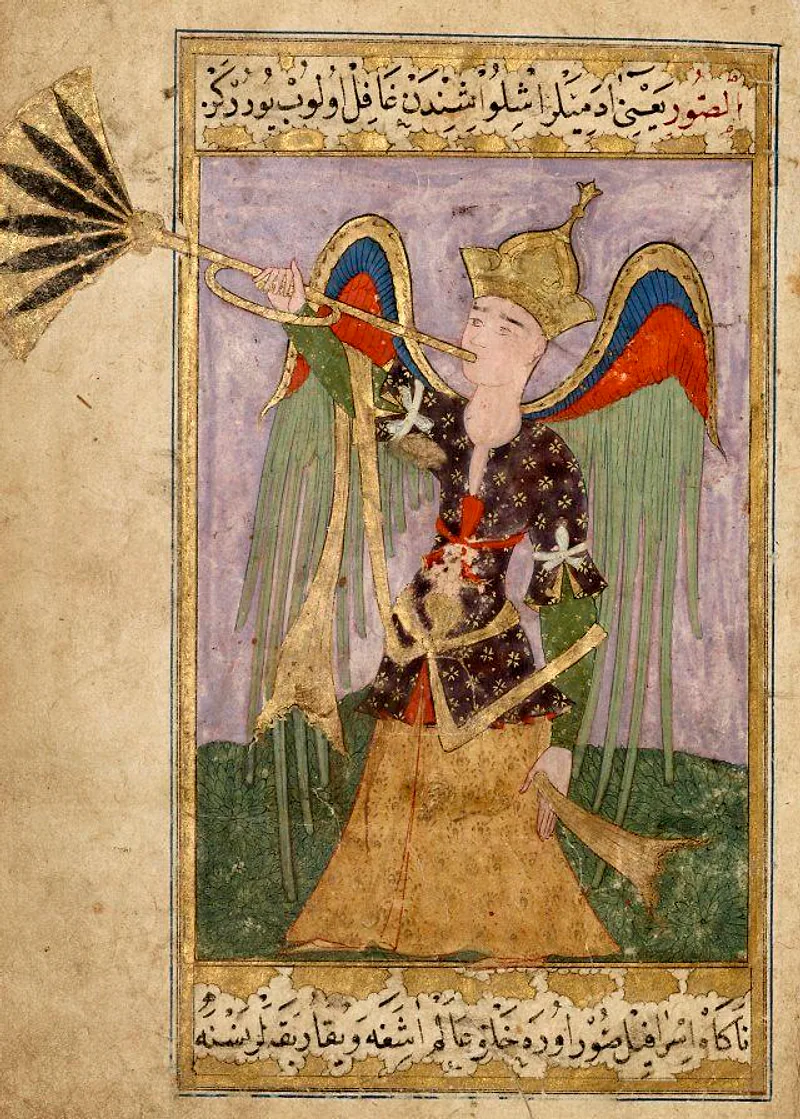
Israfil is not named in the Qur'an or the most authoritative hadith, but later tradition identifies him as the angel who holds the trumpet (al-ṣūr) to his lips, awaiting the command to blow. At the first blast all creatures will swoon and die; at the second they will rise for judgment (Qur'an 39:68).
The Angel of Death§
The Qur'an speaks of "the angel of death, who hath charge concerning you" (Qur'an 32:11), assisted by other angels who take the souls of the righteous gently and those of the wicked harshly. The name 'Azra'il, by which he is widely known, comes from later tradition, probably of Jewish background, and does not occur in the Qur'an or canonical hadith.
Recording Angels, Guardians and the Questioners of the Grave§
The Qur'an teaches that every person is accompanied by angels. Two "noble recorders" (kirāman kātibīn, Qur'an 82:11) sit on the right and left, writing down good and bad deeds, and the record they keep will be presented on the Day of Judgment. Muslims in many places close their ritual prayer by turning the head to the right and to the left with the greeting of peace, which some explain as a salutation to these angels. Other angels, the ḥafaẓa, guard each person "by Allah's command" (Qur'an 13:11).
After burial, according to hadith in the collection of al-Tirmidhī and others, two angels called Munkar and Nakīr come to the dead and ask: Who is your Lord? What is your religion? Who is your prophet? The believer answers rightly and the grave becomes spacious and bright; the unbeliever fails and is punished until the Resurrection. This "punishment of the grave" became a standard article of Sunni creed, although some rationalist theologians questioned it. Islamic beliefs about death and the afterlife are set in comparative context in Reincarnation and the Afterlife.
Angels of the Throne, Paradise and Hell§
Beyond these familiar figures stands a vast hierarchy. The bearers of the Throne (ḥamalat al-ʿarsh), eight in number on the Last Day (Qur'an 69:17), and the "angels brought near" (al-muqarrabūn) surround God in praise. In the Qur'an the damned call out to Malik, the keeper of Hell, who answers that they must remain (Qur'an 43:77); nineteen angels are set over the Fire (Qur'an 74:30). Tradition names Riḍwān as the guardian of Paradise.
Angels also intervene in history. The Qur'an recalls that they were commanded to bow before Adam, and that all did so except Iblis (Qur'an 2:34); that they questioned God's purpose in placing a "viceroy" on earth; that they brought glad tidings to Abraham and Mary; and that they supported the believers at the battle of Badr in 624. On the Night of Power, when the Qur'an was first revealed, "the angels and the Spirit descend" (Qur'an 97:4). Medieval cosmographies such as al-Qazwīnī's Wonders of Creation (thirteenth century) described the angels of each heaven, and their illustrated manuscripts gave Islamic art some of its most striking images of winged beings.
Harut and Marut and the Origins of Magic§
One Qur'anic passage links angels with magic. Verse 2:102 says that the devils taught people sorcery, "and that which was revealed to the two angels in Babel, Harut and Marut", who warned all who came to them, "We are only a temptation" (Qur'an 2:102). Commentators told a story, with parallels in Jewish legends of fallen angels, that the two angels mocked human weakness, were sent to earth to judge, fell into sin with a beautiful woman (in some versions identified with the planet Venus) and were punished by being suspended in a pit at Babylon. Many later scholars rejected the story as incompatible with angelic sinlessness.
The passage was central to Islamic discussions of the legitimacy of magic, treated in Islamic Occult Sciences: A History. Lettrist and talismanic works, including those attributed to al-Buni, invoked angels by name in prayers of protection, a practice that pious critics regarded with suspicion. In the wider Mediterranean world, comparable traditions of angel names appear in Jewish and Christian amulets and in the grimoires discussed in Angel Magic: A Complete Guide.
Angels in Islamic Theology and Philosophy§
Muslim theologians debated the relative rank of angels and humans. Many Sunni theologians held that prophets are superior to angels, since humans achieve obedience in spite of temptation, while the Mu'tazila tended to place angels higher. Philosophers such as al-Fārābī and Avicenna identified the angels of religion with the celestial intellects that move the heavens, and Gabriel with the Active Intellect from which human knowledge is illuminated. The Persian philosopher Suhrawardi went further, building a whole cosmology of angelic lights. For Sufis such as Ibn 'Arabi, angels were spiritual realities manifesting particular divine names, while for ordinary believers they remain close and constant companions, invoked in daily blessings and remembered at every prayer.
Frequently asked questions§
Do Muslims believe in guardian angels?§
Yes. The Qur'an speaks of angels who guard each person by God's command and of two noble recorders who write down a person's deeds. Their role is to serve God's decree, not to be prayed to.
Is Azrael mentioned in the Qur'an?§
No. The Qur'an speaks of "the angel of death" without naming him. The name 'Azra'il comes from later tradition and is widely used by Muslims.
Can angels disobey God in Islam?§
In the dominant Sunni view angels cannot disobey, because they lack the inclination to sin. This is why most scholars hold that Iblis, who refused to bow to Adam, was a jinn rather than an angel.
Sources and further reading§
- Angels in Islam: Jalal al-Din al-Suyuti's al-Haba'ik fi akhbar al-mala'ik — Stephen Burge, 2012
- The Islamic Understanding of Death and Resurrection — Jane Idleman Smith and Yvonne Yazbeck Haddad, 1981
- Major Themes of the Qur'an — Fazlur Rahman, 1980
- God and Man in the Koran — Toshihiko Izutsu, 1964
- The Tao of Islam: A Sourcebook on Gender Relationships in Islamic Thought — Sachiko Murata, 1992
- Paradise and Hell in Islamic Traditions — Christian Lange, 2016