Liber XVII · Islam · Chapter VI: The Prophet Muhammad
Isra and Mi'raj: The Prophet's Night Journey and Ascension
Isra and Mi'raj, the Prophet Muhammad's Night Journey to Jerusalem and ascent through the seven heavens: Qur'an, hadith, meaning, festival and art.

The Isra and Mi'raj are the two parts of the Prophet Muhammad's Night Journey, one of the most beloved episodes of Islamic tradition. In the Isrā' ("night journey") the Prophet was carried in a single night from Mecca to Jerusalem; in the Miʿrāj ("ladder", "ascent") he rose from Jerusalem through the seven heavens into the presence of God, where the five daily prayers were prescribed. Muslims commemorate the event on the night of 27 Rajab, and its story has inspired theology, mysticism, poetry and some of the finest painting of the Islamic world.
The Night Journey in the Qur'an§
The seventeenth surah of the Qur'an, called al-Isrā' or Banī Isrā'īl, opens with a verse that Muslim tradition takes as the foundation of the story. In Pickthall's rendering it begins: "Glorified be He Who carried His servant by night from the Inviolable Place of Worship to the Far distant place of worship" (Qur'an 17:1). The "Inviolable Place of Worship" is the sanctuary of Mecca; the "Far distant place of worship", al-masjid al-aqṣā, has been identified by the great majority of commentators with Jerusalem and the site of the ancient Temple.
The ascent itself is not described in detail in the Qur'an. Commentators, however, have linked it to the opening of Surah 53, al-Najm ("The Star"), which speaks of a vision seen "on the uppermost horizon" and again "by the lote-tree of the utmost boundary" (Qur'an 53:14). Whether the one seen was the angel Gabriel or, as some held, God himself, was one of the earliest theological debates about the event. On the place of the Qur'an and hadith as sources, see The Qur'an and Hadith.
The Story in Hadith and the Sira§
The fuller narrative appears in the biography (sīra) of the Prophet by Ibn Isḥāq (d. c. 767), preserved in the recension of Ibn Hishām, and in the canonical hadith collections of al-Bukhārī and Muslim. The versions differ in detail and order, but their main outline is shared.
From Mecca to Jerusalem§
One night, while the Prophet slept near the Kaaba, the angel Gabriel came to him. In several reports his chest was opened and his heart washed with the water of Zamzam and filled with wisdom and faith. He was then mounted on Buraq, a white riding animal smaller than a mule and larger than a donkey, each of whose strides reached as far as its eye could see. Carried to Jerusalem, he tethered Buraq at the Temple Mount and led the earlier prophets in prayer. Offered a cup of milk and a cup of wine, he chose the milk, and Gabriel told him he had chosen the natural path (fiṭra) for his community.
Through the Seven Heavens§
From Jerusalem the Prophet ascended with Gabriel through the seven heavens. In the best-known order, he met Adam in the first heaven, John the Baptist and Jesus in the second, Joseph in the third, Idris (often identified with Enoch) in the fourth, Aaron in the fifth, Moses in the sixth and Abraham in the seventh, where Abraham leant against the "Frequented House" (al-bayt al-maʿmūr), a heavenly counterpart of the Kaaba around which angels circle. Beyond lay the lote-tree of the boundary, sidrat al-muntahā, the furthest point that even Gabriel could reach, and then the divine presence.
The Gift of the Five Daily Prayers§
The most consequential part of the hadith narrative concerns ritual prayer. God first prescribed fifty prayers a day for the Prophet's community. On his descent Moses asked what he had been given and urged him to return and ask for a reduction, since, Moses said, he had experience of people and they would not be able to bear it. The Prophet went back several times until the number was reduced to five, with the assurance that five prayers would carry the reward of fifty. This is why Muslims often say that prayer (ṣalāt) is the "ascension of the believer": the one pillar of Islam given directly in heaven. The practice itself is described in The Five Pillars of Islam.
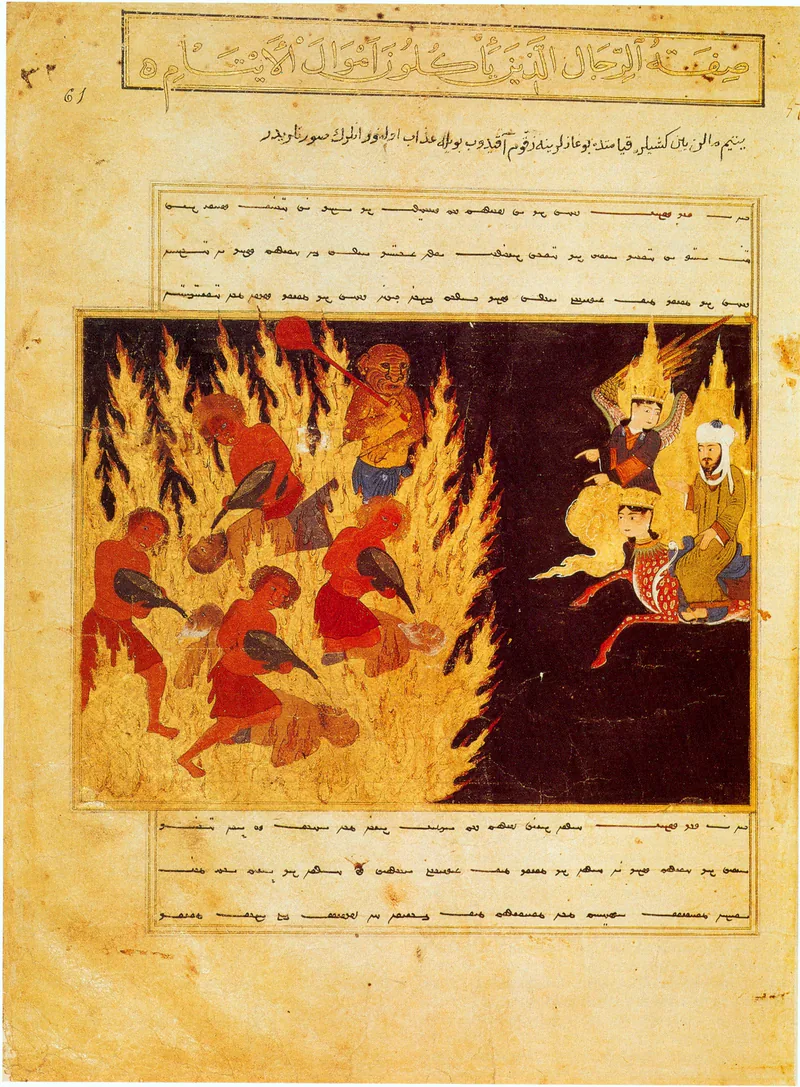
Other reports describe the Prophet's sight of Paradise and Hell, the punishments of particular sins, the angel Malik guarding the Fire and the vast host of angels in worship, themes treated further in Angels in Islam.
Body or Spirit? Debates over the Journey§
When the Prophet described his journey in Mecca, according to the sīra, many of his opponents mocked him and some believers wavered. Abu Bakr is said to have declared that if the Prophet said so, it was true, and to have earned the title al-Ṣiddīq, "the one who affirms the truth". The episode thus became a test of faith within the story itself.
Muslim scholars have asked whether the journey took place in body or in spirit, awake or in a vision. Ibn Isḥāq records reports from 'Ā'isha and from Mu'āwiya that the Prophet's body was not absent that night and that it was a true vision from God. The majority of Sunni theologians, however, came to hold that the journey was bodily and waking, arguing that a mere dream would have provoked no scandal and would not have been described as a sign. Many also distinguished the isrā' to Jerusalem, which they held certain from the Qur'an, from the details of the ascent, known through hadith of varying strength.
Mystical Readings of the Ascent§
For Sufis the miʿrāj became the model of the soul's journey to God. The ninth-century mystic Abū Yazīd al-Bisṭāmī was credited with a visionary ascent of his own, modelled on the Prophet's, and later masters described the stages of the path as heavens to be crossed. Ibn 'Arabi wrote several accounts of spiritual ascension, distinguishing the Prophet's unique bodily journey from the inner ascents open to saints. Persian poets such as Niẓāmī and Rumi opened their great works with praise of the Prophet's ascent.
Philosophers read the story symbolically: a treatise on the miʿrāj attributed to Avicenna interprets Buraq, Gabriel and the heavens as figures for the faculties of the soul and the celestial intellects. Historians of religion have compared the narrative with earlier Jewish and Christian ascent traditions, including the heavenly journeys of Enoch and the visionary literature discussed in Merkavah and Hekhalot Mysticism. Muslim tradition, for its part, sees the miʿrāj as the culmination of a prophetic pattern, sealing Muhammad's place among the messengers he met in the heavens.
Jerusalem, Festival and the Art of the Mi'raj§
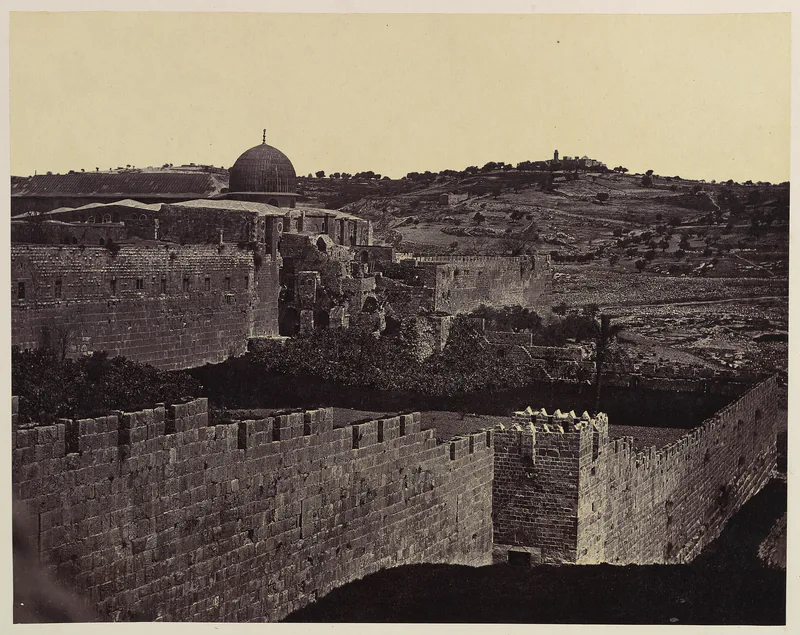
The Night Journey gave Jerusalem a special place in Islam as the third holiest city. The Dome of the Rock, built by the Umayyad caliph 'Abd al-Malik around 691–92, covers the rock from which many later traditions say the ascent began, though historians debate the building's original purpose. The adjacent al-Aqsa Mosque takes its name from the Qur'anic verse, and the section of the Western Wall where the Prophet is said to have tethered his steed is known to Muslims as the Buraq Wall.
The night of 27 Rajab, Laylat al-Miʿrāj, is observed in many Muslim countries with sermons, recitation of the story and special prayers, and it is a public holiday in several states, while some scholars regard such observances as later customs without a firm basis. Illustrated Miʿrājnāma manuscripts, such as the celebrated Timurid copy made at Herat around 1436 and now in Paris, depict Buraq with a human face, the Prophet veiled in flame, and the angels of the seven heavens. In thirteenth-century Castile an account of the ascent was translated into Castilian, Latin and French as the Liber scalae Machometi ("Book of Muhammad's Ladder"), which led the scholar Miguel Asín Palacios to propose, in 1919, that Islamic ascension literature influenced Dante's Divine Comedy, a thesis still debated. The broader life of the Prophet is told in The Prophet Muhammad: Life and Legacy.
Frequently asked questions§
What is the difference between Isra and Mi'raj?§
The Isrā' is the night journey from Mecca to Jerusalem; the Miʿrāj is the ascent from Jerusalem through the seven heavens. Together they form one event, usually called the Night Journey.
When is Isra and Mi'raj celebrated?§
It is commemorated on the night of 27 Rajab in the Islamic lunar calendar, so its date moves through the solar year. The historical date of the event itself is not known with certainty.
What is Buraq?§
Buraq is the white riding animal on which, according to hadith, the Prophet travelled from Mecca to Jerusalem. Later tradition and painting often gave it a human face and a peacock's tail, details that go beyond the brief descriptions in the early hadith.
Did the Prophet see God during the Mi'raj?§
Early Muslims disagreed. 'Ā'isha is reported to have denied it, while Ibn 'Abbās is reported to have affirmed that the Prophet saw God with his heart. Both views are found in later theology.
Sources and further reading§
- The Life of Muhammad: A Translation of Ibn Ishaq's Sirat Rasul Allah — A. Guillaume, 1955
- Narrating Muhammad's Night Journey: Tracing the Development of the Ibn 'Abbas Ascension Discourse — Frederick S. Colby, 2008
- The Prophet's Ascension: Cross-Cultural Encounters with the Islamic Mi'raj Tales — Christiane Gruber and Frederick Colby (eds.), 2010
- Heavenly Journeys, Earthly Concerns: The Legacy of the Mi'raj in the Formation of Islam — Brooke Olson Vuckovic, 2005
- The Miraculous Journey of Mahomet: Miraj Nameh — Marie-Rose Séguy, 1977
- Islam and the Divine Comedy — Miguel Asín Palacios, 1926